New AG-HPX600 PDF released by Panasonic

Wow I can't say I'm surprised, rather just disappointed. No 1080 60p, no flat gamma curve with more than 10 DR and it's price point as I remember it is around 16K?
Slap a ninja to an Sony350 and you're set!
 
Maybe I missed it before but... AVC LongG?! Long GOP on P2?!?

Wow Panasonic must've felt the pressure from Sony's XDCam 4:2:2 50mbps & Canon's XF 4:2:2 50mbps to make their own 4:2:2 50mbps.

I'm shocked by the single chip. Will be interesting to see how this shakes out.

--

The last thing that cracks me up is "Emphasis on Image Quality" ... "News"

This makes me chuckle a bit. All my years in local news there was never this emphasis... half of the equipment I was using was old & the other half was nearly broken.

Yes we used professional equipment & didn't shoot with handy cams, but far from 10bit 4:2:2 intraframe emphasis. In 2007 I was using analog Betacam SP, would often edit tape to tape & hardly ever had time to set up lights (if there were even lights available to use).
 
Maybe I missed it before but... AVC LongG?! Long GOP on P2?!?
AVC LongG was always intended for P2. It was introduced as part of the AVC-Ultra family of codecs.

I'm shocked by the single chip. Will be interesting to see how this shakes out.
Yeah, that's quite a head-scratcher. Perhaps they were inspired by the flood of single-chip large-sensor camcorders and figured that if a single-chip is good enough for an F3, C500, C300, etc, then maybe that's all that's needed? I don't know. It's certainly a bold move, I don't know that there's ever been a single-chip 2/3" broadcast camera before. I don't know why they've taken this path, unless it's a massively oversampling sensor and they just didn't see any image quality benefit from 3 chips anymore? I don't know.

The last thing that cracks me up is "Emphasis on Image Quality" ... "News"

This makes me chuckle a bit. All my years in local news there was never this emphasis...
In local news, that's true. The networks and major station groups still buy quality gear though. They're demanding it be less expensive, of course (NBC's main news cameras are 1/3" HPX370 and HPX250 cams, after all) but they still want it to be good.

Local stations, well, good luck with what you get there, I've seen all sorts of stuff used in local stations.
 
AVC LongG was always intended for P2. It was introduced as part of the AVC-Ultra family of codecs.
This is actually kinda great for those back-of-the-room gigs where you need run times, and AVC-I is overkill because nothing really happens for an hour, unlike water sports or nature where you have a million things moving in different directions.

Yeah, that's quite a head-scratcher. Perhaps they were inspired by the flood of single-chip large-sensor camcorders and figured that if a single-chip is good enough for an F3, C500, C300, etc, then maybe that's all that's needed? I don't know. It's certainly a bold move, I don't know that there's ever been a single-chip 2/3" broadcast camera before. I don't know why they've taken this path, unless it's a massively oversampling sensor and they just didn't see any image quality benefit from 3 chips anymore? I don't know.
Thinking the same thing, if they use something like an 8 or 16mp sensor and do proper down-sampling, plus the loss of the prism, the image might actually end up looking fairly nice. Also, I remember speculating on 4K capability... this might be it! Would be interesting if they really came through with their new "future-proof" slogan and have the Ultra upgrade add 4K.

In local news, that's true. The networks and major station groups still buy quality gear though. They're demanding it be less expensive, of course (NBC's main news cameras are 1/3" HPX370 and HPX250 cams, after all) but they still want it to be good.

Local stations, well, good luck with what you get there, I've seen all sorts of stuff used in local stations.
Well, it kinda sorta also depends on where you are! :cheesy: I've seen plenty of first-channel news teams using dreadfully old tech around here. The HVX200a is still the go-to compact, even for major networks, in Russia. There are only two stores in the entire country which even sell cameras worth over $10,000.

Wow I can't say I'm surprised, rather just disappointed. No 1080 60p, no flat gamma curve with more than 10 DR and it's price point as I remember it is around 16K?
Slap a ninja to an Sony350 and you're set!
Jumping the gun much? We don't know what the footage looks like yet, let alone the final camera, but I am with you on that I'm worried about limited DR. People just don't own sh!tty TVs anymore, Panny could safely push the DR to at least 12 stops.
 
Last edited:
AVC LongG was always intended for P2. It was introduced as part of the AVC-Ultra family of codecs.

I think it is a great move, I just think that a few years ago Long GOP would've been near blasphemy on the internet when it was DVCProHD vs HDV. Now, I'm sure that AVC LongG would smoke HDV in quality, Mpeg2 vs h264 isn't much of a competition. I just wish the HVX200 had a HD 25mbps mode back in the day, but at least it had 720PN30 or PN24 at around 50mbps.


In local news, that's true. The networks and major station groups still buy quality gear though. They're demanding it be less expensive, of course (NBC's main news cameras are 1/3" HPX370 and HPX250 cams, after all) but they still want it to be good.


Local stations, well, good luck with what you get there, I've seen all sorts of stuff used in local stations.

Glad the big boys are putting pressure to keep things affordable, makes it easier for the locals to purchase better quality gear.

More than the differences of "emphasis on quality" between the networks & local stations is the difference in pay. A freelancer for the networks (with a full kit of gear) invoices in a day what a local photog earns in a month.
 
Long-GoP got a really bad name in the beginning, and rightly so, because it was terrible. HDV pushed things way too far and they tried to do too much with too little. I was one of the loudest voices complaining about long-GoP, because (as implemented in HDV) it was awful.

AVCHD is a vast improvement over HDV. I mean, it really is night and day. It's not that AVCHD can't be overrun, because it can, but it's just not common. You don't get dropouts that blast a half-second of your footage into non-existence, like HDV did. You don't have to fear a little rippling water or a breeze in the trees, which would send HDV puking into macroblock hell. AVCHD is reasonably solid. It *can* be pushed too far, like trying to film a closeup of a running stream with sparkling glints of sunlight reflecting all over it, but in general usage it's quite robust. At least, in proper professional implementations (such as in the AVCCAM and NXCAM product lines). But it can also be awful, as in the GH1's original codec, that was just horrible and degraded even worse than HDV did. Wost codec ever.

Point is, it's not that Long-GoP *as a tool* is bad, it's fine if used in a properly designed system. Given enough bandwidth it's a perfectly reasonable choice. But if it's relied on too heavily in order to push the bandwidth too low, well, that's when I have problems with it. I would never shoot 6mbps AVCHD on a sports event, for example, that's just begging for HDV-style image degradation. But for a seated interview it may be acceptable.

Intraframe is immune from motion artifacts, but just going intraframe doesn't necessarily mean you'll be getting better quality inherently. If you don't allocate enough bitrate to intraframe, you can get codec degradation too -- I mean, think about saving out a JPG on "lowest" quality, it's an intraframe but certainly is degraded. So you have to make sure you have adequate bandwidth no matter what you do. A more efficient codec (such as AVC) can do more, with less bandwidth, than a less-efficient codec (like MPEG-2 or the older DV-based DCT codecs).

All other things being equal, Long-GoP can make a codec more efficient than not using Long-GoP. If you had a choice of 50mbps I-frame 4:2:2 MPEG-2, and 50mbps Long-GoP 4:2:2 MPEG-2, you're going to get generally higher image quality out of the Long-GoP version. But you do open the door to needing heftier processing to handle the footage, and potential image variations if the codec gets overloaded. In the intraframe version changes from frame to frame will never affect how the codec encodes, but in any long-GoP codec that remains a possibility... and the more bandwidth the codec is allocated, the less likely that possibility will ever happen.

In the NanoFlash, for example, you can choose Long-GoP *or* intraframe. And you can choose your bitrate. Convergent says that 100mbps long-GoP is the best size-for-quality bang-for-the-buck sweet spot, but they also say that if you want ultimate quality, 280mbps intraframe is the best.

I would always shoot AVCI-100 (or 200!) over Long-GoP anything, if recording space requirements were appropriate for the higher-bandwidth codec. But when you have to squeeze more recording time onto an existing limited-space recording media, the addition of the Long-GoP option is quite welcome, as long as it performs reliably and consistently. I'm a little nervous that 25mbps may not be truly enough to handle 10-bit 4:2:2; I'd much rather see the Long-GoP codec be 50mbps 4:2:2. 50mbps in Long-GoP AVC should look fantastic and should rival 100mbps intraframe, and 50mbps should be enough bandwidth to really protect against any codec degradation due to too much detail.
 
Just curious. Could this single sensor design allow to mount super16 lenses?

2/3" B4 standard has a flange back distance of 48mm; PL mount, for both 35 and 16mm cameras is 52mm. Theoretically is possible to accomadate a cine lens on a 2/3" inch camera. However, I seen only adapters to mount B4 video lenses on 16mm cine cameras.
 
2/3" B4 standard has a flange back distance of 48mm; PL mount, for both 35 and 16mm cameras is 52mm. Theoretically is possible to accomadate a cine lens on a 2/3" inch camera. However, I seen only adapters to mount B4 video lenses on 16mm cine cameras.

I asked that question a couple of years ago and got told that the problem was somehow related to the location of the 3 sensors plus prism normally built into a 2/3" camera. As that issue was no really concerning my own work I didn't investigate any further. But as I red that the HPX600 has a single sensor design I just thought that it might be possible now, at least theoretically.
 
Flange back distance difference between PL and B4 seems small, but the PL mount goes into the camera, almost right up to the sensor, while B4 not so much because the prism is almost flush with the mount surface (the glass plate you see when you take the lens off). The PL mount is deep because cine lenses may weigh up to several times as much as even the heaviest ENG zooms, which top out at around 4lbs, compared to 20lbs easy for a cine zoom; it's for maximum stability even w/ rails.

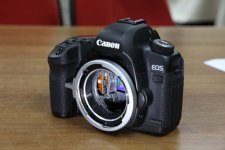
Here's what one person had to do to his 5DII to get PL lenses to mount:

Canon5D_PL_3.jpg

And EOS mount already has a short-ish FB of 44mm.
 
Brutal. At least with the HPX 600 the prism would not be in the way anymore...

Wondering how that will work, since modern 2/3" lenses are designed for 3 chip/prism cameras. If they price this camera reasonable (sub 10K) it could be a great option for a variety of markets.
 
I would be shocked if the HPX-600 comes in at under 10k.

Haha, so would everybody else! The camera the HPX600 will have to beat is the Sony PMW350. So if it's going to be priced more
it's going to have to deliver more. IMHO all the gadgets and trinkets wont save it. People in majority want 1080 60p and a flat high DR gamma mode
combined with a good codec (this, it already has).

For me it would be a viable option if it came under 10k:) Higher than that the Sony is looking quite nice.
 
I've already seen a few UK sites advertising the AG-HPX600 Body for between £11000 to £12000 ish, Of course you still need to add a lens and viewfinder too. It's starting to creep up towards the Sony PMW-500 level, lets hope we get some concrete facts about this camera soon.
 
Back
Top