Need help with Indoor Lighting, Overcoming Shadows on Walls

Ken1212

Well-known member
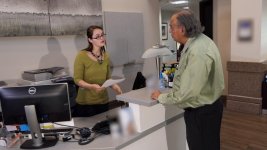
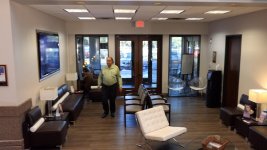
I had a shoot at a large shared reception room in a medical building and the Wide opening shot was done with a jib of the talent entering walking in and approaching the reception desk. The jib was about 30 feet away from entry and 10 feet from the reception desk. The hall had lots of lights coming in from wide doors and large partial ceiling glass. To light the talent properly because of external light and distance of light from talent I used two 1k lowel DPs, I used a CTB gel for color correction and a tough gel on top to reduce shadows. Because I was dealing with a wide shot I had to be careful about light and camera placement to avoid reflections in the wide entry glass. However the talent shadows where still somewhat hard on the walls behind the reception desk which is about 8 feet from talent behind desk and 11 feet from second talent who walked in. Usually I try to throw a light on the wall to diffuse shadows but this was not an option as the light would be in the shot.

After leaving location I wished I had a solid frame scrim with at least 4x4. Would a large scrim or butterfly be my best option for such a scenario? Do you have any other suggestions?
 
Anyway you can post the footage so we can see what you are talking about? Its hard to make a suggestion without seeing it.
 
Indeed, frame grabs would be helpful. However there's enough info there to start.

A larger source will certainly help make the shadows more palatable, at least a 4x4 as you noted. Keeping the units high will also make it look more natural.

Adding light to a background wall to erase shadows is not generally the way to go--usually you want the walls a little lower level than the talent so faces pop more. The usual route is to add a topper, i.e. a solid cutter. The further from the light (i.e. closer to talent), the more specific and effective the cut. Keeping the unit off axis from the reflective angle of the glass will help, and then you can use a sider (another solid) to knock it out of reflection. As Bill notes, you can also bounce a light which will be even easier for reflections. It's funny because that technique is often thought of as a cop-out style of lighting, but it's actually really effective and naturalistic and I do it all the time. If you want to knock down the background from a ceiling bounce, you can hang duvetyne or in a pinch, black plastic (visquine) from the ceiling (easy if it's a drop ceiling) as a skirt.
 
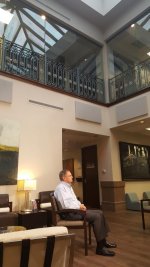
It's a three story building with open reception space of about 30 foot high. Attached is a frame grab. Two lowel DP lights where used about 15 feet away from talent and close to 25 feet from walls. Since I had lots of exterior lights I used a CTB and a tough gel to diffuse the lights.
 

Attachments

  • Jib.jpg
    Jib.jpg
    58.6 KB · Views: 0
Could you have used much taller stands and put your lights high so that the shadows appear much lower in your frame ?
 
I think the stands were about 8 feet high, but that does make sense, the question is what height would one need and what light stands could give the extra reach. I would probably have to be at least 12 feet to get them low enough. Another scenario what about if there is no counter to hide the lower parts?
 
Last edited:
Larger light sources ( i.e. lights with modifiers to increase the physical size of the light source ) will throw much softer shadows. This will lower the brightness of the lights but you can place the lights closer your subject.
 
Larger light sources ( i.e. lights with modifiers to increase the physical size of the light source ) will throw much softer shadows. This will lower the brightness of the lights but you can place the lights closer your subject.

Yes I should have had C-stands with some 4x4 scrims. The problem with this shot is I started on the talent walking in on a wide Jib shot and the light would have been in the shot or reflected in the glass if I moved them closer. Photo show talent walking in before reaching reception desk.

Jib 1.jpg
 
It appears that the room has a drop ceiling and lights rigged on scissor clamps would have been one way to go, assuming you had access to a ladder and the time to rig lights in the ceiling. Having the lights rigged at a higher position would have dropped the shadows down the wall. And yes, a larger / softer source would have made for less noticeable shadows, the downside being that it would also bring up the overall illumination and the two subjects would less "pop", would more be illuminated at the same level as the rest of the room. But you need a relatively powerful source if you go through a diffusion frame. You also need a relatively powerful source ( in the neighborhood of an 800w HMI ) if you light the subjects via bouncing direct light off the ceiling ( essentially making the ceiling above the subjects into a broad soft source that downlights the subjects. )

One way to avoid lighting issues is to make demands as to the frame. If a super-wide shot is going to force you into lighting that isn't good, fight against the wide frame. That is, explain to the Director / Client why the wide frame is bad for lighting and talk them into a framing more conducive to good lighting, if you are able. Was a wide shot a necessity here? I don't see anything in the frame grab that necessitates a wide frame. Had the camera been positioned more to the left and set to a longer focal length you would have avoided the shadows of the subjects being in frame. Tighter framing not only helps with lighting but produces a more shallow depth of field that results in an image that looks "less video" and more "cinematic". Big wides are a pita when you don't have powerful lighting units and don't have the luxury of rigging lights in the ceiling.

I would have rather let the lighting here be "flat" than have the shadows on the wall. You can always cheat a bit in that you just let the big wides be flat-lighting but change the lighting to something less flat for the medium shots / close up shots. Big feature films do that often. DP's will often sacrifice lighting continuity in exchange for making the actors look good. They just try to keep it to a minimum and make it not so obvious. They would not likely switch from a flat-lit wide to hard-lit closeups. But they do re-light once the camera moves in closer. From flattish soft-lit wide to less-flat but still soft-lit closeups.

Another option here would have been to front-light the subjects, sending the shadows away from the camera and towards the open space behind them. You then may have been able to flag or barn-door the light off the wall to the left behind the woman. There is a tendency to avoid front-lighting and for good reason. It makes the subjects flat-lit to the camera and makes for less 3-dimensional shaping. But there are times, and this might be one of them, where it is better than negative results of side lighting or 3/4 rear lighting. Often times as a DP you are avoiding bad lighting more than you are creating great lighting. Sometimes you are in a situation where you are but choosing the lesser of two evils.
 
Indeed, frame grabs would be helpful. However there's enough info there to start.

A larger source will certainly help make the shadows more palatable, at least a 4x4 as you noted. Keeping the units high will also make it look more natural.

Adding light to a background wall to erase shadows is not generally the way to go--usually you want the walls a little lower level than the talent so faces pop more. The usual route is to add a topper, i.e. a solid cutter. The further from the light (i.e. closer to talent), the more specific and effective the cut. Keeping the unit off axis from the reflective angle of the glass will help, and then you can use a sider (another solid) to knock it out of reflection. As Bill notes, you can also bounce a light which will be even easier for reflections. It's funny because that technique is often thought of as a cop-out style of lighting, but it's actually really effective and naturalistic and I do it all the time. If you want to knock down the background from a ceiling bounce, you can hang duvetyne or in a pinch, black plastic (visquine) from the ceiling (easy if it's a drop ceiling) as a skirt.

Charles thanks for the input. I uploaded couple frame grabs to the thread that you can review.
 
Given your lighting package as described and the high ceiling above talent at the end position, I would suggest a 4x4 beadboard 10 feet up at around the same place you have the current light (just right of camera) and bouncing one of the DP lights into it. That will give you a softer and higher light to avoid the shadows and it will feel more tied in to the fluorescents seen elsewhere. You could also add a unit from up against the wall far left up aimed back at the gent to give him a little pop--a DP with diffusion knocked down with a few scrims would kind do it but better, a vertical 4x2 fluorescent or LED with hard grid to keep it off the woman. And further into the wishlist, I'd make the dominant source a soft unit positioned to the gent's right and up around 9 feet that would act as reverse key for the woman and an edge for the man, but that would require a pretty sophisticated rig since you are panning through that whole area and the ceiling is so high. Probably I'd be arming it down from the 2nd story in that atrium, but without seeing that part of the layout I can't say for sure.

If you are relying on those DP lights and don't often have grip, I'd look into the gel holders for the DP lights which will give you a much bigger/softer source than clipping onto the barn doors. And I'd recommend getting sheets of 216, 250 and 251 instead of tough spun. More efficient transmission and various options to tailor for a given scenario.
 
However the talent shadows where still somewhat hard on the walls behind the reception desk which is about 8 feet from talent behind desk and 11 feet from second talent who walked in.

Looking at the pictures I'd say that wall was no more than 3 feet behind the receptionist...?
 
It appears that the room has a drop ceiling and lights rigged on scissor clamps would have been one way to go, assuming you had access to a ladder and the time to rig lights in the ceiling. Having the lights rigged at a higher position would have dropped the shadows down the wall. And yes, a larger / softer source would have made for less noticeable shadows, the downside being that it would also bring up the overall illumination and the two subjects would less "pop", would more be illuminated at the same level as the rest of the room. But you need a relatively powerful source if you go through a diffusion frame. You also need a relatively powerful source ( in the neighborhood of an 800w HMI ) if you light the subjects via bouncing direct light off the ceiling ( essentially making the ceiling above the subjects into a broad soft source that downlights the subjects. )

One way to avoid lighting issues is to make demands as to the frame. If a super-wide shot is going to force you into lighting that isn't good, fight against the wide frame. That is, explain to the Director / Client why the wide frame is bad for lighting and talk them into a framing more conducive to good lighting, if you are able. Was a wide shot a necessity here? I don't see anything in the frame grab that necessitates a wide frame. Had the camera been positioned more to the left and set to a longer focal length you would have avoided the shadows of the subjects being in frame. Tighter framing not only helps with lighting but produces a more shallow depth of field that results in an image that looks "less video" and more "cinematic". Big wides are a pita when you don't have powerful lighting units and don't have the luxury of rigging lights in the ceiling.

I would have rather let the lighting here be "flat" than have the shadows on the wall. You can always cheat a bit in that you just let the big wides be flat-lighting but change the lighting to something less flat for the medium shots / close up shots. Big feature films do that often. DP's will often sacrifice lighting continuity in exchange for making the actors look good. They just try to keep it to a minimum and make it not so obvious. They would not likely switch from a flat-lit wide to hard-lit closeups. But they do re-light once the camera moves in closer. From flattish soft-lit wide to less-flat but still soft-lit closeups.

Another option here would have been to front-light the subjects, sending the shadows away from the camera and towards the open space behind them. You then may have been able to flag or barn-door the light off the wall to the left behind the woman. There is a tendency to avoid front-lighting and for good reason. It makes the subjects flat-lit to the camera and makes for less 3-dimensional shaping. But there are times, and this might be one of them, where it is better than negative results of side lighting or 3/4 rear lighting. Often times as a DP you are avoiding bad lighting more than you are creating great lighting. Sometimes you are in a situation where you are but choosing the lesser of two evils.


Good input concerning sacrificing wide shots for better lighting. Going tighter and using longer stands might have done the trick. Using the lights from the opposite side would not have worked as the lights would have been in the shot as the jib panned. See attached photo for partial view of height of reception area (drop ceiling is only at entry), I really wanted a wide Opening jib shot that moved with the talent as he walked in. Part of the problem is rushing the shoot, it's a shared medical facility and I couldn't setup till after hours and had a limited time to finish the shoot.
 

Attachments

  • Interview - Copy.jpg
    Interview - Copy.jpg
    47.2 KB · Views: 0
I didn't get into the arena of shot design because that's even tougher to make recommendations without knowing the context of material. We all know that camera movement can add pizzazz and production value to corporate pieces, so it's not surprising that you were interested in including a jib shot. Rather than suggesting eliminating it based on lighting concerns, I'd want to know if it was helpful to use up running time by tracking the individual traveling through the lobby--was there voiceover on the soundtrack? From my early years doing corporates, I can well remember designing shots that were basically a form of eye candy to get the viewer through the spoken information that didn't require a literal translation onscreen, so shots like these were pretty helpful. However, if there isn't a need to burn up that running time it would probably be more efficient and logical to just cut to the subject approaching the desk. The term we use for sequences that simply illustrate a subject traveling without advancing the narrative is "shoe leather", i.e. the character drives up, puts car into park, opens the door and gets out, locks the car, walks around the car to the sidewalk, walks up to house, unlocks door and walks in. Unless important information or a specific rhythm needs to be established, you can trim that down to the car pulling up and then cut to subject walking in door (or maybe just the walk-in)!

More specific to this shot: without seeing it I can't comment on how well it works as a jib shot, it's not like that entrance area is so stunning that it obviously calls for a sweeping wide but again I'd reserve judgement without seeing what you did. Certainly you could have simplified things from a lighting perspective if you didn't hinge around to the reception desk all in one shot. So, jib down etc. but pull back with the guy as he approaches the desk, and then shoot her side of coverage from over his shoulder etc. (maybe even drive behind him the last few feet so you can cut on the move). This gives you all of the upstage space to place lights without them getting in the frame.

So to add my thoughts to JPNola's suggestion above on fighting against the wide frame; rather than reject the whole notion, suggest a limited version i.e. no pan around to the desk. When a director suggests a shot that sees multiple directions, I'll calculate how long that will take from a lighting perspective, give them an estimate and then suggest an alternative such as the above that comes with a more palatable time estimate and let them make the call. Sometimes they will bite the bullet and say "yeah, I really want that shot" and other times they'll make the concession. It's a give and take, and it keeps the decision-making process in their hands which is politically better. In your case you really didn't have the gear to properly light that wide shot, so in prep it would be just as useful a discussion but may have become a monetary choice, where you tell them that you need X and Y piece of gear to do this version of the shot but only X if you can simplify it.
 
Thanks for the tips, the link is not working. Concerning distance I am not sure if it's the photo angle but the male actor was about 10 feet from the wall. Don't mean to get off topic, if you were doing a corporate shoot with an opening jib shot (in this case Kessler traveler), two camera interview setup, three point lighting, motorized slider for B roll, and edit a finished 3 minutes video, what would an average market price be using cameras say like the DVX200 for A and a GH4 for a B camera.
 
Given your lighting package as described and the high ceiling above talent at the end position, I would suggest a 4x4 beadboard 10 feet up at around the same place you have the current light (just right of camera) and bouncing one of the DP lights into it. That will give you a softer and higher light to avoid the shadows and it will feel more tied in to the fluorescents seen elsewhere. You could also add a unit from up against the wall far left up aimed back at the gent to give him a little pop--a DP with diffusion knocked down with a few scrims would kind do it but better, a vertical 4x2 fluorescent or LED with hard grid to keep it off the woman. And further into the wishlist, I'd make the dominant source a soft unit positioned to the gent's right and up around 9 feet that would act as reverse key for the woman and an edge for the man, but that would require a pretty sophisticated rig since you are panning through that whole area and the ceiling is so high. Probably I'd be arming it down from the 2nd story in that atrium, but without seeing that part of the layout I can't say for sure.

If you are relying on those DP lights and don't often have grip, I'd look into the gel holders for the DP lights which will give you a much bigger/softer source than clipping onto the barn doors. And I'd recommend getting sheets of 216, 250 and 251 instead of tough spun. More efficient transmission and various options to tailor for a given scenario.


Thanks for the tips, the link is not working. Concerning distance I am not sure if it's the photo angle but the male actor was about 10 feet from the wall. Don't mean to get off topic, if you were doing a corporate shoot with an opening jib shot (in this case Kessler traveler), two camera interview setup, three point lighting, motorized slider for B roll, and edit a finished 3 minutes video, what would an average market price be using cameras say like the DVX200 for A and a GH4 for a B camera.
 
Thanks for the tips, the link is not working.

Worked for me but in any case, search for Lowel D2-24.

Concerning distance I am not sure if it's the photo angle but the male actor was about 10 feet from the wall.

You were saying the receptionist was 8 feet from wall and visitor was 11 feet, I was going off the 8 feet part. That's really the more relevant person anyway, it's much harder to keep shadows off a wall the closer the subject is. Nothing you could have done about it in this instance, the desk is where the desk is. But that can all be part of how you design the sequence. If it played in cuts as I described above, you could easily light her where you wouldn't see shadows on the back wall with the same lighting package.

Don't mean to get off topic, if you were doing a corporate shoot with an opening jib shot (in this case Kessler traveler), two camera interview setup, three point lighting, motorized slider for B roll, and edit a finished 3 minutes video, what would an average market price be using cameras say like the DVX200 for A and a GH4 for a B camera.

I'll let someone else tackle that, it's not my particular sandbox.
 
I didn't get into the arena of shot design because that's even tougher to make recommendations without knowing the context of material. We all know that camera movement can add pizzazz and production value to corporate pieces, so it's not surprising that you were interested in including a jib shot. Rather than suggesting eliminating it based on lighting concerns, I'd want to know if it was helpful to use up running time by tracking the individual traveling through the lobby--was there voiceover on the soundtrack? From my early years doing corporates, I can well remember designing shots that were basically a form of eye candy to get the viewer through the spoken information that didn't require a literal translation onscreen, so shots like these were pretty helpful. However, if there isn't a need to burn up that running time it would probably be more efficient and logical to just cut to the subject approaching the desk. The term we use for sequences that simply illustrate a subject traveling without advancing the narrative is "shoe leather", i.e. the character drives up, puts car into park, opens the door and gets out, locks the car, walks around the car to the sidewalk, walks up to house, unlocks door and walks in. Unless important information or a specific rhythm needs to be established, you can trim that down to the car pulling up and then cut to subject walking in door (or maybe just the walk-in)!

More specific to this shot: without seeing it I can't comment on how well it works as a jib shot, it's not like that entrance area is so stunning that it obviously calls for a sweeping wide but again I'd reserve judgement without seeing what you did. Certainly you could have simplified things from a lighting perspective if you didn't hinge around to the reception desk all in one shot. So, jib down etc. but pull back with the guy as he approaches the desk, and then shoot her side of coverage from over his shoulder etc. (maybe even drive behind him the last few feet so you can cut on the move). This gives you all of the upstage space to place lights without them getting in the frame.

So to add my thoughts to JPNola's suggestion above on fighting against the wide frame; rather than reject the whole notion, suggest a limited version i.e. no pan around to the desk. When a director suggests a shot that sees multiple directions, I'll calculate how long that will take from a lighting perspective, give them an estimate and then suggest an alternative such as the above that comes with a more palatable time estimate and let them make the call. Sometimes they will bite the bullet and say "yeah, I really want that shot" and other times they'll make the concession. It's a give and take, and it keeps the decision-making process in their hands which is politically better. In your case you really didn't have the gear to properly light that wide shot, so in prep it would be just as useful a discussion but may have become a monetary choice, where you tell them that you need X and Y piece of gear to do this version of the shot but only X if you can simplify it.


The issue was the client wanted dynamic shots in the B-Roll, however his office room was small, can not do much moving shots their and it was another problem with windows on two complete sides and blinds that created moire problems with the motion sliding shots, another dilemma. So I decided to go with the jib shots with the talent entering and another with the doctor approaching receptionist to review client documents, the lateral was not as pronounced with shadows as I used a different angle and didn't have to worry about the lights reflecting and showing in the entry glass . I have used diffused soft lights aimed at walls in the past successfully to reduce or get rid of shadows, the angel and height of light is of great importance. Will be using the interview audio with the doctor as a voice over to the B-roll. I am definitely going to add the lowel gel frames, less work than taking a 4x4 and c-stand for smaller budget projects. I think two 4x4 silk scrims on c-stands would have given me a much better results, which I own but did not want to take a grip truck for a small budget project :). On the other hand I like the idea of a 4x4 bean board, not sure thought it would have worked with the DPs well in this instance because of distance to talent, would have needed probably 2k lights.
 
Back
Top