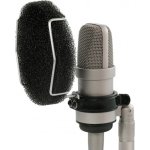
Need a recommendation for a microphone with shock mount for voice-overs

I often have the need to record audio of talent or a simple voice-over where I do not have the opportunity or budget to go to a recording studio. This often happens in a quiet room near the edit suite with a bunch of moving blankets (though have been considering the voxguard) hung around the mic to deaden the sound. Sometimes it happens at the location where we've been shooting. I’ve been using my boom mic for this but have been considering an upgrade to a large condenser mic specifically for voice only. That mic would likely be placed on a stand mounted with a shock mount with a screen in front.

I have no knowledge of any of these products and would appreciate hearing your experience and getting advice on what to buy. I don’t have a huge budget but would like to educate myself as to the range from bottom to top. What should I have in a system.

Thanks in advance for your help.
 
I use a rode nt2000 these days, it is good value and comes with a suspension mount.

It sounds very good and has a high pass filter, pad and variable polar pattern which can be useful for different installations.

I have used a neuman U87 and AKG 414 in the past but find that the nt2000 is just as good for most applications, there is a review here http://www.soundonsound.com/sos/may04/articles/rodent.htm
 
Last edited:
What is your budget Marshall? You may want to factor in a good quality mic preamp as well if you don't already have one.
 
Are you absolutely committed to a condenser? Large diaphragm dynamic mics like the Electro-Voice RE20, Shure SM7B and Heil PR40 are also strong contenders for voiceover work, and tend to be a little less fussy about shock mounting and pop protection than condensers. Their low output dictates a high quality preamp, however.

- Greg
 
What is your budget Marshall? You may want to factor in a good quality mic preamp as well if you don't already have one.


Good point Rick. I'm likely on the low end of the scale say under $500 for the entire package. Likely less. I've been looking at the entry level Rodes for starters but honestly have no experience with any of them directly which is why I'm reaching out.

Reading the suggestions above is very helpful.

To hyscully, "why an NT1 over an NT1a? About the same cost"?

To GaryNattras, "will the nt2000 really be that much better than the NT1a"?

Rick, if I'm looking for a mic preamp should I consider something low end like a Focusrite iTrack Solo audio interface or can I use the preamp out of a mixer. On my need list is a AD mixer to sit in front of my DR-680. Been wanting either the 442 or the 302. But there is something to be said for being able to just plub a mic into your computer and go as well.

And what about the reflection filters? Are they worth the extra cost? The blanket thing came from using them on location to deaden bright rooms. Wish we could find them in neutral colors for the same costs as Home Depot. Regardless of the color they really do the job and most of the time it's easy to throw 4 or 5 into the pack.
 
I use the Heil PR40 and everyone has liked it so far. It has rare earth magnets so it has a pretty strong output so you don't need as high powered a preamp and it's dynamic so you don't need phantom power.
 
Are you absolutely committed to a condenser? Large diaphragm dynamic mics like the Electro-Voice RE20, Shure SM7B and Heil PR40 are also strong contenders for voiceover work, and tend to be a little less fussy about shock mounting and pop protection than condensers. Their low output dictates a high quality preamp, however.

- Greg

So what would be the charachteristic differences between a Large diaphrgm mic vrs a condenser mic? Also any suggestions on the preamp and/or is the preamp from a mixer enough?
 
Last edited:
The pre amps in the DR-680 ain't 'that bad' on their own. Putting a 'cheap' external pre in front would be throwing away money and any improvement would be negligible at best . A sound devices mixer would be a good though.. and could be used in the field, but that would blow your mic budget right there.. and then some.
Keep in mind, even the most expensive mic and pre amp won't make an untalented and/or weak-voice person sound pro.
 
I have a good number of mics and mic pres at my disposal, but in this case I might suggest something like a Blue USB mic plugged into your computer.
 
The pre amps in the DR-680 ain't 'that bad' on their own. Putting a 'cheap' external pre in front would be throwing away money and any improvement would be negligible at best . A sound devices mixer would be a good though.. and could be used in the field, but that would blow your mic budget right there.. and then some.
Keep in mind, even the most expensive mic and pre amp won't make an untalented and/or weak-voice person sound pro.

I hear what you're saying. Talent is talent no matter....

Also remember your thoughts from a few months back that the DR-680 is better when someone can listen and ride the gain which the 680 is not really user friendly for. That a good (Sound Devices... is there an echo in here) mixer in front of the 680 is a better solution. It also to some degree solves audio problems with the Blackmagic as that's what I'm currently shooting with. Since getting that advice I've been planning to do just that, add a mixer in front of the 680 just have not had the immediate need or the money. The holy grail thing???

But I do have a fair amount of voice work coming up so thought I should learn up. It's not a huge amount of money to get voice work that is substantially easier to produce allowing me to concentrate harder of what's being said putting more effort into the performance. Originally was thinking about a Rode NT1 or NT1a but realizing I have absolutely no knowledge of these mics thought I'd reach out. I wanted to record that directly to the computer so was thinking about a USB type of mic. That does not seem like the right way to go at this point. Still interested to learn the difference between condenser and large diaphragm mics?

Again thanks for your suggestions.
 
Are you talking about the difference between a large and small diaphragm condenser mic, or between a LDC and a dynamic mic?

The reason I suggested a USB mic is because of your limited budget. So you are not having to buy a mic, mic stand, cable, mic pre, computer interface. You will also need a good pair of headphones.
 
Read the review on the NT2000 and you will see that using such a mic in omni and fig 8 mode can produce a more natural sound, I personally prefer omni condenser mics for voice over as you can get them very close without proximity or too much poping therefore giving a punchier sound.

Fine an Nt1a is cheaper but it may be better to invest a little more in one mic with more options!

I agree that there are some good dynamic mics too but you asked for my recoomendation and that is what I gave and thr NT2000 is the mic that I have bought and use on a daily basis!
 
After having grown up in Radio with RE20s, I recently purchased a sE Electronics USB2200A. It turned out to be an excellent voice mic.
 
I often have the need to record audio of talent or a simple voice-over where I do not have the opportunity or budget to go to a recording studio. This often happens in a quiet room near the edit suite with a bunch of moving blankets (though have been considering the voxguard) hung around the mic to deaden the sound. Sometimes it happens at the location where we've been shooting. I’ve been using my boom mic for this but have been considering an upgrade to a large condenser mic specifically for voice only. That mic would likely be placed on a stand mounted with a shock mount with a screen in front.

I have no knowledge of any of these products and would appreciate hearing your experience and getting advice on what to buy. I don’t have a huge budget but would like to educate myself as to the range from bottom to top. What should I have in a system.

Thanks in advance for your help.

What do you mean by "not a huge budget"?

A good mic. in the mid range is the Gefell M930 with "donut" shockmount and pop killer.

p110_with_m950_cutout.jpg

This mic. is popular with broadcasters and works very well for what you describe.

The top end would be the Neumann U87 or TLM 67, but these are two to three times the price of the M930.

You can go down in price, of course, and there are many options available - the Violet Black Knight may be worth looking at. But I don't use cvheap mics. myself, so don't have much experience at the low end.

I hope this helps.
 
First of all to each of you, thank you for taking the time to respond. I really appreciate your willingness to share your knowledge. Learning about the range of mics from top to bottom so I'm able to understand what I end up buying and how it fits in, is just what I've needed. I had been thinking about just spending up to $500 for a kit, probably buying a Rode as that was an easy solution. That's when I decided that I know nothing about these mics at all, just that they might be better than my boom mic. It was then I decided to reach out here.

As each of you has made your suggestions, I've searched the web for reviews and am starting to get a better picture of the range in quality and how each item fits into the value range. Hearing your personal reviews is perhaps the most valuable information passed on.

I've got a bit of time before I need to decide so will continue to research but will get back once I move forward.

The Neumanns seem to be the top of the food chain.
The Gefell M930 looks pretty interesting and that it was the starting point for Neumann makes it even more so.
I hear what you are saying about the NT2000. That is costs a little more but is a large step in quality.
The Rode nt1 or 1a remains a terrific value at the entry level.

One of the reviews I read in Sound on Sound basically said that there are three categories of mics. The low end, the middle end, and the upper end. The writer argued that the upper end tended to not color the sound at all, the middle end provided coloring that was all over the spectrum, and the lower end was just inconsistent where you are getting just what you pay for. He went on to reflect that if you had a great voice in the first place that each level could make a very pleasing sound and further that the lack of coloring at the high end tended to make that choice not seem best at first glance. That only over many many recordings would you realize that the higher end consistently recorded the voice flat letting you make the alterations in post where the middle and low end, though from time to time blowing you out of the water with altered sound also took you to the low depths of quality as often. Now that analysis was pretty general and might be applied to many products that I own.... lenses, camera, etc. But it also made a great deal of sense to me. But I still only have a certain amount to spend and am cannot yet afford to buy at the top of class. Decisions, decisions.....
 
That's when I decided that I know nothing about these mics at all, just that they might be better than my boom mic. It was then I decided to reach out here. .

What boom mic do you have?

As an example, I have done a lot of national spots using a Sennheiser MKH416, which many uninformed folks only consider to be an exterior shotgun mic, run into a John Hardy M-1 Mic Pre.
 
As David stated, the 416, which would not normally be considered, more than a few 'big name' pro VO artists prefer them over the usual suspect LDC mics.
 
The SonS article seems a little? not really accurate. There is the top end. In some cases the mics have a lot of color. But they are of high quality and consistent. most recording is not for scientific purposes and the goal is not a pure and uncolored sound but a sound that sounds good. The mid range has expanded a LOT in the last ten years or so and some of these mics are right up with the high end except with out the brand name. The cheap section kind of break into two sub sections. One is very consumer mics with mini plugs and are sold in all kinds of places. The other are prosumer/consumer mics that are dominated right now with cheap mics from China. Some of these are pretty good but quality control is almost nonexistent so YMMD.

If you have the $$$ the high-end is a nice place to shop. If you don't there are a lot of choices in the midrange that will work really well.

Large diaphragm condensers are really nice studio mics. The downside to non studio use is that they tend to be very sensitive and will pick up more background "noise". They are as a rule pretty sensitive to handling noise and breath hits so you really need a pop filter and a good shock mount.

A large diaphragm dynamic mic tends to have a closer range and not pickup BG noise as much and have much less handing noise and less sensitivity to breath pops. You still may need a foam screen but you probably don't need a pop filter.

With rare earth magnets the dynamic can put out a signal that is almost as strong as a condenser and the dynamic doesn't require phantom power.

All mics sound different and there are more than a few different approaches to recording VO. They range from using a LD Condenser in omni for very little coloration and more room to using a short shotgun. Anything with some directionality will have some proximity effect. You can either not like it because it will color the sound or you can like it because it allows you to beef up a vocal.

So what you personally want and end up liking has to do with your taste and how you use the mic. The one thing that doesn't change is that you want a mic from the mid of the mid range or better. Cheam mics of all sorts generally are fairly noisy and often have a not pleasing coloration, many being overly bright to try and mask the self noise.

I've used both a LD condenser and a LD dynamic for VO and ADR. Both have worked well, but with out a vocal room or very quiet location I would lean to the dynamic since it has ended up coming out better and needing less cleanup.

But that is my experience with my workflow so YMMD.
 
Back
Top