movie making books are mostly nonsense

nycineaste

Well-known member
sorry to cross post, but i thought this was worth starting a new thread for cause im an internet attention whore:

you know, Im convinced most books on movie making SUCK and are total FLUFF, total NONSENSE. The same BASIC information parroted out from people with no experience making movies.

Did you know when you shoot an explosion, fall, or other big action, that the action is, more often than not, split up over multiple camera angles to extend and amplify the event, since it would likely look anticlimactic taken in one shot? Almost NO BOOK talks about this.

Did you know when you cut back and forth between heads in a dialog scene that its often good to get TIGHTER CLOSE UPS for high point/climaxes in the dialog? or just for variety? NO BOOK TALKS ABOUT THIS.

how about carrying a moving actor forward in space with match cuts?

ALMOST NO BOOK explains how much coverage/crosscutting/alternate angles/match cuts go into the average movie.

"Grammar Of The Film language" touches up on this stuff, but most of the book is a waste of space.

heres what I'm doing:

read "Pudovkins "Film Technique" and get an idea idea of what "constructive editing" means. Or listen to RoberRodriguez when he talk s about building your movie from shots.

I watch movies on my PC, pause them, and WRITE DOWN THE SEQUENCES. yes, SHOT by SHOT.

heres my analysis of the opening of Mario Bava's "Rabid Dogs". I write POP IN and POP OUT since im convinced you need to learn to think in SEQUENCES not individual shots.

1. cu woman crying- pull back to wide (credits over)
2. cu hand on steering wheel
3. cu driver
4. pop out OTS he looks back
5. cu wrist checking time
6. cu other guy hand gloved wrist checking time
7. It's glasses dude looks around
8. cut back to two shot- two dudes in car one has a suitcase
9. cut back to shaded dude- popped out, wider now- he closes suitcase
10. reversal, wider as he shuts it, he goes to pasenger side door
11. cross cut back to suitcase guys for a split (shorter shot)
12.pop in alternate angle on shades dude as he enters car
13. alternate angle, in car, close OTS on shades dude and gloves guy they drive off- we stick with them for a while.
14. Pop out to wide, reversal, follow their car as they stop.
15. pop in tight close up as they exit (short)
16. reversal other side of car cu exiting (breaks 180 rule)
17. pop out XLS overhead
18. CU/MS low angle as guy fires
19. cut to reaction shades dude
20. cut to cop car arriving, shock zoom in to CU cop
21. cut to OTS in car on other cops ariving
22. pop out reversal WS cops drive by
23. whiet car backs up, guy gets out
24. cut to security guard pushes button
25. CU gate closing
26. bad guy aiming
27. reaction suitcase dude as they try to enter car
28. cut back to security guard reacting
29. bad guy calls to other guy
30. firing dude moves out of frame
31. back to suitcase reaction
32. POV as mask guy smashes window- slow mo
33. Reversal suitcase guy showered in glass
34. back to bad guy as he opens car door
35. new angle in car as bad guy fights for suitcase.
36. driver reacts as gun is held to head
37. pop in to knife
38. alternate angle as he pulls knife back thrusts it int0 frame.
39. pop in mask guy as he digs in knife
40. cu knife in suitcase guys chest
41. back to mask guy enjoying it
42. reaction driver
43. back to knife, being pulled out guy taking suitcase
44. pop out taking suitcase
45. pop in, slow mo, guy dying
46. back to suitcase being taken, follow as they all run away, into car
47. cut to security guard runing in, firing.
48. pop in, new angle on car as it speeds off.
49. back to security guard, he chases.
50. cut to bank personell running
51. POV/OTS gun firing at car
52. in car, driver is hit, passenger takes over
53. pop out, car as it swerves
54. reversal as car stops, hits garbage can
55. back to scene of crime, dead guy , wide and above, now. move up to take in car arriving.
56. new angle back to bad guy car as they take dead guy out
57. bad guy takes driver seat, zoom in to hole on car, leaking gas.

you thought i was kidding?

I shoot a short next week Im pumped to apply this stuff, though Im struggling with how to write my shot list and make sure I get the shots I need.

yeaahh books hardly tell you anything. Even "5 C's", for all its brilliance and usefulness, barely goes into how to cover a scene (never mind an action scene!).

you can find pudovkins "film technique" online if you're so inclined.
 
I've seen a few books that were more about the visual storytelling aspect of movie making -vs- the logitics. I wouldn't call anything nonsense just because they have a different focus than what you're seeking.
 
alright, alright, nonsense is a strong word. Apologies. All I know is that using the Master Scene Technique or Triple Take Technique in 5 C's would get you not-very-far in reproducing the scene just quoted.

I did check Mascelli's IMDB, he shot horror trash like "the Thrill Killers" and this gem:

http://www.youtube.com/watch?v=TwtSMhhpuQw

Ironically I have more respect for the guy now- these are my kind of flix!
 
Last edited:
sorry to cross post, but i thought this was worth starting a new thread for cause im an internet attention whore:

you know, Im convinced most books on movie making SUCK and are total FLUFF, total NONSENSE. The same BASIC information parroted out from people with no experience making movies.

Did you know when you shoot an explosion, fall, or other big action, that the action is, more often than not, split up over multiple camera angles to extend and amplify the event, since it would likely look anticlimactic taken in one shot? Almost NO BOOK talks about this.

Did you know when you cut back and forth between heads in a dialog scene that its often good to get TIGHTER CLOSE UPS for high point/climaxes in the dialog? or just for variety? NO BOOK TALKS ABOUT THIS.

how about carrying a moving actor forward in space with match cuts?

ALMOST NO BOOK explains how much coverage/crosscutting/alternate angles/match cuts go into the average movie.

"Grammar Of The Film language" touches up on this stuff, but most of the book is a waste of space.

Have you ever seen the production credits for the authors of these books?

'nuff said.


I'm looking at my bookcase and I agree!


Who are these Christopher Doyle, Jon Fauer, Andrew Laszlo, Freddie Young, James Wong Howe, Jack Cardiff, John Altman, Joseph Walker, and Charles Clark people on my book shelf?! What the hell have they shot?! hahahaha.

I'm having fun here. I think the OP is buying the wrong books, friend. Stop complaining and go read the good books. If you need a suggestion, I currently own over 55 books about cinematography or by cinematographers. I also own every american cinematographer magazine from 1938-today, and about a dozen before that. I've learned something from every single book and think I might have one of the best resources available to any young working cameraman on the west coast. The only thing that could be better than this is a close relationship/apprenticeship with a legendary DP.

Don't bash the books because they don't give you blueprints to emulate other peoples work or tell you how to shoot a dialogue scene, etc. There isn't a sure fire way to shoot anything. Everything is different. It would be like a writer asking how to write a love scene... well that could go down a million different ways described by possibly thousands of different words. Use these books to find inspiration and to learn how to think, not how to do. These guys were masters not because they simply knew how to light something, they were masters because they knew when and why to do something.


If you must go buy one book to redeem your opinion of cinematography books.... Go by "Reflections" yes it's expensive but it will open your eyes. With chapters written by some of the true greats: Stephen Burum, Jordan Cronenweth (not Jeff although he's awesome), Stephen Goldblatt, Frederick Elmes, Haskell Wexler, Laszlo Kovacs, Vilmos Zsigmond, Jack Green, Denis Lenoir, Darius Khondji and Vittorio Storaro. I skipped some other good ones, but those were my favorites. If you did not recognize 8 out of those 11 names, you need to brush up on DP's, imo. These are all pretty legendary. Go get the book.
 
Last edited:
Your "did you know" questions are just basic stuff. You don't have to be taught these, you should extrapolate these from your experience (as an imagemaker, and as a viewer) applying knowledge and doing some thinking.
And being creative is not something you learn by reading books with tips. You can learn the craft, but not the art. Yes, you will accumulate knowledge, and you should do that. But you also need to think, analyze, explore, imagine, develop your skills in any way possible.

ALMOST NO BOOK explains how much coverage/crosscutting/alternate angles/match cuts go into the average movie.
Because these are all based on preferences and artistic choice. No rules here.

Anyway, watching and dissecting movies is the best way to learn.
Also, good points by RPO.
 
I haven't read too many books on the subjects of general filmmaking but I can say I've learned a lot, and some of the books I've read have actually gone quite in depth with angles and the points you made.
 
I've never read single book on or taken a single class in film making. What I HAVE done is watch a LOT of films (good, bad and ugly) and thought about what they did, why they did it, how effective it was.
 
Hehe... makes me think of:

But like Ryan said, I think you might be getting into the wrong stuff or not enough of the right stuff. However, with 5 C's I think you have had to high expectations, I think it serves well as a general reference to get started. Imagine a book covering every little aspect of film making down to specific examples like yours. It would be so heavy that you'd have to make a movie about the last tree in South America.
You don't read a couple of books about psychology and then complain about those books not giving you enough tools to analyze a person.
One thing I know though, because I'm not getting as much as I want, is that you learn the most from pratical experience. But I also find that taking in some theory to relate to while doing something practical is also very rewarding, and by definition there is nothing bad about anything if you gain the slightest amount of knowledge from it....
 
alright, alright, nonsense is a strong word. Apologies. All I know is that using the Master Scene Technique or Triple Take Technique in 5 C's would get you not-very-far in reproducing the scene just quoted.

Well no ****. You're not training for a waiter position at a chain restaurant, throw that crap out.
But just because you're reading the bad books, doesn't mean the books are worthwhile. But it sounds like you're looking for or expecting formulas from these books. If you actually find any, they will let you down.
 
.... I also own every american cinematographer magazine from 1938-today, and about a dozen before that....
Golly Mr. O'Hara, sir. In your avatar, you don't look that old!:shocked: May I help you to to a chair?
But seriously, that's a lot of magazines, taking up a lot of space. I've got about 5 years worth so far, and I'm wondering if I'll need to start throwing out old issues. You must have a very understanding family.:grin: Or were you able to get a CD or DVD collection of old American Cinematographer's?

-- Ken
 
I see where the OT is going with this. I do agree that many "beginner" books can be rather bland. But to read book by the greats (as RPO mentioned), or interviews are great learning experiences. Because even if filmmaking and cinematography is very technical, I love to hear great cinematographers talk about tricks, ideas or philosophy. Oftentimes, I see things that I can pick up on or use myself. I've also read one book on screenwriting, the aptly called "Screenwriting" by Syd Field, which again was one of those books that really hit me. I think the best reading isn't the reading explaining the basics or technicalities, those are a bit "bogus" after a while. The ones that help are those that provide ideas and substance. Any book talking about three point lighting will sound more or less the same, but reading an interview with Roger Deakins explaining how he dislikes to use the term key/fill light will instead cause you to learn.

And these are the authors of books you see when you go into the "Filmmaking" section of Barnes and Noble?

Great point. If I want to read a book, I will head over to SFI's (Swedish Film Institute) Library and search there... But not everybody has that opportunity.
 
And these are the authors of books you see when you go into the "Filmmaking" section of Barnes and Noble?

Why would anyone look for small market, niche industry specific books at the biggest general/consumer bookstore in America? That would be like buying your film equipment at walmart, or your lighting at home depot. You'll end up with lights and a camera, but likely not what you really need. Same with these books! It's a damn shame that Barnes and Noble do not have books like A Cloud in Trousers by Christopher Doyle, *insert one of many camera manuals here* by Jon Fauer, ASC, Every Frame a Rembrant by Andrew Laszlo, ASC, Seventy Light Years by Freddie Young, ASC, The Light on Her Face by Joseph Walker, ASC, and Reflections, Masters of Light, Writer of Light, etc, etc.

But that's what one gets when ones ambition ends no farther than searching the 'Filmmaking' section at BnN.

If you want the deep books, you have to dig deep. The ASC has a bookstore and Ebay is a great place to find used books for cheap. Plus you never know the cool surprises you may find with used books. I bought a book, The Cinemagraphic Annual 1930 (predecessor to the American Cinematographer Handbook Series and ASC Manual Series) and inside the front flap, a previous owner had signed the book as being his... the name was Clyde DeVinna. Cinematographer who won the 2nd Annual Academy Award for Best Cinematographer and the first cinematographer to win the award solo. Fun fact.
 
Last edited:
Golly Mr. O'Hara, sir. In your avatar, you don't look that old!:shocked: May I help you to to a chair?
But seriously, that's a lot of magazines, taking up a lot of space. I've got about 5 years worth so far, and I'm wondering if I'll need to start throwing out old issues. You must have a very understanding family.:grin: Or were you able to get a CD or DVD collection of old American Cinematographer's?

-- Ken

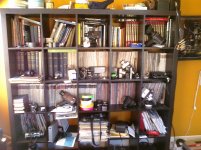
LOTS of space. This picture, although messy, is my bookshelf. Every magazine and book is about cinematography, photography, lighting, screenwriting, or directing.

I believe you can buy three of the books pictured here at Barns and Noble... maybe. Point is, there is lots to learn and it's out there!

564271_10100148718728667_1894922518_n.jpg
 
But that's what you get when your ambition ends no farther than searching the 'Filmmaking' section at BnN. If you want the deep books, you have to dig deep. The ASC has a bookstore and Ebay is a great place to find used books for cheap. Plus you never know the cool surprises you may find with used books. I bought a book, The Cinemagraphic Annual 1930 (predecessor to the American Cinematographer Handbook Series and ASC Manual Series) and inside the front flap, the previous owner had signed the book as being his... the name was Clyde DeVinna. Cinematographer who won the 2nd Annual Academy Award for Best Cinematographer and the first cinematographer to win the award solo. Fun fact.

I didn't have those resources, nor the money to spend, at the time I was looking for books. Sure, if you can find them they are great, but how much do those go for as well, even now?
 
Not a book, but the "Being Cinematic" post here on DVXUser, in the Cinematography section, is pretty good to get some tips on, well, being cinematic...

It is sad that it is unfinished though.
 
Not a book, but the "Being Cinematic" post here on DVXUser, in the Cinematography section, is pretty good to get some tips on, well, being cinematic...

It is sad that it is unfinished though.


Well there you go. I guess if you happen to not have any money to spend, live in a place without any cinematography books at the library, and all the bookstores carry garbage books.... be happy for the internet: DVXuser, Google, Book Preview on Amazon, American Cinematographer magazine, online subscriptions, and things of that nature! I know a very old Chinese cinematographer from the days of James Wong Howe (1940's-1960's era). He told me about how he used to have American Cinematographer shipped to him in Hong Kong and that was the only way he could read about what was going on in Hollywood. That made me very grateful for the internet.

Regarding money, I think the best bang for the buck (unless you find a steal on Ebay) is AC magazine. Probably the best resource around, is very contemporary and comes every month! As far as other books? ...

It depends. I collect vintage books on Cinematography and those would not be the first I'd recommend for learners. Those are more for heritage and trivia reasons, like knowing really old camera tricks. Some other books I listed like Seventy Light Years and The Light on Her Face, are more introspective to the industry and inside the mind of a cinematographer geniuses, not really about 'how to' do anything.

On ebay you can get Seventy Light Years, by Freddie Young for $15 and free shipping.

Amazon has these at lowest used rates:
The Light on Her Face for $20,
Writer of Light for $9
Conversations with Jack Cardiff $12
Reflections $50
Blain Brown Cinematography Ed. 1 $7, ed.2 $30
Masters of Light $4
Cinematographer James Wong Howe $21
Professional Cinematography $6
Masters of Light and Depth $25
Every Frame a Rembrandt: $25
Painting with Light : $14

Many of those are a steal!

The ASC bookstore has almost everything that is still in print. Brand new and more expensive than Amazon used.
 
Last edited:
I have found that what makes a film look like a "movie" is coverage. If you review the very first post in this thread, it's coverage.
For me, it comes before perfect lighting and perfect camera movement. Coverage - 'nuf said. You don't just open a briefcase...you set it down, look at it, reach in your pocket, select the right key, insert the key, pop the latch, look around to make sure no one is watching...you get the idea.
 
Back
Top