Move back, zoom in?

PerroneFord

Deals in Lead
Ever since I can remember I've heard the mantra from video shooters of "move back and zoom in" to get shallow DOF. This always seems backwards to me based on my background in photography.

We see the advice given by long time shooters to new shooters. It's offered almost without question these days. While I cannot say for sure, but I believe the advice comes from the fact that long focal length lenses tend to have shallower DOF than short focal length lenses (sort of).

The problem with this is the change of perspective. If you are doing an interview in a small room, there often isn't the space to back way up and zoom in. And even with there is, long focal lengths tend to compress the space behind the subject so that bookcase 10ft behind the subject now looks 1 foot away. Not desirable at all.

If you consult a table of DOF, you'll find for any given focal length, the closer you are to the subject, the shallower the DOF. This is why Macro photography works. So, it would see, that the opposite of the conventional wisdom would be the choice. Instead of moving well back and zooming in, move as close as you can and zoom out to fit the frame.

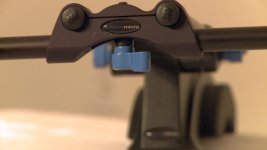
As an example, I am going to post a photo for discussion. I just snapped it in my living room so pardon the rather hasty preparation. :)

I'd like to hear guesses on:

1. Focal length
2. Aperture
3. General comments
 

Attachments

  • RRM_Buck_the_Trend.png.jpg
    RRM_Buck_the_Trend.png.jpg
    36.4 KB · Views: 0
While I agree with you that the farther back you are, you'll get increased depth of field, shooting close ups at a wide focal length might not be the look they are trying to get.
 
If you are doing an interview in a small room, there often isn't the space to back way up and zoom in. And even with there is, long focal lengths tend to compress the space behind the subject so that bookcase 10ft behind the subject now looks 1 foot away. Not desirable at all.

This is absolutely true.

But the issue comes from the size of the chip. When people make this statement they are always referring to small chip cameras such as 1/2 inch or smaller. Many cameras like the DVX / HVX fell into this category. Probably why it came up so much on this forum.

Now the issue for a small chip camera (vs a s35mm or similar sized still photo camera or motion camera) at the wider end of the lens (you know the math), even wide open the depth of field is huge. So positioning the camera 2-3 feet in front of the subject to get the composition youre looking for at full wide and even wide open, everything from the subject to the wall will still be in focus.

The general advice is therefore to give as much separation from the background as possible so not to overly compress the shot, and then back up. This is why using a kicker in small chip camera cinematography, especially interviews, became so important. Because as you say by backing up your compressing the subject to background, so extra tools are needed to give good separation. And I know that in applying some kind of light like a pepper in every shot, if not careful you can kill the look, mood and style your shooting for. So its a far from perfect solution, but for many it was always a better compromise to an all in focus flat looking shot.

But again as you say this is not always possible due to limitations of space available then lighting for separation is the only trick left in your bag. Ive always thought that even for a good cinematographer that lighting for small chip cameras is a little bit trickier because to get the composition your looking for with good separation vs the style / theme of lighting you actually want to use often conflict.
 
I have to disagree with you Perrone.
Shorter focal lengths exaggerate the nose (or ears when in profile) and makes people look ugly.

CU's doing it the way you described might work for innanimate objects but not for narrative.
 
That's an excellent point Noel... so what if I took the EX1 and did the same thing. Instead of following the conventional wisdom of moving back, I moved as close as I could and zoomed in just tight enough to get my frame?

So I've attached a still from an EX1 video I just shot to test this.

Video:

IMPORTANT NOTICE: No media files are hosted on these forums. By clicking the link below you agree to view content from an external website. We can not be held responsible for the suitability or legality of this material. If the video does not play, wait a minute or try again later.
I AGREE
 

Attachments

  • RRM_EX1_Snap.jpg
    RRM_EX1_Snap.jpg
    35 KB · Views: 0
I have to disagree with you Perrone.
Shorter focal lengths exaggerate the nose (or ears when in profile) and makes people look ugly.

CU's doing it the way you described might work for innanimate objects but not for narrative.


Which is why I asked you to guess the focal length on the shot I posted... And I don't disagree that going "wide" is the best choice. When I say wide in this instance, I am referring to wider than the usual zoom to 400mm that everyone seems to say is the way to do this.

Do you see any strange distortions in the photos I posted?
 
18mm
24mm
35mm
50mm
85mm

edit:
sorry that was a bit oblique but 400 made me raise an eyebrow or two !
 
Last edited:
400 mm ? what !?!

barrel distortions - you mean like circles stop being circular?

No, I mean like the distortion you get when you shoot up close with a 20mm lens. You shouldn't see any of that in either photo here. I'm not that wide.

The EX1 fully zoomed is equivalent to 437mm in 35mm terms.
 
I dont know but i dont like perspective on wide angle closeups,those tiny ears and big noses look terrible.
 
moving back and zooming in, if done equivalently should yield indistinguishably similar DoF, however the background CoC will be magnified, thus looking like it's more shallow. Classic video maneuver. Thus, not so indistinguishable.
 
Interesting subject. The DOF does stay the same as a number but it changes in distribution and the fixed foreground and background blur also change.

8mm f1.4 at 1m
16mm f1.4 at 2m
32mm f1.4 at 4m
64mm f1.4 at 8m
128mm f1.4 at 16m

All produce the same framing at the (new) focus distance and the same DOF.

And if you are starting with a normal, the telephoto could easily produce deeper DOF because the wide apertures are not very common in long focal lengths.

And if you calculate the 20x blur DOF (coc->20*coc), the result is the same for all focal lengths.

What distance and different focal length does change is the behavior around the subject, 1m closer to the lens and 1m further from the lens. Since we are imaging at 1m, 2m, 4m, 8m, 16m the wall behind the subject stays 1m behind and the object in front of the subject also stays 1m to its front.

On these graphs you can see how wide lenses have an advantage on the focus-1m point (foreground), and telephoto lenses have an advantage on the focus+1m point (background). It is also visible how the distribution, the percentage of DOF area in front and to the back of the focus distance changes.

On the left of x axis on the graph is the -1m point, on the center the focus distance, on the right the +1m point. I did the graphs for 5*COC to make it easier to see. You can measure the 5*COC DOF vertically between the cyan curves. The pink curve is the focus point.

If the background distance was even greater, 5m instead of 1m, the difference in the blur at that point would be even greater, because as seen on the graphs, the long focal lengths maintain the shallow DOF behind the subject more while the wide angles quickly move into massive DOF.

dof---.jpg
 
yes but the REASON that I read is responsible for PORTRAIT photographers shooting long lenses like telephoto from further away to obtain shallow DoF via compression is because the compression phenomenon not only produces shallow DoF but also subtlely "compresses" the features and as such makes people look better for portraiture, i.e. thinner faces, smaller noses, just tighter features in general = more desirable and appealing look.

If you used a wide lens and shot from a few inches away from someone's face, the parts that extend out the closest towards the camera i.e. nose and perhaps brow will look exaggeratedly huge and will look ugly and unappealing
 
yes but the REASON that I read is responsible for PORTRAIT photographers shooting long lenses like telephoto from further away to obtain shallow DoF via compression is because the compression phenomenon not only produces shallow DoF but also subtlely "compresses" the features and as such makes people look better for portraiture, i.e. thinner faces, smaller noses, just tighter features in general = more desirable and appealing look.

This is exactly right. However, as with anything it can be overdone. The challenge on these digital crop-frame cameras is although the common 85mm and 105mm portrait lenses compress the same as they would on full frame they offer a smaller FOV. Thus if you want the FRAMING of the 85mm or 105, you've got to use lenses with a smaller focal length. But if you want the compression of the common focal length, then you live with the tighter frame.
 
To further complicate things is cropping. If you want 1:2.39 crop off 1080p
then you are using 1920x803 which means you need to go wider yet again.

I find 65mm is great portrait focal length on aps-c but when I'm cropping to 1:2.39 I'm using a 50mm for the same CU shot.
 
To further complicate things is cropping. If you want 1:2.39 crop off 1080p
then you are using 1920x803 which means you need to go wider yet again.

I find 65mm is great portrait focal length on aps-c but when I'm cropping to 1:2.39 I'm using a 50mm for the same CU shot.

Man, don't do that crazy 2.39 crop. Cut it to 2.40 and use 1920x800. Compressors HATE odd numbered frame sizes.

On your other point though, that is why we see the basic spherical prime sets with tight variations out 50mm and then pretty loose above that. Stuff like 18mm, 20, 24, 28, 35, 50, 75, 100, 135, 180, 300. You spend a LOT more time on that wide glass than you do long glass. A 135 is INSANELY tight in a crop camera when you're framing to 2.40. Either that, or you need a LOT of standoff. I might use that for a closeup around reflective surfaces...
 
If keeping the composition the same, the TECHNICAL DOF will stay the same (almost exactly) if you move and adjust focal length...

Meaning a CU shot of something 10 feet away on a 100mm lens will have the same depth of field if you move back to a total of 20 feet and use a longer lens of 200mm.

Simple as that.

The out of focus circles of confusion will appear larger from background magnification... thus the illusion which video guys (smaller chip) use all the time comes into play.

Not sure what the hangup is on this... :shocked:


Here is a sample below. You'll see it is exactly the same when composition is kept the same, by changing the lens accordingly when moving closer or away. Not doing so means you are getting a different shot of the subject in which case what are we comparing anyhow?

Panavision 3-perf 35mm film for 1.85 projection

subject is 10 feet away on 100mm lens @ a T/2.8
Total DoF= 5"
FoV W= 2' 4.75"
FoV H= 1' 3.5"
AoV= 13.7*

Subject is 20 feet away on 200mm lens @ a T/2.8
Total DoF= 5"
FoV W= 2' 4.75"
FoV H= 1' 3.5"
AoV= 6.9*


As you see the composition remains the same because of the subject being in the same sized FoV AND the DoF remains the same... however the background out of focus elements will appear to be larger because they are being magnified by the AoV.


Images Back:
1283545582.jpg


1283545614.jpg
 
Last edited:
this is all getting hella technical.

I think most important is stating clearly to those that would benefit from hearing it, that the old "moving back and zooming in to get low DOF" technique, is somewhat mythical. The technical aspect overlooked in that equation is that... DOF decreases the -closer- you are to the subject (when you do the technique, your really just zooming in to the blurry parts of the picture that you don't notice in wide shot, not really decreasing DOF).

You can get "blurry background" shots with a wide angle and moving close, but you'll also get distortion, which you may or may not want for certain subjects.
 
Last edited:
Back when I shot tons of film we would move the camera in very close to a subject then unseat the lens and slide it forward until we could focus. It made for extreme macro and very shallow DOF.
 
I think most important is stating clearly to those that would benefit from hearing it, that the old "moving back and zooming in to get low DOF" technique, is somewhat mythical.
Mythical or not, hypothetical or not, it works.

If you want shallower DOF, there's not really any solution other than to open the iris more. But if you want the APPEARANCE of shallow DOF, zooming in tremendously definitely does that.

Here's the same subject, framed for the same size, using the same iris. On one I zoomed all the way out and moved close; on the other I zoomed all the way in and moved back to frame up the subject to be the same size.

One appears to have deep DOF, the other appears to have shallow DOF. And that's all that folks are really trying to accomplish when they use this technique anyway.

DOF-Combined.jpg


Going extremely close can work too, but usually only on extreme closeups, and the resulting distortion is quite unflattering on faces. Going long telephoto is usually the only practical way to fake the shallow-DOF look on a small-chip camcorder. The optical compression that happens when you go long-telephoto may be problematic, but if you're stretching circumstances to make a shot look like it has shallower DOF, why not stage the shot so that your subject is much further from the background than normal, so that the optical compression will neutralize the exaggerated distance and -- while you're at it, you'll get shallower DOF anyway because you'll have moved the background out of the actual zone of depth of field anyway...
 
Back
Top