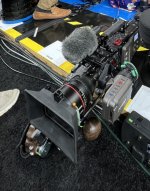
mounting phone to camera

I hadn't realized GDU was as connected to RED, but I guess I shouldn't be surprised. "Gaudy" is the first term that comes to mind regarding that design ethos. Not my taste at all.

For those who haven't seen the Panavision side-rod system, here's a pic from my archives. This was the "down on patient" setup we did pretty regularly on "ER" during trauma scenes. This system was obviously great for the swingaway mattebox, not as helpful for motor mounting but that was not as standard as it is now--focus and iris pulling was done manually by the AC's except for remote head and Steadicam (we didn't use the studio rod system on Steadicam for weight reasons, supplying our own via Steadi-specific brackets).
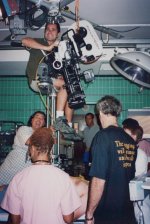
Work99_ER_0013 copy Large.jpeg

Funny note about the mini-rods and the short bite. I never liked mounts that didn't give much room for the rods to telescope, felt like there was always some compromise brewing where you'd end up too long or too short for a given lens. Longer rods often had too much flex for focus motors, which would constantly pop off the threads at the worst time (the dreaded KACK KACK KACK KACK KACK as the motor banged against the gear. I still have my old collection of rod bridges and clamps to try to help with that. Sometimes we'd use a lens support that screwed into the lens, not because the mount needed the lens to be supported but just to tie it to the rods more securely so that the motors wouldn't torque off the lens. Ahh the fun we had.
 
Yeah, once you know the tie-in between RED and GDU, the graphic elements make perfect sense.

I always thought the side rods looked cool, though. But the fact that you always saw them on a big Panavision camera with a big zoom was probably part of it.

I used to hate iris rods and thought they just got in the way. Until I started using them. Now on the rare occasion that I'm not shooting with my gear or with something that doesn't have/accept rods, I don't like it. I've become so accustomed to having rods and a sphere on the left side to grab/brace, even when I'm shooting with my 2/3" ENG cams.

Speaking of, ahh ummm, rod length... When Bright Tangerine came out with their titanium iris rods a few years ago (I highly recommend them, btw), I had to have them make me a special set for my ENG set-up to match my lens lengths. One of my Arri matte boxes cannot slide back on the rods much past the ends, because the filter tray cassette/mounting plate obstructs the travel. I guess it was just 100% absolute dumb luck that it all lined up perfectly back then with the lenses, rods and MB working together for all of those years. It wasn't until I got that first C300 and then some primes that I realized that MB wouldn't slide any farther back on the rods, because it never needed to with my 2/3" set-ups.


Wooden spheres and custom grip from ErgoCine. David was real craftsman. The sphere on my Amira in the bottom picture was in a box of pieces that his brother sent me that were left in his shop after he passed. It's absolutely beautiful. It took me a long time before I decided to actually use it, because it was so nice and I knew I couldn't get it replaced, but then I finally just said to myself that hey, he built this stuff for a purpose and to be used, not to just sit on a shelf and be admired.

IMG_9263 copy.jpg

IMG_8827 copy.jpg
 
I have the Bright Tangerine Left Field baseplate on my Varicam and yes you are right, the "drumstix" are nicely made. I'll even allow them that kinda silly name!
 
Fortunately, they kinda have to be at just the right angle to the light to see where they etched the name into them.
 
I never used the Ergocine products, but I was aware of them and thought they looked great. Obviously those handgrips harkened back to the Aaton. I was just reminded of the first time I saw one, a crew came to my high school to shoot a PBS doc my senior year ('83) and I talked my way into PA'ing for them. A few months ago I managed to track down a copy of it which I hadn't seen since it first aired, which was trippy to say the least (I make a barely visible cameo, several of my friends are better captured). But I remember marveling at the curves of the Aaton and was fascinated by that sexy wooden handgrip.
 
Probably not the direction you want you go in, Rob, but I really enjoy my wrist strap mount for smartphone. I got it for monitor/control on gimbal and it's always there for me no matter the camera position. Now I take it to the grocery store so I have hands-free access to wife's shopping list. Also great for monitoring while adjusting your lights. They're marketed to joggers/athletes.

Now that I've been working with Sidus Link, I strapped a 2nd phone (a $50 galaxy) on my other wrist to keep lighting controls at the ready.
 
To beat the dead horse on the rods discussion, 15mm sliding bridgeplate rods (aka studio rods) were a holdover in the LA market far more than they were on the East Coast. That's mostly because the major Arri rental houses (Clairmont & Otto) had millions invested in matteboxes, follow focuses and other accessories which were all for 15mm, not 19mm. I believe Arri introduced the 15mm bridgeplate system with one of the 35BL models. Can't recall which, but it was likely the BL3 as that's when the PL lens mount was introduced and the camera was finally quiet enough to do away with the lens blimp. That was around 1979, which was also when the MOS (noisy) camera the Arri 35-III was introduced. Charles is right that the offset was because of the side motor. The 19mm rod standard was introduced in 1990 with the Arri 535 camera, the successor to the BL4S. Lots of rental houses and other equipment owners were PISSED and Arri quickly released a 15mm offset bridgeplate solution for the camera so older accessories could be used. The dual systems continue to this day, but most companies in the US ignored the 19mm system until RED adopted it for the RED One in 2007. It took about a decade but the 15mm bridgeplate system has pretty much faded from existence.

I believe lightweight 15mm frontrods (rods generally made from aluminum and extending forward from the front of the camera, as opposed to studio rods that are usually steel and extend underneath the camera with a bridge plate that mounts to a dovetail plate so the camera can be balanced fore/aft on a tripod) were introduced in 1975 with the Arri 16SR. That camera had a cold shoe-like (but not the same thing) mounting plate on the front directly below the lens. This matched the mount plate above the lens on the older 16mm cameras the Arri S, Arri M and 16BL (on the 16BL a big carry handle came with the camera that mounted to the plate). Before the 16SR this plate would usually be used with a single square tube to attach a small mattebox. It was only on the 16SR that the mount moved below the lens and a 15mm lightweight frontrod adapter was included. If memory serves, I believe it came with non-removable 6" rods and you could get screw-on extensions for longer lenses like zooms. Adapters were designed to add 15mm front rods to Aatons and other 16mm cameras as this new standard was quickly adopted. Chrosziel made adapter plates to add front rods to various portable broadcast video cameras (Betacam, U-matic, etc.). When small camcorders like the Sony VX1000, the Panasonic DVX100 and the Canon XL-1 gained popularity in the professional production world, accessory companies made lightweight 15mm baseplates for them and let the rods extend out the back for counterweights, shoulderpads and other accessories. That's when stuff got really messy as all sorts of junk were stuck onto rods!

I always LOATHED the side-mounted rods on Panavision cameras. They pretty much meant that an AC was forced to always be on the "operator" side of the camera as access to the lens was awful from the "dummy" side. Rods underneath always made much for sense from an access perspective as well as more easily providing physical support to large lenses.

And Charles only touched upon the little custom plates with stubby rods that Steadicam operators had to keep in their kits for the various cameras. No one wanted to fly several extra pounds of metal a sliding bridgeplate would add, so a clip-on mattebox and a stubby little rod on a thin plate for mounting a motor to interface with the lens was all that was needed. But unfortunately not everything aligned well so a small variety of plates and rods were needed in the kit.

Oh, and I believe it was the Brits who called them "rails" instead of "rods." Screw that colonialism, they're rods!
 
Probably not the direction you want you go in, Rob, but I really enjoy my wrist strap mount for smartphone. I got it for monitor/control on gimbal and it's always there for me no matter the camera position. Now I take it to the grocery store so I have hands-free access to wife's shopping list. Also great for monitoring while adjusting your lights. They're marketed to joggers/athletes.

Now that I've been working with Sidus Link, I strapped a 2nd phone (a $50 galaxy) on my other wrist to keep lighting controls at the ready.

Thanks Abe. What wrist strap do you use? Dual wielding smart phones on the wrists, people must think you're a production dude from the future. I don't mind that thinking at all, you're just redistributing what you need away from the ideally small camera rig. For the questions list though, I'm liking the phone being in the same-ish area as the camera monitor. This is obviously what Mitch and team are onto with the Accsoon products.

Is there some weird 3rd party app that lets you split screen two apps? Two phones is obviously better for screen real estate. Wouldn't you have them both on the same arm? Or does the hand with the camera monitor make changes to the lighting app? Do you have any photos!?
 
Thanks for all the history Mitch, that all sounds like what I half-remembered...! The little plate on the SR...the integrated rods on the XTR Prod. It all comes back.

Those "stubby rods" on Steadicam plates were largely problematic. For years they were 1/2" in diameter, so we needed bushings to bring them up to 15mm. Between the skinnier post size and flex on the plate as well as stiffness of many of the older lenses, it was a terrible combination (to this day older Superspeeds give me PTSD, thinking about Heden motors skidding off them in the cold Boston winters).

Later in the game, Jerry Hill came up with a series of custom brackets for different cameras that fastened on to various spots on the bodies and gave various options for 15mm rods to emerge so we could festoon our motors as needed. I still have a bunch of his square-to-round rods that converted to an Arri rosette clamp. Clever stuff.

Every Steadicam operator in those days had a box of "Lego" to make things work with different cameras. These days the cameras all emerge from prep not only with rods in place, but FIZ already mounted. As the Northern English lads from Monty Python would announce, "Luxury!"
 
Thanks Abe. What wrist strap do you use? Dual wielding smart phones on the wrists, people must think you're a production dude from the future. I don't mind that thinking at all, you're just redistributing what you need away from the ideally small camera rig. For the questions list though, I'm liking the phone being in the same-ish area as the camera monitor. This is obviously what Mitch and team are onto with the Accsoon products.

Yes, I've been the butt of many cyborg-themed jokes of late. I use this wrist strap: https://www.amazon.com/gp/product/B06XSZ375C/ref=ppx_yo_dt_b_search_asin_title?ie=UTF8&psc=1

Is there some weird 3rd party app that lets you split screen two apps? Two phones is obviously better for screen real estate. Wouldn't you have them both on the same arm? Or does the hand with the camera monitor make changes to the lighting app? Do you have any photos!?

Many apps can natively go split screen with another app on my personal phone which is the A unit (a Galaxy S22+) but for some reason that functionality is not programmed into the Monitor+ app which I use and love for Sony camera control. Going split screen was my first choice, although as you said, the readouts would be pretty darn small.

And I first tried to mount both phones to the same arm but the wrist strap that I'm using doesn't fit around the lower part of my forearm. (You can buy larger wrist straps that are designed for the bicep and would fit there.) Of course, you might also run into issues of phones bumping into each other depending on how they're oriented, but I've never tested that configuration. I can see both screens just fine when I use camera monitor hand to make changes to the lighting app. No photos on hand.

Actually, I originally bought a 2nd copy of the same wrist mount for mounting to a light stand. At weddings, I run a phone for monitor/control to an a7iv on a 13' light stand and connect via usb-c. (I'd rather go wireless, but the signal strength and reliability of the a7iv is crap, so much worse than the a7siii/fx3. The cabled connection is bulletproof.) So, I leave the B phone tethered at the base of the stand (and switch my A phone to the Ronin app to tilt/pan the unit which then captures a static master shot). My first choice was to clamp a rigid smartphone mount to the stand, but before that purchase arrived I had experimented with using the wrist strap to grip the phone to the light stand on top of a tie-down. It saves weight and space in my kit vs a rigid alternative and it gets the job done. I doubt I'd want that rigged to my actual camera though.
 
Back
Top