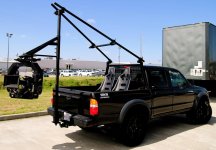
You may notice that there are a series of holes in the rig so the struts can be set at accute or less accute angles so it can be 'tuned' without using adjustable struts like you get on the black arm.
Also the rig adjusts for/aft giving it more/less leverage on the struts.. another means of tuning.
I started with some strutts from an scrap Merc A class boot. They were too hard and said 400n on them... I then bought some stutts that are 200n
I think those are the numbers.
Garage science.
--
The four verticals are a parallelogram (sprung) that allows the rig to move fore aft to account for movement in that axis - ie smoothing braking and acceleration movements.
Every axis the springs hit multiple holes so can be 'tuned'
S
I was wondering where to even begin as far as selecting proper tension struts. That helps.
You are very smart. Earlier I was thinking you would have to change struts when changing to a different camera weight but now I see you've already allowed for that by the ability to change the acute-ness of the angles. Bravo!
The more I look at your design the more I'm impressed with how good it is. And the more I see how much this is all over my level.
When I saw this video here I thought it might not be too super hard to get good results mounting a camera to a car with an isolator and gimbal.
https://vimeo.com/160542127
And I saw a video where some guys had a simple seven jib in the back of an old truck and got some good shots. I figured they got a lot more bad shots but that with a gimbal and more effort put into the design it might be possible to get a lot of good results.
This seems to be quite a niche field, but at least now there are some people trying it and some companies making products. 20 years ago I had no choice but to just hang out a car with a camera and hold on.