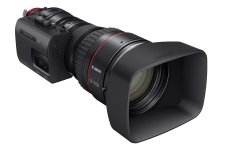
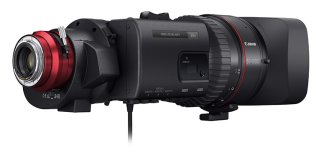
50-1000 in Ef or PL mount - Yikes! I'm thinking of getting one to go with my 60d so I can do really cool videos of my friend's bands 'n stuff. And ducks on ponds.
http://cpn.canon-europe.com/content/news/canon_unveils_cn20x_50_ias_h_e1_p1.do
London, UK, 16 October 2014 – Canon today bolsters its cine servo lens line-up with the new CN20x50 – a high performance, ultra-telephoto zoom lens for sport and nature TV production. Leveraging Canon’s long-standing and unparalleled expertise in lens design, the CN20x50 delivers superb image quality and exceptional creative control, and is the first lens of its type to combine a built-in 1.5x extender, class-leading 20x magnification and a removable servo drive, with a native 50-1000mm focal range that expands to a huge 75-1500mm.
Designed to be a portable solution for broadcast productions using super 35mm cameras – whether HD, UHD or 4K – the CN20x50 is a tool of unprecedented quality, versatility and usability. Featuring a completely removable updated servo drive unit that enables an agile shooting style that’s difficult to achieve with typical cine lenses, the new cine-servo lens helps to meet growing demands for Ultra High Definition (UHD) resolution sport and nature television production.
Versatile and reliable
With productions today expected to shoot in demanding and unpredictable environments, a huge level of lens flexibility is required. For wildlife television, operators
typically work in hostile and sensitive conditions which often necessitate shooting from extremely long distances, while sports productions typically require extremely high resolution for close-to-the-action stadium work. In both situations, operators require fast, reactive positional changes, shooting flexibility and nimble hardware that allow them to respond to changes in the scene.
Weighing just 6.6kg, the CN20x50 is conveniently portable and lightweight and offers an unrivalled focal length and zooming capabilities for its class. It enables sport and documentary crews to capture footage at a distance, while maintaining the highest quality throughout the zoom range. The lens’s huge zoom range also significantly reduces the volume of hardware that crews are required to carry, offering a superb solution for location shoots.
The latest in Canon’s cine-servo lens line-up, the CN20x50 is also user-friendly and robust. The design has been developed to ensure high levels of ruggedness and reliability, even in unforgiving broadcast environments – combining the finest quality optics with a weather-and-shock-proof construction that makes it suitable for use in the most hostile conditions when on location, to the same level as conventional Canon broadcast lenses.
Flexible operability
Compatible with a wide range of cameras, the CN20x50 also supports communication between lens and camera and will be available in both EF-mount and PL-mount variants. The EF-mount version utilises Canon’s own system, while the PL-mount variant supports Cooke’s /i Technology standard. Both models feature a 12-pin serial connection for integration with typical broadcast equipment.
The focus ring rotation is 180 degrees, balancing the accuracy required for 4K imaging with the speed needed for broadcast use. In scenarios where every second counts – and operators only have one opportunity to capture a shot – high speed zoom, iris and simple focusing operation mean that even rapidly changing scenes can be captured with ease and accuracy.
The lens’ design supports a range of cinema and broadcast accessories including operational zoom and focus controls, matte boxes and 0.8- and 0.5-type gear module accessories such as follow focus units, to provide a truly versatile solution.
CN20x50 key benefits:
• Ultra-telephoto lens with class-leading focal length
• Capture every detail in sports and nature TV broadcast
• Achieve stunning shots in outstanding 4K quality
• Enjoy a wide variety of shooting and expression
• Portable and durable with intuitive operation
Last edited:
 Looks spot on though, just what we need.