Mixing different LEDS in same shot: DIFFUSION

PIMP

Well-known member
Hello group:

I currently own a LITEMAT 4 S2 and I want to accompany it with another light. *My first instinct was to get another LITEMAT to partner it up with. *However one gripe I have with the litemat is that its not as punch as I would like in certain situations. *I have come across a lot of videos on the aperture 300d mark 2 light and one has become available for sale. *So my dillema is which light to get. *If I were to get the APARTURE 300d will it void using the LITEMAT in the same shot since they are a different quality of light? *One thing that has me thinking is I love to diffuse it with bleached muslin. *Does it matter what light you use as long as you use a similar material to light through? *I have a cinematographer magazine article where Lubezki claims that it doesn't matter what light you use in the end when your only going to be blasting them through diff.


Any help would be appreciated

Thanks

O.R
 
I think you need to be more worried about color differences: https://www.newsshooter.com/2020/05/11/how-do-you-get-led-lights-to-play-well-together/

You can mix diffusion qualities of different lights no problem.

If you're going to gang the 2 lights together and they mix together into one source, you probably don't need to worry about color differences. But if you use them separately, any color differences between the LEDs will be noticeable.
 
]Most lighting is accomplished using a multitude of different units, different modifiers, different materials for diffusion...this is all part of the craft, deciding what characteristics you want each source to accomplish. If you are replicating daylight coming through a window, you may have one soft unit delivering the ambient push and another creating hard light like sun, with a notably warmer color temp. No reason you'd want the same kind of unit for both. I would actually suggest in response to Abe that if you were making a unified source you should be more concerned with the color temps matching than not, so you have control over the end result (the color temp will alter depending on the intensity of each unit--reduce intensity of one, and the temp will shift towards the other).

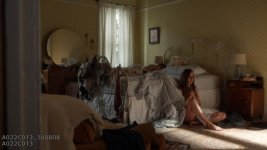
Part of what makes for a vibrant and realistic image is embracing that in the real world, sources are different colors and qualities. In the example below, I had the ambient sources outside the windows cooled off while the sun hit from the right was warmer, and once it bounced off the carpet, warmer still (this was on stage).
In the case of a big hard source being pushed through muslin vs a Litemat, the choice is largely one of convenience, speed and riggability. Litemats are low profile from front to back and self contained, so they are great for hanging or pushing up against a wall, or on the floor etc. Any unit that requires a separate diffusion frame often also needs solids to keep direct light and/or bounceback from the diffusion from polluting the scene as well.
 

Attachments

  • CFbed2.jpg
    CFbed2.jpg
    50 KB · Views: 0
I would actually suggest in response to Abe that if you were making a unified source you should be more concerned with the color temps matching than not, so you have control over the end result

I agree with you Charles but I was talking about green/magenta shift and holes in the spectral response of different LED units, not color temperature. So my thinking was that if two "daylight" LEDs are unified, you can white balance or color correct to neutralize whatever mix of colors emerges from the diffusion. If you use the lights separately and they don't match each other, whichever one you don't balance/correct to will have a cast (unless you gel it to match). No?
 
There's a lot of what-ifs in the equation and I don't want to overcomplicate. Yes, you can white balance your camera to neutralize a cast from a given fixture, whether it contains one or two sources--but then every other source in the shot will be shifted with it. If you do it with gel, OK great, but you could still do the same thing if the units were separated and used for different things as well.

I'll try to reiterate the point I was making about mixing two different sources into one unified source through diff as I may not have been clear. Let's say one unit spikes green and the other magenta, and when you point them through the diff they balance each other out and all is good. Now let's say you are ready to shoot and at the last minute you need to lose 2/3 of a stop intensity from the source. If you dim the one that casts green and not the other, the source will shift to the magenta as that source begins to dominate. So to maintain your color, you need to dim them both equally--but two different units, two different settings, now you are having to guess at how many points to bring each down equally.

Two solutions: use a light meter, divide the output change by half and split amongst the units-in this instance, dial one down 1/3 of a stop, then the other. Another would be to use a net in front of the diffusion--but that seems awfully clunky given the convenience of LEd units and their output dials.
 
Copy that. I was thinking that if he bought another unit from the same manufacturer, he might have a better chance of getting a matching color cast. But I agree that there's far more versatility in having 2 units with different designs and beam angles, etc.

In that sense, I think the aputure 300d is a great buy. You can use it open-faced, with a fresnel, through diffusion or a softbox. It can be hard or soft.

I have a similar 330w COB LED with a Bowens mount from Nicefoto. For quick soft setups (where I have space to work with), I like to use this Glow 60" gridded softbox with Bowens mount: https://www.adorama.com/glsbez60octa.html?utm_source=adl-gbase-privatelabel

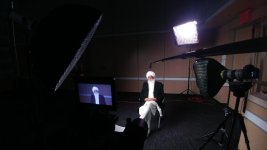
It was about $100, it opens like an umbrella, mounts to the light so you don't need more stands or rigging, and the grid helps you control the spill. Here I used it for a series of one-man band interviews I had to set up in an hour or so, you can see the light and softbox on the left:
recent one-man band interview shoot I shot last week.jpg
 
Great example Charles and nice shot. Your work is always beautiful and its great to have people with your background and skills on this site.

I think the takeaway from what you said is that there are no simple rules to lighting . In the old days we may have used gels to intentionally get different hues from the same lights in a shot for more texture and realism. . There is really nothing to do nowadays except to study, watch how real light looks in a room, and what painters have done, know your instruments and try to be creative. Every situation will be different. Just be thankful we have monitors these days. In the old film days you just had to know what you were doing from the get go. Mixing color sources back then was a real PITA especially flourescents.
 
When we used tungsten, tungsten halogen and then discharge in CSI, HMI and MSD variants we always had colour differences, and we'd open up the case of gels and look at the scene and then sort it. We've got increasingly obsessed with colour rendition by the specs, the science and the data sheets which all use different descriptions and test conditions. We've moved away from the eye and the art and moved into spec chasing. In virtually every location or studio shot this notion of white is flawed. We don't live in a world of constant colour temperature. We paint ceilings white by and large, but who has white walls? Paint, wallpaper, furniture, drapes etc are all coloured and the sun streaming through the window lands on the right hand side of your face, and we white balance to the sun, but the green subtle shade of the wall lights the other side with a tint. The red carpet warms up under your chin and under your eyebrows. We look at the scene and make decisions. We might ND the windows and then use light to cure the green cast, and try to avoid bouncing light off the carpet.

We have the usual colour correction gels, the greens and oranges and the blues. But we also have hundreds of subtle tints, and skin imperfection concealers. We have an enormous enormous range of softeners too, and that's before we try fabrics.

I get the opinion now that people make subtle decisions on paper specs, and never try things. I did lots of live shows and we'd agonise because the follow spots would be different.some with a different type or brand of lamp that while the spec said they were identical clearly they weren't. Nobody could decide what white was any longer with maybe eight or nine different 'whites' on the go.

Nobody in real life would pay any attention to wall tinted bounce light, because the difference looks real. We're trying to remove reality and replace it with scientific accuracy. One question. What's it look like in the viewfinder?
 
Last edited:
Back
Top