Miller Tripods “Smooth Start and Stop Technology”

Yeah, some of the O'connor's will counterbalance from zero to their limit, in an infinitely variable fashion, but the Sachtler's are in steps(as is their drag) and your payload can sometimes land, less than optimally, between steps and you can end up fighting your tilt, because the counterbalance is either not enough or it's too much and it wants to return to center when you're not applying force.

But it's great that we have so many choices, because we all like different things.
 
Has anyone used an O'Connor 1030HD? Just got offered a used one for sale. There seems to be very little info out there about them.
 
I actually kind of like that no one nowadays recognizes/appreciates Vinten heads in the “cine-centric” world we live in, now.

I only use Vinten since decades, and even my old Vinten 20 head works still perfectly fine and super smooth.
The counterbalance is still way ahead of most modern heads, despite it was developed in the 80s.
 
Has anyone used an O'Connor 1030HD? Just got offered a used one for sale. There seems to be very little info out there about them.
I used to own two 1030B heads. I sold them a while back when I was downsizing, and my biggest regret was selling both. I do have an Oconnor 515, and that keeps my overhead low, and if I need to work with a cine zoom, I rent a 1030 or 2575. The 515 is easier for the smaller gigs, and I feel it is a good size for modern cameras, but the 1030 is so much more versatile.

it is good. one of the best all rounders. good combo of size and weight. possibly my favourite. might be a little heavy for a GH5 and a little light for an Alexa Classic. Yet, can handle both. Alexa classics and big zoom lenses can exceed the weight limit.

Some people might not like the heft of the head, but only you will know that. I think when something is that well designed, you just adapt and get used to the weight and heft. That said, I still consider it a "lightweight" cine head. The 515 is appreciably lighter weight, but also quickly gets overloaded, whereas the 1030 could just about handle most modern camera setups.

helps if you live in a city that has good repair person, or service center, but they also don't need much if well cared for. They have a reputation for being some of the more long lasting designs with fewer points of failure. Repairs can be expensive, because of the high end pedigree of these things, but they last a long time and can be worth it.

Once you get used to the perfect no-backlash operation, it will be difficult to use anything else. It is the kind of fluid head that you end up loving more than cameras and lenses.
That’s a pretty darn good testimony for the O’Connor! The head I’m looking at is a 1030HD and not a 1030D. But I’m not clear on how different it is. Their literature says things like “optimized for HD use”, whatever the hell that means. I get the sense this head was developed back when the term “high definition“ was being used on everything. It became a marketing buzzword. I even remember Windex selling a WindexHD version of their glass cleaner.
 
They are essentially the same head.

1030HD is just the refreshed Vitec version.
 
HD cameras are traditionally lighter weight than cinema cameras.

So HD is likely just a weight class sort of signifier.
 
Speaking of, looks like the 1030d is no longer available at b&h - https://www.bhphotovideo.com/c/product/910984-REG/oconnor_c1237_0001_ultimate_1030d_fluid_head.html

They must want the 1040 to take the reins in the 100mm category.

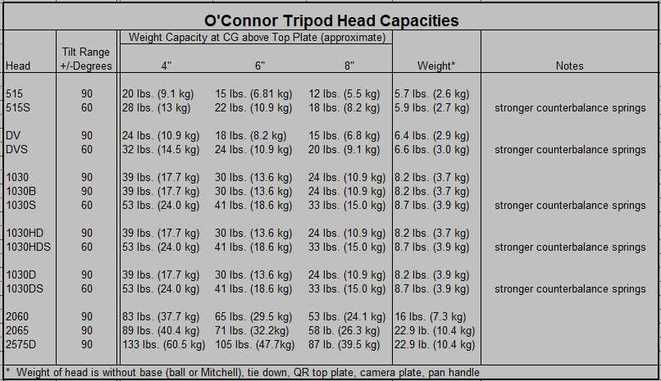
Makes sense. The 1030D only has a 30lb payload capacity. The 1030DS has a higher payload capacity than the 1030D, BUT can only tilt +/- 60 degrees(deal breaker for ENG). The 1040 gives you the full tilt range(+/-90) of the 1030D and a higher payload capacity like the 1030DS.

And keep in mind that the weight capacities are based on specific CoG heights. The higher the CoG, the less weight it can counterbalance, and vice-versa. Most major manufacturers, like Vinten, O'connor and Sachtler, will have a chart for each head showing the weight and height ranges that each head can accommodate.

well said.
 
Speaking of, looks like the 1030d is no longer available at b&h - https://www.bhphotovideo.com/c/product/910984-REG/oconnor_c1237_0001_ultimate_1030d_fluid_head.html

They must want the 1040 to take the reins in the 100mm category.

1040 is quite an accomplishment. And it is the perfect cine fluid head to transition from full size to lighter weight camera/lens combos.

The reason the 1030 "S" variants couldn't tilt the full 90degrees on both ends, was because the counter weight springs had enough power to eventually snap out. So, the restricted tilt was necessary to handle more weight and bigger payloads in the same form factor. The fact that they made it so that 1040 is 40lbs counterbalanced and does 90degrees in such a small head is pretty awesome.

2856023.jpg
 
Geared heads are wonderful tools for narrative shooting. Much easier to control on a fast dolly move, where the acceleration can work against you on a fluid head. If the shot requires significantly more than the roughly 30 degrees of tilt available fore and aft, it's usually better to switch to a fluid head (the built-in tilt plate can shift the range but the further you engage it, the less nodal the tilt becomes and it's a chore). It's a good skill to have for remote head work as well. I think with the wheels setups for gimbals, newer operators are getting into the game which is good (just make sure you have the wheel directions matching a mechanical geared head)!
 
If the shot requires significantly more than the roughly 30 degrees of tilt available fore and aft, it's usually better to switch to a fluid head (the built-in tilt plate can shift the range but the further you engage it, the less nodal the tilt becomes and it's a chore).

Yeah, probably hard to do this with a geared head...

 
Last edited:
Back
Top