Mid-Format DOF Adapter

Please check Vimeo.com and see a couple of videos that I have there shot completely with the medium format lenses. See if you can see extreme shallow dof. DOF depends on the focal length of the lens, just like in still photography you select your lens according to the requirements of the shot. The wider the lens the greater the DOF. I see that someone has built a dual format adapter, why isn't anyone asking for footage? I would love to see footage shot with your adapter. Check footage at www.monstarfilms.com shot with the HVX200. See what you think.
 
Just a question about mid-format:

Isn't the low resolution on the DV-HDV format-cameras not enough for make it in to an advantage with the high resolution available with mid-format lenses etc? Like Hasselblad H3D cameras, the resolution surpasses other digital cameras by far. But in this field for DV-HDV cameras it won't be to an advantage…

You have certaily made a great adapter, but I just want to know if the market is in a need for the technology?

Thanks
This is a good point, this is why I have always been oppose to the use of motion picture lenses on these adapters. The only reason for using them is that usually the focus range is wider on the barrel, so it's easier for the focus puller, but as far as the quality of the video.. that's questionable. I have also mounted Hasselblad lenses on my adapter but they are terrible for follow focus.. much too hard and heavy and the quality did not make me fall off my chair. 30 years ago I used Nikon lenses to film with my Eclair and Bolex cameras and they worked great because you're using the the center of the lens.

The other myth is using super speed lenses on the adapters with cameras that have let's say a F/1.9 maximun aperture. Place a F/1.2 or a F/.95 in front of that lens and are you miraculously turning your camera lens to that aperture? Like I say.. If I start out with a 2 inch water pipe and then add a 1 inch water pipe to it will my water output be the same?

The advantage of the medium format adapter is simple .. you're filming a larger area, more than twice the size of 35mm, in some cases no need to use a close up lens, less magnification less grain. Disadvantages are simply a much more expensive ground glass, forget about lens speed. I have a F/1.9 and most others are F/2.8 fast enough no matter what the experts say.
 
John,

You're always posting about and advertising for Winston. You should know that Winston is not the first to make a dual adapter. If you search the forum, you'll see that someone else created a dual 35mm and mid format spinning GG DOF adapter many months ago. In fact, he's the person that helped me with my CA issues by telling me how he solved his.

Winston is the person I was referring to that is sellng a retail mid format vibrating adapter. As I mentioned earlier, after numerous requests from many on this forum, up until 6 days ago, he had yet to post downloadable HD 720p footage so we could see how the adapter works without the compression artifacts. Not having that footage is what spurred me on to build my own, and, finding the vibrating version I built (with the same GG dimensions that Winston uses) produced a less than stellar image, I built the spinning GG version which turned out much better.

This thread is not about selling a mid format adapter. It's just about my project and sharing what i've learned. No offense, but posting an advertisment for Winston is, in my opinion, out of place in this thread. But, if you want to talk about the technical aspects of a mid format adapter, offer constructive suggestions for improvement, etc., then you're more than welcome.
Well I agree with you on advertising on this board. In actually have no need for that. The store that's selling the adapter is advertising in over 30 publications monthly and daily on their website, so why bother. As far as the footage check Vimeo.com and www.monstarfilms.com. I don't understand why you're image was less than desirable when you built the adapter. The trick is not in building the adapter.. the answer is the quality of the groundglass. It wold be interesting to see your footage even in DV format. One does not need hidef to see the quality of the image.
 
Winston,

I actually used the same GG material (real glass) in the Vibrating adapter as I used in the spining adapter. A link to the footage from the spinning adapter is on the first page of this thread. The footage from the Vibrating adapter wasn't worthy of posting and I no longer have it. Besides, that buzzing drove me crazy!

I'm quite pleased with the spinning adapter so far and I plan to refine it even more...like adding adjustable back focus... I'm have no intention of selling this thing. This is just a personal project.

There have actually been at least two people that have built dual format adapters and they did post footage through this forum. The footage looked pretty good and one was used for a travel commercial. if you search exposureroom.com for DIY you'll easily find that footage. The person that built the one used for the commercial was very helpful while I was building mine.

I disagree that you can judge the quality with DV footage if you plan to use the adapter for HD. DV will cover up many things like grain and imperfections, soft focus, etc., that will jump out at you in HD. When you first posted about the adapter you had for sale I was among the many asking for downloadable HD examples. I was very interested in mid format adapters for the reasons you indicated above. But, months later there still were no HD examples so I just decided to build my own. Fortunately I didn't give up with my vibrating adapter attempt. So, actually, I have you to thank for providing the incentive to bulid my own mid-format spinning adapter :)
 
I'll tell you there are a lot of disappointments in making them, but when you finally get it you will feel that the endless hours and expense was worth it. There will always be room for improvements as you go along. The whole thing comes down to try to make it as light and portable as possible in order to use it for documentary style shooting. That's the request that I always get.

People ask me well how much did it cost to make ? I know what it cost me now, but I have no ideas how much I've spent along the way. Good luck with the project.
 
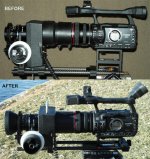
Well it's been a while but I've finally had time to finish the modifications I wanted to make on the adapter. It is now more compact. It's shorter in length and now has the standard 85mm distance from the rods up to the lens mount for lining up to matte boxes. I've also added a condenser lens between the lens mount and the GG to eliminate any hot spot. And, as a final touch, a handle on top. :)

Although not perfect, I think the footage came out half-way decent for under $100 in parts (not including lens and achromat).

This was a fun project. I learned a tremendous amount about the workings of a DOF adapter; learned how to cut a circle out of real glass; and have a new appreciation for what companies like Letus, Cinevate, Shoot35, Redrock Micro have accomplished.

Here's sample footage: www.exposureroom.com/doftest3
Details:
Mamiya 645 80mm mid-format lens @ f 5.6 (equivalent field of view to a 50mm, 35mm format lens)
Canon XH-A1, zoomed to 65, focus 0.3, ND filter 1/6 , @ f 5.6 (except last shot at f 22)

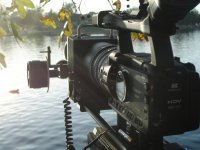
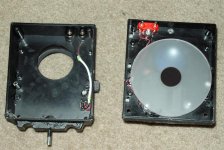
Here are some pictures (before and after) and a shot of the inside:
 

Attachments

  • BEFOREAFTER.jpg
    BEFOREAFTER.jpg
    125 KB · Views: 0
  • DOFLake.jpg
    DOFLake.jpg
    56.1 KB · Views: 0
  • InsideDOF.jpg
    InsideDOF.jpg
    65.2 KB · Views: 0
I do have a question for 35mm adapter owners. If you watch my footage and notice when I rack focus, the images seems to zoom in and out a bit. Is that a function of the lens? I notice that when I focus the Mamiya lens the element moves in and out. Do 35mm SLR lenses do the same thing? I've seen some footage of rack focus with 35mm adapters and I really don't notice that zooming effect.

Thanks in advance for the info.
 
Great job on your adapter Marcel,

That effect of a change in fov when rack focusing is called "breathing" and , yes, its common in a lot of lenses designed for stills and in some video lenses.

The stock lens of my JVC, the 16x fujinon, breaths as well.
 
Thanks, Ted. I've heard that term before but wasn't sure if that was describing the effect that I"m seeing.

I noticed that my A1's stock lens doesn't breath and on some example footage of 35mm adapters rack focusing, they didn't either. I guess that's a downside to the mid-format lens, at least Mamiya...although in some cases, the effect might be desireable.

Since many 35mm adapter users use Nikon or Nikor lenses, can I assume that these lenses tend not to breath or at least as much? Or does the speed of the glass also factor in?
 
Marcel,

Using both 35mm and mid-format, I was able to compare them. And while my sleeping pill was about to kick-in I grabbed my cam and compared my nikons against the mamiya 80mm f1.9 lens to make sure before posting this.

Guess what, the nikons breath more the mamiya, especially the 50mm f1.4. The 85mm slightly, the 105 the least of the bunch. I didnt bother testing the zooms.

Hope this gives you comfort. :-)

Ted
 
Try Zeiss medium formats of the 60s and 70s.
I use them all the time (got a nice collection) and they dont breath at all.
As a matter of fact, I love the look so much, I don´t use any other lenses anymore.

You can get almost new ones for cheap on german Ebay.
Make sure you only buy the ones with the "Zebra" rings.

Frank
 
I like stories about time paradoxes!

Was that medium format or 35mm? I noticed Letus listed in the equipment.

Also, I noticed a lot of slow zooming, did you use zoom lenses, zoom in on the GG, or do the zoom in post?

Thanks!
 
As a stills shooter (and H1 owner) maybe I can explain a bit about the perspective
if the whold field of view is used with an 80mf lens you get the field of view of at 50 on a 35mm lens but still the 80mm DOF

so that is even less dof than just a regular 35 adapter

most 35 lenses are however available at wider maximum apertures than MF lenses 80/2.8 is typical 645 lens wheras 1.8 is avaliable on most 35mm 50s

so if absloute minimum DOF is waht is required you can get that from super fast 35mm primes 50 1.2, 85 1.4 etc

However those wide open DOFs are often a little 'silly'

It is my opinion/experience that using a larger format gives a smoother transition to out of focus even at a smaller aperture - so a 50 at 1.4 does not look the same as an 80 at 2.8

The larger format is IMO smoother and far 'cooler' if you like (as most adapter users will) that creamy blurred look with crisp in focus strip

I must try filiming the ground glass screen on the back of my 5.4inch sinar - with wild tilts and shifts applied !

I did a blog and test here.. http://213.120.106.237/smmcom/blogger.asp?blogid=15

S
 
Focal length doesnt create shallow depth of field Ohara,

it only serves to magnify the out of focus area even more, causing it's blurryness to become more apparent
 
Here's a quick test of the adapter indoors. I haven't tested indoors it since the original design.

One thing that I experienced in the previous outdoor test was not being able to focus on infinity. I resolved that problem by moving the condenser lens closer to the GG. As a surprising benefit, that adjustment also caused the distance markings on the Mamiya lens to now be accurate.

This was shot 24F 1/48 on the A1. A1 lens set to f2.8. Mamiya lens set to f5.6

Lighting was accomplished by one Lowell Omni (500W) and a 100w bulb in an overhead light fixture.

http://exposureroom.com/dofindoor

.
 
condensor question

condensor question

mvansomeren,

Can you give me info on the condesnsor you incorporated? I am trying to build a spinner too.

I'm going to incorporate a condensor and I'd like to know what kind you used, how close it ended up to the gg. that sort of thing. I didn't see any pictures showing that part of your adapter. I'm curious what i need to do.

Thanks

(I just stumbled upon this thread so I'm sorry for the late post.)
 
The condenser lens I used was the front lens from an old set of binoculars. I noticed that it was just the right size and was shaped like a PCX lens. I just got lucky. One point, my adapter used mid-format lenses not 35mm lenses but the basic concept is the same.

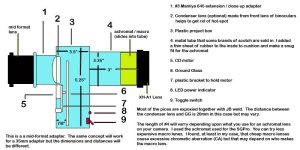
I think most manufactureres put the condenser lens between the GG and the Achromat. I found, at least for my DIY, that it worked best between the mid-format lens and the GG. The distance was approximately 20mm between the condenser and the GG. I had to adjust it to get focus at infinity on the

Here's a diagram that might help you:

___
 

Attachments

  • DIYdiagram.JPG
    DIYdiagram.JPG
    56.6 KB · Views: 0
Back
Top