Mic'ing a piano with typical videographer kit

mcbob

Veteran
My wife and I helped a friend out to shoot some of her songwriting and piano for her blog. I'd never mic'd a piano before, read up on it, and saw a range of professional methods involving boundary mics, large diaphragm mics, and other stuff that isn't in my kit or present budget. Substituting a few lav mics, stick mics, and shotguns worked ok, but not great. Biggest problem was the baby grand overwhelming the lavs, which we wound up removing from the setup.

She'd like to do a few more, so I wanted to collect more practical strategies on mic deployment. Equipment onhand includes:

Marantz 660
Sennheiser Me66 or Me65
AT897
2x Sennheiser wireless lavs w stock me4 bugs
ECM44b wired lav
Rode VMP

Any thoughts?
 
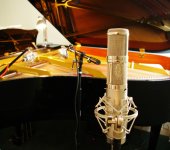
What is your goal? Is it to get studio quality recording or just to get the best possible with your existing equipment? I would actually look for a pair of Rode NT5's. A used pair goes fro around $200 to $350 on ebay. Start by placing them about 3 to 5 inches behind the hammers evenly spaced across the registers. Tweak the placement to balance the sound to get the desired amount of attack and tone. There are a lot of different ways to mic a piano so this is just one easy setup. The ME66 will not be usable to get a quality recording of a piano. The ME65 could work as a single mic placed at a distance. The lavs, as you discovered, won't be of much help in this situation.
 
Yes, if you could get two matched mikes, preferably cardioid LDC's, the method above will work well. The closer to the strings, the brighter/more hammer-ish the sound; the farther back (but not too high), the mellower.

GJ
 
pianosquare2.jpg
In the other recent piano topic there is some useful stuff, but for simplicity, and an open sound, there are some specialist mics around. For when you need something that sounds open and natural, then this type works really well for me - two multi-pattern mics mounted one above the other so you have access to a number of patterns that will work, and record in X/Y or M/S or in a nice sounding space, you can use the two fig-8 patterns in a Blumlein style - a little old fashioned, but lovely in the right room.
 
Last edited:
Here is a single mic technique for grand or baby grand pianos that was taught to me by a major concert pianist that might work with either the ME65 or the AT897. The 897 is the most neutral and probably the best choice. The ME65 has a presence peak in the 5k-8k range for vocals and low end roll off. But the response will change with mic placement. I've used it occasionally for live concert recordings with good results.

Raise the piano top to its highest position. Boom the mic over the middle of the piano aimed up at the top with the tip of the mic between 2" and 6" from and square to the top. Essentially makes it into a boundary mic. Play around with the positioning and distance to get the sound balance you want. Not sure miking a piano for stereo spread for video is all that useful. From an audience POV it is a single point source.

Give it a try and let us know how it works for you.
 
Last edited:
My wife and I helped a friend out to shoot some of her songwriting and piano for her blog. I'd never mic'd a piano before, read up on it, and saw a range of professional methods involving boundary mics, large diaphragm mics, and other stuff that isn't in my kit or present budget. Substituting a few lav mics, stick mics, and shotguns worked ok, but not great. Biggest problem was the baby grand overwhelming the lavs, which we wound up removing from the setup.

She'd like to do a few more, so I wanted to collect more practical strategies on mic deployment. Equipment onhand includes:

Marantz 660
Sennheiser Me66 or Me65
AT897
2x Sennheiser wireless lavs w stock me4 bugs
ECM44b wired lav
Rode VMP

Any thoughts?
Recording piano is my speciality.

I would not use any of the mics you have - thouugh if you had the omni ME2 thay would have done it OK, but not the ME4.

Normally you need a pair of omni mics to record a grand piano (a directional mic. misses out on the lower octave of the piano).

A pair of omni tie microphones stuck to the open lid of a grand piano will act as boundary microphones and work very well.

If you had had the better Sennheiser system with the ME2 omni mics, I would have suggested that you get the XLR phantom adaptors and use those wired in (though the radio option would also have worked with care).

My first choice for this method, though, would be a stereo set of DPA 4060.


For the 20cm spaced omni method, that I normally use, my first choice would be a pair of Gefell M221 or Sennheiser MKH 20 or 8020. Going cheaper, a pair of Røde NT5 or NT55 with the omni heads is a good option (or a Sontronics STC-1S stereo set with the omni heads).

I hope this helps.
 
Did a live transmission for the anniversary of the Japanese Tsunami recently and we used two omni DPA's on the 9ft steinway grand and they sounded superb, the violin had another radio mic based DPA and the string backing section had two AKG 414's around ten feet away.
 
Did a live transmission for the anniversary of the Japanese Tsunami recently and we used two omni DPA's on the 9ft steinway grand and they sounded superb.

That's what I said. :thumbsup:


You just stick them to the lid with hypo-allergenic tape (so they come off easily, don't damage the lid and don't leave a residue) and they become great boundary mics. :thumbsup:
 
Thanks a ton for all your suggestions.

Budget (non-existent) for this project precludes the purchase of additional equipment. After double-checking, I actually do have ME2 lav mics, not ME4's... I'll try using them as boundaries on the lid, plus also the 897-as-boundary suggestion.

One curiosity would be how to deal with the piano overwhelming the ME2's... the transmitter was peaking even with the sensitivity turned all the way down, but then I had them mounted much closer than an open lid would be.
 
>>>>Normally you need a pair of omni mics to record a grand piano (a directional mic. misses out on the lower octave of the piano).<<<<

Depends on your set-up, and with piano, where you put them. I don't like them too close to the strings.

>>>>One curiosity would be how to deal with the piano overwhelming the ME2's... the transmitter was peaking even with the sensitivity turned all the way down, but then I had them mounted much closer than an open lid would be. <<<<

If you have to go with what you have, and you can't beg, borrow, steal (or rent) something else, try whatever you have in different positions and distances from the piano. maybe backing the lavs way up will give you enough signal without clipping. Experiment and take your time (you didn't say there was a rush, and you didn't say whether you were getting paid or not... I'd just use the time to experiment and learn, and to get the most out of your gear that you can).

GJ
 
Thanks a ton for all your suggestions.

Budget (non-existent) for this project precludes the purchase of additional equipment. After double-checking, I actually do have ME2 lav mics, not ME4's... I'll try using them as boundaries on the lid, plus also the 897-as-boundary suggestion.

One curiosity would be how to deal with the piano overwhelming the ME2's... the transmitter was peaking even with the sensitivity turned all the way down, but then I had them mounted much closer than an open lid would be.


Stick them to the lid with hypo-allergenic tape - lid open on full stick.
 
Back
Top