matching color temps for a 5600 cool light LED to 3200 Arri

pulpwoody

Well-known member
is just about impossible.

I have a couple of the 5600k cool light LEDs. On their own, the LED's are fine, but I have yet to find a combo of filters that allow me to use them with my Arri's/Lowels.

First, just to use the cool lights, you have to put a 1/4 minus green filter on it to negate the green spike, which turns the light kinda pink. So that means that you're no longer putting out a true 5600k light, so putting a CTO on the Arri's don't work. The colors don't match, and it's pretty frustrating.

Any one else have this issue or have a solution?
 
Do you really need the 1/4 minus green? Try with just the CTO on your LED lights and it should be fine.

Another idea is to leave your daylight lights as-is and put CTB on your ARRI light (blue gel).

I've mixed my ARRI tungstens with daylight balanced flos many times and blue gel worked just fine.

FRAME GRABS:


BTS:


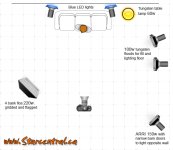
LIGHTING DIAGRAM:
KTlighting-diagramII.jpg


FINAL RESULT:
Switch to HD mode!!!
http://www.youtu.be/5E58qNzYzho?hd=1
 
Last edited:
Just an update to this post, I looked up the specs for your LED lights and the CRI is pretty bad (80'ish) and below standards you would find with more "professional" lights (CRI in the mid-90's).

Try my suggestion of making your ARRI's daylight, and hopefully that works out for you.
 
Last edited:
Just an update to this post, I looked up the specs for your LED lights and the CRI is pretty bad (80'ish) and below standards you would find with more "professional" lights (CRI in the mid-90's).

Try my suggestion of making your ARRI's daylight, and hopefully that works out for you.


Yeah, I've tried that as well, but in the end, your dealing with a pure, 100 CRI light (arri), and a not pure light( LED), so they're never really gonna match I guess. Frustrating. We do a lot of pure white background shooting, so there must be a 100% match in color temp.
 
Yeah and of course for my application I was not fussy about differences in color since I knew I would end up mucking around in post with it later anyway.

You may have go to something with a higher CRI like LitePanels (CRI is 90'ish) but it comes at hefty price, nearly 4 times each light what you probably paid.

You can also try renting some kino flo's... or, instead of using ARRI tungsten use a low powered HMI.
 
I am currently posting a shoot we did that mixed some LED panels and HMIs.

It is a mightmare to cc and grade. Not only the color but the "light feel and quality" is causing me grief. Harsh and spiked.

As the DP..I made the mistake in allowing the gaffer to use his new LED panels on my shoot...without me doing my homework or a test. My BAD.

What is worse...I am also doing some replacement scenes for this shoot. HO will I match

My solution..No LEDS in the future again!


With LED's only, it's not that bad, but really, I'm not working and paying good money for anything, at any price, that's not that bad. I didn't think the green spike thing was that big of a deal, but hell, why should I have to deal with ONE MORE THING? The arri's and lowels never let me down, they're just hot.

I was thinking first and foremost about the comfort of the people in front of the camera, so LED's were a good choice for that, but I had no idea of the added hassle that would arise from this. In the end, for the white background shoots we do, I'm using 100% tungsten anyway. Bummer.
 
What about flo's they are pretty cool too! i might get small portable LED light for just off camera lighting if its only light source I am using at the time, then it can be cheap and doesn't matter.
 
This isn't really new, thinking back. When we had the first halogen version of tungsten lamps, then discharge sources, then flus, now LEDs. Correction filters appeared and we started to have to spend time balancing things up. Now every LED system has a different CRI - we have not just one new source, but lots of different ones. So far, my experience is that there are usually solutions - and the biggest one is deciding which of your sources is the one to correct TOO - and often, you discover you can't get it right - so you pick another source and try different solutions - It's happened to me twice this week and the solution was experiment - experiment - experiment! Eventually you get there.

I have been very anti LED in the past, but the brightness and CRI is creeping up to the point that they're quite workable and I've changed my mind. However, what the specs never tell you is what 'kind' of light comes out. I still think it's difficult to beat the softness of a tungsten halogen lambed soft light, and the lovely beam quality of a Fresnel. There are more and more Fresnels coming - but already a friend discovered that buying the exact same unit two months later doesn't mean they will match - LED improvements made matching impossible. If you need two for the project two months ahead - buy them in one go, don't buy one with the intention of adding another later!
 
Last edited:
The harshness of the multiple individual leds can be countered with some light diffusion. The real problem is with color. LED color is all over the place.
IMO, for now, they should be mostly used in lighting large industrial spaces or in other motivated situations. Tron: Legacy, Prometheus and Skyfall come to mind as good examples. In these cases you just don't bother to correct anything and play the setting. On the other hand, mixing LED with tungsten is begging for problems. It will probably be another year before predictable color, high power LED lights become more common. CRI isn't that useful with non-continuous spectra because it is usually averaged over multiple measurements. You can have bad skin tones and excellent blues and greens and still get average CRI in the 90s.
 
I try not get lost in numbers, which is easy to do in this business, and let my eyes give me the final word. I didn't think that matching light sources would be such an issue, but I had to try it myself first. It's not that I don't like the cool light LED's, because on their own, they work well.
 
"My solution..No LEDS in the future again!"

Yep. LEDs are what you use to light the inside of a moving car or maybe in the middle of the woods at night. Not something I'd even think about for a nanosecond if there is power available.
 
Try 1/8th plus green, 1/4 is a lot. From there add the full CTO.


Tried it and tried it. I don't think there's a gel/filter combo, using on the LEDs or the ARRIs, that worked. With a light source that is pure, 100% CRI and a source that is around 80%, there's no way you can perfectly match them, no way, no how.
 
Of course you're not going to perfectly match them, but heck you can always get it closer. If that doesn't work though, just don't use LED's or shell out the cash for higher CRI lights. Otherwise you're trying to fit a square peg in a round hole.
 
Try 1/8th plus green, 1/4 is a lot. From there add the full CTO.


There are a number of reasons why you will never be able to match a 5600 Coolights LED to tungsten. Many of them have been discussed in other forums and blogs, so I will only paraphrase the most pertinent here. Where it is possible to correct the green bias of the White Phosphor LEDS used in Cool lights and Litepanels with minus green (magenta) gels, it is not possible to correct with gels the deficiencies in the discontinuous color spectrum of LEDs necessary to match them to a continuous spectrum light source like a tungsten Arri light without a substantial loss of output. This is true both of inexpensive 1x1 panels like the Cool Lights and high CRI LED lights like the Litepanel 1x1s (but to a lesser degree.)

In his blog, DP Michael Morian recently posted some camera tests of the Lightpanels 1×1 Superspot and the Shantou Nanguang CN-600HS 1×1 panel to see how the color output of an expensive Litepanel compares to an inexpensive Chinese 1x1 panel. The results demonstrate that the color rendering of the LEDs they both use (Phosphor White LEDs) are pretty poor in general, but more specifically that inexpensive Chinese LEDs like the Shantou Nanguang and Cool Lights 1x1 panels are nearly impossible to color correct to tungsten with gels, while the more expensive Litepanel 1x1 can be marginally corrected, but at the expense of their light output. For example, the gel pack that made a Litepanel 1x1 Daylight Spot marginally similar to a tungsten light in Mike’s tests, was only able to do so at the expense of two stops (so much for the greater efficiency of LEDs.)


The primary reason that neither is capable of being corrected to tungsten has to do with the discontinuous color spectrum of the White Phosphor LEDs they both use. If you look at a Spectral Power Distribution graph of a White Phosphor LED light, a gel pack that would match it to a continuous light source (whether Tungsten, HMI, or LEP) would have to include a violet gel to extend its’ spectral output below 425nm. It would have to include medium blue, cyan, and turquoise gels to fill in the missing wavelength from 465-510nm. Finally it would have to include pink, red, and orange gels to extend its’ spectral output beyond its’ 600nm cut-off. All of these gels would have to be quite saturated, since there is very little, if any, output of these wavelengths in White Phosphor LEDs to begin with (especially 3200K LEDs) where they predominate in tungsten light. Imagine how much light you will get out of a LED light panel with such a gel pack (LED light panels put out barely enough to begin with, and have no output to waste to such accurate color correction.) In other words, White Phosphor LEDS are so deficit in certain parts of the color spectrum that by the time you came up with a color gel pack to match them to a continuous light source, the LED panel would put out very little light with all those gels on it.

You can see the results of Mike’s test on his website at http://talltalepictures.com/blog/2011/12/06/are-led-1x1-panels-ready-for-prime-time/.

Movie Mike
 
Back
Top