Making a Swimming Pool look like an Ocean

Nick Royer

Well-known member
Hi all,
I need to shoot some scenes of a diver in a lake/ocean - and being in Nebraska where our lakes are fairly muddy - it needs to be done in a pool. I have complete access and control to the pool.

I was thinking we would shoot in the deep end of the pool and cover the sides and bottom with dark blue, grey, or black muslin. Would also throw the chemicals of the pool off a bit so that the water would be more cloudy than normal and disguise the background.

I was also thinking that we would either shoot in the daytime with sunlight, or shoot at night with an HMI light, which may be more controllable.


Anybody have experience/examples/advice on this?


Also, is there a reliable place to rent underwater housings from? Going to shoot with either C300/100 or 550D (not sure if I trust putting the C300/100 in a housing).

Thanks!
 
No direct experience, but the original 'Piranha' was supposedly shot in a pool, check it out for ideas.

There are underwater housings available for several of Canon's point and shoot cameras, cheap ones good to 10 feet, which should be enough for a pool and full scuba models. I have an ELPH 300 HS which takes very nice 24p full hd video, and have used the case as a splash housing in the ocean, but haven't shot any true underwater with it. This could be a viable option to drowning a more expensive camera.
 
What kind of shots do you need? Pro housings (any housing for that matter) often cost more than the camera your putting into it. Along with the camera housing you will also need appropriate lens port(s) for the lenses you plan on shooting with. Also has having done UW photography and video as a hobby I know that all cameras and housings can and will flood at some point. Probably the cheapest solution would be a GoPro Hero 2 HD, but that pretty much leaves you with no lens choices.
 
Blacking the bottom of a pool and adding substrate to cloud it a little are both the right idea for shots looking into the pool.

For the upshots, it can get more complicated. The best and of cours most expensive resource is Hydroflex, who are the top name in underwater shooting and rent various rigs, underwater lights etc. If nothing else, check out their website for ideas.
 
In Valhalla Rising, they essentially used what amounted to large garbage bags combined with harsh lighting to simulate the effect of a large, peacefully rippling body of water.
 
This is for a feature - so I am definitely wanting to shoot with a DSLR or the C series, probably not a GoPro or consumer cam just because I need the control and lens choices.

I did find that BorrowLenses has some nice underwater housings and ports for rent for the DSLRs. That might be a viable option.


Has anyone tried the underwater bags? Seems kinda risky to me but being in a pool with low water pressure is that an option?
 
I have shot some stuff with a GH2 and an underwater bag. Works fine. Not perfect and can be a bit fiddly, but for low pressure it's nice since it's cheap and very universal.
 
I was also thinking that we would either shoot in the daytime with sunlight, or shoot at night with an HMI light, which may be more controllable.

I would suggest shooting at night because it will will be easier to make the background drop off, so that you don’t see that you are in a pool, if there is not a lot of sunlight. Using HMIs at night will also give you greater consistency since they won’t be constantly moving through out your production day as the sun will.

However you decide to light the pool be sure to use GFCIs on all the cables supplying your lights – whatever size they happen to be. GFCIs are a must when working around water in order to avoid someone taking a potentially lethal shock. If you decide to go with quartz lights instead of HMIs, you will be fine with the hardware store variety of GFCI cords. But, if you use HMIs, or even Kinos, you will need film style GFCIs, like Shock Blocks, that are specifically designed for motion picture lights. To prevent the nuisance tripping that electronic Kino & HMI ballasts can cause with standard GFCIs, film style GFCIs sense on an "Inverse Time Curve." And, to deal with the harmonics that non-PFC Kino & HMI ballasts kick back into the power stream (that will cause other GFCIs to trip), film style GFCIs include a harmonic filter. Attenuated by the filter, the harmonics generated by dirty loads such as non-PFC Kino & HMI ballasts, pose less of a problem.

If you want to learn more about ground fault protection in wet situations, there is a IATSE training curriculum available online. It covers ground fault protection for everything from battery boxes to Crawford Studio generators. Really interesting stuff like the fact that even though the Honda Inverter generators have grounded receptacles they don't offer an equipment grounding system. Not only that, but even though GFCIs will test positive on them, GFCIs don't work on the Hondas. To find it search for the "Local 481 GFCI Workshop Curriculum" on line.

Movie Mike
 
Thanks for all the suggestions. I did know about Underwater Realm but hadn't checked it out in a while - very helpful video as I was considering doing green screen or a method similar to theirs and it looks like that works much better. Also, thanks for the tip on GFCI's - I haven't used those before as I normally shoot indoors. Is something like this: http://www.filmtools.com/shock-safe-gfci-adapter-11754.html going to be good enough?

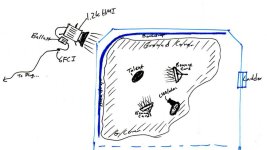
Here is a diagram for the set-up I think we will go forward with:

PoolDiagram.jpg

We will put up some sort of backdrop (either printed like U.R. or dark blue muslin) on two+ sides of the pool, and then we will also do a ground cover similar to what U.R. did - that looked great.

Will light with a 1.2k HMI and then use one or two bounce cards underwater to fill the talent.


Leaning towards an Ewa-Marine bag/housing - they seem to be reliable yet affordable for what we're doing - since we don't need to go more than 12ft down. Probably going use my 550D rather than the C100 because I'm not recording sound and don't need video out for this part of the shoot - plus if it gets flooded it is way cheaper to replace. I also looked at the GoPro again - they have come along way with the dive housing and LCD, but I'm worried about the auto exposure messing up with the contrast I want in the image (talent in the mid-tones and the background fairly dark) - so I will probably use those for BTS but not shooting the actual footage.
 
Hey Nick, your ideas sound good. I have a salt water pool in my back yard and have done some filming in it. If your doing any shots where the cam is pointing downward, you will need to cover the bottom. I would suggest a large tan tarp and rocks (large) to hold it where you need it. For the sides, The muslin would work, use the same rocks or sandbags to hold it down. You can find cheap plants at most dollar stores or craft stores to give it an element of realism. Let me know when your shooting, I have a medium sized housing that could work well for you. I can take some pics of it if your interested in using it for your shoot. let me know.
 
Thanks for all the suggestions. I did know about Underwater Realm but hadn't checked it out in a while - very helpful video as I was considering doing green screen or a method similar to theirs and it looks like that works much better. Also, thanks for the tip on GFCI's - I haven't used those before as I normally shoot indoors. Is something like this: http://www.filmtools.com/shock-safe-gfci-adapter-11754.html going to be good enough?

.

I don't think those will work for an HMI ballast. You might want to rent a Bender.
 
Back
Top