
While the intro article for Pre-Production emphasizes the idea that you should have a plan for your finished video from the very start, and you should be planning your edit in pre . . .
Sometimes, as an editor, you are given footage and images which never had a script, like someone’s vacation videos and photos, or cinema verité projects - or in this case here, serendipitous video snapshots which were a product of unexpected opportunity. How do you approach editing what would otherwise be shots without any particular order or scheme?
For a possible answer, let’s look at some nuggets from the intro articles for Pre-Production:
And Post-Production:
Some background:
I shot this footage on the original DVX100 (no A or B) back in 2005. Vacationing in the area, I happened to see a Ford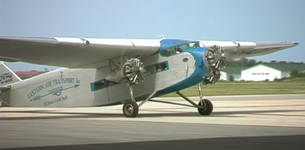 Trimotor circle over. It’s not a common plane to see in the air, so I made my way over the local airport, known for having been home to two of the last Trimotors in commercial service (ending in the late 1970s), and found that the EAA touring Trimotor was in town for that day.
I had no shooting plan*. I just asked permission to shoot, pulled out the DVX, and tried to get the best shots I could. (I do wish I could have gotten shots of the plane in the air from both inside and outside, but alas, I didn’t have access to it on that day.)
As a result, I had footage which was halfway interesting, but no script.
The local enthusiast club requested a copy of what I shot. I could have just given them raw footage, but I’m never content with that. I wanted to edit it into a piece worth watching.
So, I had the ideas behind the two quotes above in mind from the get-go.
As the intro article says, every video worth watching tells a story with a beginning, middle, and end. It was my job as a self-appointed editor to create a story out of footage which didn’t start out with any in mind. So, I found a story to tell regarding the EAA Trimotor, and that gave me a framework for editing the footage.
It was also my job as an editor to plan for consistent use of color, FX, text, and transitions so it would be a coherent, flowing whole which makes sense. Before taking to my editing timeline, I wrote down a plan of how I would proceed. I tried to use text that evoked the feel of the lettering on the plane itself and of the era of the Trimotor’s heyday. I took advantage of some vintage filters to pay respect to the history of the plane. I used some slo-mo, and I even used a little VFX to help create an engine startup sequence it wouldn’t have been safe for me to shoot practically. And in so doing, I tried to make it all make sense within the story, even to help drive the story forward.
It should be noted that I had help in my editing from some music by DVXuser's own Neil Rowe. Editing to music is a time-honored method of pacing out scenes and whole projects, and sometimes brilliance happens almost accidentally when you do.
The result:
So, while this is not any Oscar-worthy short, the enthusiast club liked it, and hopefully it serves as a useful illustration of the ideas from the Intro articles.
*Yes, I could have. I could have planned something out on the spot.
Sometimes, as an editor, you are given footage and images which never had a script, like someone’s vacation videos and photos, or cinema verité projects - or in this case here, serendipitous video snapshots which were a product of unexpected opportunity. How do you approach editing what would otherwise be shots without any particular order or scheme?
For a possible answer, let’s look at some nuggets from the intro articles for Pre-Production:
Successful Productions Start With Good Scripts
. . . Anything worth watching tells a story. It doesn’t matter what kind of film or video you’re making; you’re telling a story with a beginning, middle, and end.
And Post-Production:
Detailed Planning
. . . now’s the time to fine-tune your editing plan. Directors and editors work together to use transitions, graphics, music, text and effects consistently and within the artistic vision of the project. Doing so makes for a much more polished and coherent final product that flows easily and effectively.
Some background:
I shot this footage on the original DVX100 (no A or B) back in 2005. Vacationing in the area, I happened to see a Ford
Trimotor circle over. It’s not a common plane to see in the air, so I made my way over the local airport, known for having been home to two of the last Trimotors in commercial service (ending in the late 1970s), and found that the EAA touring Trimotor was in town for that day.I had no shooting plan*. I just asked permission to shoot, pulled out the DVX, and tried to get the best shots I could. (I do wish I could have gotten shots of the plane in the air from both inside and outside, but alas, I didn’t have access to it on that day.)
As a result, I had footage which was halfway interesting, but no script.
The local enthusiast club requested a copy of what I shot. I could have just given them raw footage, but I’m never content with that. I wanted to edit it into a piece worth watching.
So, I had the ideas behind the two quotes above in mind from the get-go.
As the intro article says, every video worth watching tells a story with a beginning, middle, and end. It was my job as a self-appointed editor to create a story out of footage which didn’t start out with any in mind. So, I found a story to tell regarding the EAA Trimotor, and that gave me a framework for editing the footage.
It was also my job as an editor to plan for consistent use of color, FX, text, and transitions so it would be a coherent, flowing whole which makes sense. Before taking to my editing timeline, I wrote down a plan of how I would proceed. I tried to use text that evoked the feel of the lettering on the plane itself and of the era of the Trimotor’s heyday. I took advantage of some vintage filters to pay respect to the history of the plane. I used some slo-mo, and I even used a little VFX to help create an engine startup sequence it wouldn’t have been safe for me to shoot practically. And in so doing, I tried to make it all make sense within the story, even to help drive the story forward.
It should be noted that I had help in my editing from some music by DVXuser's own Neil Rowe. Editing to music is a time-honored method of pacing out scenes and whole projects, and sometimes brilliance happens almost accidentally when you do.
The result:
So, while this is not any Oscar-worthy short, the enthusiast club liked it, and hopefully it serves as a useful illustration of the ideas from the Intro articles.
*Yes, I could have. I could have planned something out on the spot.