Lowel 80W CFL question.

Jim Brennan

VHS Member Old Skool
I'm looking at buying a bunch of these for some DIY banks. Can't seem to get a stat on a tungsten equivalent for wattage. I always multiply by about 3.5 or 4 for something close, but I was looking at another brand that was 75W that claimed a 150W tungsten equivalent.

Anyone have a stat on the Lowel 80W bulbs? Cant seem to find anything on their site.

Thanks.
 
I'd always figured 23 watts CFL to 100 watts incandescent. Looks like I have been overrating the bulbs. But I guess it does depend on the bulb, as they do have different energy efficiency ratings. So figuring using Lumens I am going to use 1700Lumens/per 100watts. Of course I will break out the ol' light meter and do some basic photometric testing to see what each type of bulb is giving me.
 
Honestly, the whole thing is a bit confusing to me. Most of the references I have seen say that a 14W CFL is about equivalent to a 60W incandescent. That, along with your reference of 23W to 100W gives about a 4:1 ratio.

Does that number go down with higher wattages, or is the difference in the fact that those references are for household lights, so they are not focused?

I think that the issue is that wattage consumption to light output is not necessarily standard across all the bulbs. From what I can find the energy efficiency of the CFLs (relative to incandescents) range between 20% to 30%, so that would be from about 3.33:1 to 5:1. I think that calculating it based on rated light output (in Lumens) is better than trying to figure it based on power consumption.

Doing personal photometric testing of the bulbs I have and will get seems like the best way for me to really understand the lights I will be using. What I will do is just measure light output, in foot-candles, at select distances. This works for me because I started shooting film and using foot-candles (incident measurement) is the standard reference I learned on. I am using a HDDSLR now, and this works well FOR ME to design my lighting and set exposure. It really is about having a standard of reference so you can wrap your head around what you are doing.
 
I'm looking at buying a bunch of these for some DIY banks. Can't seem to get a stat on a tungsten equivalent for wattage. I always multiply by about 3.5 or 4 for something close, but I was looking at another brand that was 75W that claimed a 150W tungsten equivalent.

Anyone have a stat on the Lowel 80W bulbs? Cant seem to find anything on their site.

Thanks.
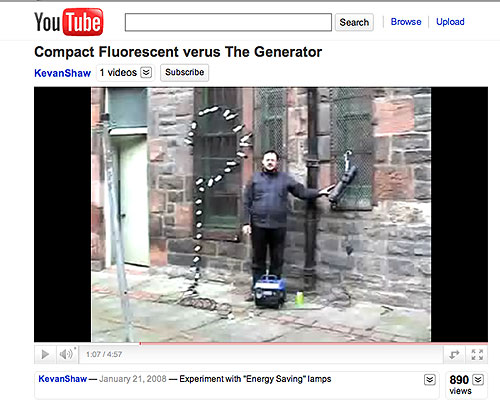
Lumens/watt is not the whole story. Because they use a quarter of the power of a comparable tungsten light, there is a popular misconception that CFLs are an efficient light source. While they are more efficient than tungsten lights, the ballasts of CFL bulbs are not Power Factor Corrected (PFC) and so usually draw twice the amperage for their wattage and return harmonic currents into the power stream. For this reason, on their website Lowell warns about their compact fluorescent (CFL) fixture, the Lowel Ego, that: “The lamps may cause interference with radios, cordless phones, televisions, and remote controls. If interference occurs, move this product away from the device or move to a different outlet” (http://www.lowel.com/ego/lamp_info.html.) The same harmonic currents that can cause RF interference, also cause fixtures using the bulbs to return double the current on the neutral of the electrical system powering them; and, since there is no over-current protection on the neutral, can lead to overloading of the neutral. Anyone who is unfamiliar with the excessive draw of CFLs and the adverse effects of the harmonics they generate, should check out this You-Tube Video:

CFL_vs_Gen_Dem.jpg

In his You-Tube video, “Compact Fluorescent verses the generator,” ( http://www.youtube.com/watch?v=LeCqreRMzKM) Lighting Designer Kevan Shaw compares the effect of equal wattages of CFLs and Incandescent lights on a small portable generator. In his test, he first operates a 575W ETC Source Four Leko with Quartz Halogen bulb on an 850W two stroke gas generator without problem. However, when he tries to operate an equivalent wattage of CFLs (30-18W bulbs) the generator goes berserk. Only after turning off half the CFL Bulbs does the generator operate normally with a remaining load of 15 - 18W CFLs (270 W.) What accounts for the erratic behavior of the generator in this video under a smaller load of CFLs? It is a combination of the poor Power Factor of the CFL bulbs and the harmonic currents they generate.

Even though the 15 CFL bulbs have a True Power of 270W (30x18W bulbs), the Watt indicator on Kevan's generator indicates that they draw twice that in Apparent Power (535W), or have a Power Factor of .5 (270W/535W =.504.) The fact that CFL bulbs consume double the energy (Apparent Power) for the 18 Watts of light (True Power) they generate, is only half the story here. Kevan Shaw’s video also clearly demonstrates the severe effect that leading power factor loads - like CFLs, HMIs, & Fluorescents - can have on the governing systems of conventional AVR generators.

When Kevan turns off the 18W CFL bulbs one at a time until the generator stabilizes, he is not only demonstrating that 15 – 18W CFL bulbs has roughly the same Apparent Power (535W), according to the generator’s Watt meter, as a 575W incandescent light; but, also that the maximum Leading Power Factor load a 850W conventional generator can operate satisfactorily is 270 Watts (15 – 18WCFL bulbs). Looked at from another angle, 576 Watts of Apparent Power with a Leading Power Factor (16 - 18W CFL bulbs) overloaded the generator, while 575 Watts of Apparent Power with a Unity Power Factor (the 575W Quartz Leko) did not. What accounts for this difference? Since the load is almost the same (576 & 575 Watts of Apparent Power respectively), the only factor that can account for the generator going berserk with the equivalent load of CFL lights is the harmonic currents that they generate, that the Quartz Leko does not. Without a doubt, Kevan Shaw’s video is a clear demonstration of the adverse effect that the poor Power Factor and harmonic currents generated by CFLs can have.

For the same reason that Kevan Shaw was not able to operate more than 270 Watts of CFL bulbs (15–18W bulbs) with a Power Factor of .5 on his 850W generator, he would not be able to operate a lighting package consisting of a Joker 400, Joker 200, and two 70W 1x1 Litepanels. The adverse effects of the harmonic currents that non-PFC ballasts generate, so graphically demonstrated in Kevan’s video, limits the total amount of Leading Power Factor loads (whether CFL, HMI, or LED), as compared to Unity Power Factor loads (tungsten lights), that can be reliably operated on conventional generators and household circuits.

For this reason, when building your own “DIY” bank of CFLs you must bear in mind that CFL bulb’s have poor Power Factor and generate harmonic currents that will stack on the neutral. If you don’t take into account the fact that a CFL will draw twice the current for it’s wattage and return more current on the neutral, you may end up with a fire like the one that occurred in Vice President Dick Cheney's suite of offices in the historic Eisenhower Executive Office Building next to the White House on December 19, 2007. The cause of the fire that started in an electrical closet on the building's second floor was found to be the result of uninformed staff replacing all the incandescent bulbs on the floor with CFLs.

For this reason, I would recommend Jim wire his “DIY” bank so that he have only as many sockets on each circuit as the circuit can carry (taking into account that the bulb will draw twice its load.) If he does this and beef up the neutrals in his fixture (so that they don’t overheat), and spread his load around, he should have no problem.

If a reader of this post still doesn’t entirely understand what I mean by the poor Power Factor of CFLs, I would encourage them to read an article I wrote for our company newsletter that explains the electrical engineering principles behind Power Factor, harmonic distortion, and it’s adverse effects before attempting to build their own lights.

BoxBook.jpg

This article is cited in the just released 4th Edition of Harry Box's "Set Lighting Technician's Handbook" and featured on the companion website
"Box Book Extras." Of the article Harry Box exclaims:

"Great work!... this is the kind of thing I think very few technician's ever get to see, and as a result many people have absolutely no idea why things stop working."

"Following the prescriptions contained in this article enables the operation of bigger lights, or more smaller lights, on portable generators than has ever been possible before."​

The article is available online at http://www.screenlightandgrip.com/html/emailnewsletter_generators.html.

Guy Holt, Gaffer, ScreenLight & Grip, Lightng & Grip Rental in Boston
 
Back
Top