Looking for a specific low-noise lav

ryangschultz

Active member
I'm mounting a lavalier inside of our on-camera personality's motorcycle helmet and running at speeds from 30-50mph. When testing with omnidirectional Lectrosonics and Tram lavs, I was finding that these microphones are overly sensitive to their surroundings, especially facial hair. There's not always a lot of room between the interior of the helmet and the host's mouth.

I'm looking for suggestions of lavs that might be less sensitive than what I've currently tested. I'm not very proficient in all the options out there, I don't even know if "low-noise" is the correct terminology, but hopefully I got the point across: Mic palcement is extremely close to the mouth with the cable running inside the helmet to a transmitter, and we don't necessarily need to be hearing things from far away outside of the helmet.
 
Did you use covers on your lav mics ? ( to protect against breath and anything rubbing against the mic itself )

Yes, I used a standard foam cover, then a sort of mini dead cat cover over that to try to block out wind and pops from vocals. However, it seems that when facial hair touches the cover on the mic, all of that noise is transmitted directly into the mic and is very loud and distracting.

It's odd, but the microphones that come in the bluetooth communicator kits (for motorcycle helmets) that my company sells isn't nearly as affected by facial hair, but they're not exactly plug and play into a professional wireless transmitter.
 
Professional lav mics are sensitive because they have to be. Even with a foam windscreen or a furry wind cover they'll still pick up noise if that gets rubbed. What you need is a combination of a good lav and experience, and in this situation, I'd highly recommend hiring an audio professional who has done this type of work before.
 
It sounds like you are either asking for "lower sensitivity" microphones which can handle higher sound levels,
and/or you are asking for mics which are less sensitive to wind noise (which would be OMNI-directional mics),
and/or you are asking for mics which have less mechanical sensitivity (vs. acoustic sensitivity).

You might want to contact Oscar Sound Tech who are a US maker of lav mics.
The have a few variations, and they are small enough that they could probably work with you to discover the right kind for your application.

http://www.oscarsoundtech.com/
 
You do have a very hairy MC. You might be able to construct something that sticks to the helmet where the visor would normally close on. You would have to make a shield to block the wind but you would loose the hair. Since you have a GoPro hanging off the chin of the helmet one more thing attached to the front shouldn't be a big issue.

For those that didn't watch the show the guy has a Jerry Garcia level of facial hair, stuff that in a helmet and there is not a lot of places that are not going to be in contact with hair.
 
My immediate thought would be placing the lav in the upper part of the helmet, on the inside of the top opening, right where the eyebrows are. There's room in the helmet to get something in there (I used to ride with a full face helmet), and there is nothing that can really rub the mic when it's there. Use an
Omni and you should pick up the dialogue fine.
 
Thanks for all the feedback guys.

It sounds like you are either asking for "lower sensitivity" microphones which can handle higher sound levels,
and/or you are asking for mics which are less sensitive to wind noise (which would be OMNI-directional mics),
and/or you are asking for mics which have less mechanical sensitivity (vs. acoustic sensitivity).

You might want to contact Oscar Sound Tech who are a US maker of lav mics.
The have a few variations, and they are small enough that they could probably work with you to discover the right kind for your application.

http://www.oscarsoundtech.com/

Richard, thanks for the resource. I'll definitely be getting in touch with them. I've also been looking at a Countryman B3 Lav on B&H that is listed as made for "strong vocals" and sounds like it may be a lower sensitivity that you were referring to. An audio pro buddy of mine did recently recommend Countryman to me as well.
 
You do have a very hairy MC. You might be able to construct something that sticks to the helmet where the visor would normally close on. You would have to make a shield to block the wind but you would loose the hair. Since you have a GoPro hanging off the chin of the helmet one more thing attached to the front shouldn't be a big issue.

For those that didn't watch the show the guy has a Jerry Garcia level of facial hair, stuff that in a helmet and there is not a lot of places that are not going to be in contact with hair.

Thanks for the idea, I'll give it a try. Although with even more direct wind on the mic I'm not sure it will be able to handle it.

My immediate thought would be placing the lav in the upper part of the helmet, on the inside of the top opening, right where the eyebrows are. There's room in the helmet to get something in there (I used to ride with a full face helmet), and there is nothing that can really rub the mic when it's there. Use an
Omni and you should pick up the dialogue fine.

I'll have to try this as well, with the positioning of the face shield it might still block some wind if the mic were in that location.
 
#1 What exact helmet?

#2 why not use an intercom microphone that is made to reject the ambient noises and work in close proximity to the source. Not sure if you can buy pieces, but this system is one of the top of the line and they make the headset for the Harley brand. I recently bought two of them based of recommendations from other riders, but haven't done any riding yet (too much cold and salt on the roads).

http://www.amazon.com/Motorcom-HS-H130P-Open-Face-Headset-Davidson/dp/B000KDZJL2

Parent site and parts
http://imcmoto.com/products/accessories/microphones.html

What you can't really see is that the microphone attaches with a 2 pin micro Molex connector, so all you would need is a shielded cable with that micro connector and whatever you need to connect to (probably) a wireless unit. You could try and hunt down the spare part for the boom, should be pretty cheap. If you look at their other products, I think you will find a mic made for full face helmets, if not Sena has one that I think has an 1/8 connector on the end for one of their intercom systems. I guess my advice is to stop thinking like an audio person and start thinking like a motorcycle rider. No matter what you do, ultimate audio fidelity will be compromised by the wind and cycle noises, so shoot for good voice range which puts you into a noise cancelling intercom mic.

Let us know what you end up doing.
 
Sorry... I just noticed your employer... Why haven't you tried an intercom yet? Just take the output from a Sena or Scala unit in the chase vehicle and record that. Hook up the microphone in the chase car so you can give direction to the rider. Should be pretty simple to accomplish and should sound good too.

Tell Anthony I said Hi (never met him but still can't hurt, and yes I'm a customer)

[edit]

FYI, Sena recently released a firmware upgrade that allows them to pair to a GoPro Hero4 so you can add narration to your action videos. Not sure if any other action cameras support a bluetooth audio input.

[edit 2]

You might need to get an 8 ohm to 1k ohm transformer to connect the speaker out from a Sena to the input on your camera or recorder, think there are a few places that still make these, if not they are easy to knock together for probably under $100 in parts and labor.
 
Last edited:
Sorry... I just noticed your employer... Why haven't you tried an intercom yet? Just take the output from a Sena or Scala unit in the chase vehicle and record that. Hook up the microphone in the chase car so you can give direction to the rider. Should be pretty simple to accomplish and should sound good too.

Tell Anthony I said Hi (never met him but still can't hurt, and yes I'm a customer)

[edit]

FYI, Sena recently released a firmware upgrade that allows them to pair to a GoPro Hero4 so you can add narration to your action videos. Not sure if any other action cameras support a bluetooth audio input.

[edit 2]

You might need to get an 8 ohm to 1k ohm transformer to connect the speaker out from a Sena to the input on your camera or recorder, think there are a few places that still make these, if not they are easy to knock together for probably under $100 in parts and labor.

Thanks for the info Greg. To answer your question, yes! I have been running 5 Sena 20S units, one for each crew member so we can communicate real time (director, producer, camera bike operator, cameraman, host). Sena makes a Bluetooth Audio Pack that plugs into the back of a GoPro and connects via bluetooth to the Sena 20S, that's how I've done all my audio thus far. The problem is that for every rider you add, interference and an unbearable crackling noise is added. The bluetooth technology just isn't there yet. As a quick fix, I run two bluetooth communicators in the host helmet. One is connected to the group, and the other is on a separate channel recording clean, "HD" audio to the GoPro via the Sena Bluetooth Audio Pack. The problem is there's no way to listen to that audio that's actually being recorded and we ruined a couple shoots because of that, so I started researching more professional options and shying away from bluetooth.

Sorry for the long explanation, this has been over a year in the works. I'm now looking into separating our communication devices and recording devices. We've had far too many dropouts with the Sena 20s and that simply can't happen with these fast paced shoots, so for wireless comm we're looking into full-duplex radios like APPI-Comm and MULTIVOICE, that's a different subject though!

I have considered trying to adapt a bluetooth communicator mic to our Lectrosonics wireless setup, but you raise the point of the connector, so I appreciate your advice on adapter or even running out from the communicator itself because I think that would be worth trying. I'm not sure if it's the bluetooth communicator mic that's the ticket, or all the technology packed into the communicator for filtering out wind noise. They really do work well, but random dropouts are scary in a fast paced production environment.

I work with Anthony on a weekly basis, he's quite a character. Also probably the hardest working and smartest man I have ever met. Here's a link to one of our most recent productions so you can get a listen to the audio the communicators put out (when they actually work). It's quite good.
 
Sorry... I just noticed your employer... Why haven't you tried an intercom yet? Just take the output from a Sena or Scala unit in the chase vehicle and record that. Hook up the microphone in the chase car so you can give direction to the rider. Should be pretty simple to accomplish and should sound good too.

I think I just came up with a solution. I didn't realize the Sena 20S microphone is actually a 2.5mm, so would anything stop me from putting a 2.5mm female to 3.5 male adapter on the Sena mic, then run a 3.5mm female to 3.5mm male cable from the adapter to the wireless mic system? Or even run that directly into a portable digital recorder, recording the audio at the host, then run that into a wireless transmitter so someone could listen in on the receiving end, or run it straight to the camera? Then I would get the benefits of the noise-canceling/wind resistant bluetooth communicator mic, but a more professional and reliable system for recording.
 
It should work fine, assuming the Sena mics are only two conductors (tip/sleeve), if they are 3 or more conductors, then it might be a guessing game of which two wires they actually use and of those which contact is ground. Assuming a TRRS connector, there are two "standards". One with ground the top most ring and mic next, the other is mic the top most ring and ground next.

I would be more inclined to cut the connector off so I knew exactly what I was working with, got any dead mic booms around the store? Alternate is contact Sena support and ask them how the connector is wired, they should be fairly helpful. Might take a little soldering after that, but not a difficult thing.

Can you tell I haven't done much work with those bluetooth intercoms? I had no idea the sound quality would drop like that, none of the manufacturers ever mention the crackling. Wonder if it is a proximity issue where the units are too close to each other, and signal bounce within the chase vehicle.

[edit]

Tough to see the pictures on the Sena site, but it looks like just a tip/sleeve connector. This means that unless they wired it backwards from standard (know to happen to prevent compatibility with other devices) a simple adapter and extension should work. Or at least it shouldn't damage the transmitter. Bias voltage on the mic could be an issue, if too much you might wreck the microphone element, but it is unlikely from a 3 volt device like the intercom.
 
Last edited:
Beard noise, makes sense now seeing Lemmy on there.

Looks like you are doing a lot with chase cycles vs. chase car... Or you get to ride in the back of a pickup and slide from side to side depending on the angle you want.

I'd probably opt for a Sony, JVC, or Panasonic on the forward looking helmet cam (attached to the side), that big thing on the chin must not be comfortable. The little 4K Panasonic might be the nicest here because of the tethered "lipstick" camera.

In order to see more face, something like a Bell Mag 9 3/4 helmet might be nice, should give plenty of beard room too. Might be able to keep the shield down and still see him well vs. having him open the visor to address the camera.
 
It should work fine, assuming the Sena mics are only two conductors (tip/sleeve), if they are 3 or more conductors, then it might be a guessing game of which two wires they actually use and of those which contact is ground. Assuming a TRRS connector, there are two "standards". One with ground the top most ring and mic next, the other is mic the top most ring and ground next.

I would be more inclined to cut the connector off so I knew exactly what I was working with, got any dead mic booms around the store? Alternate is contact Sena support and ask them how the connector is wired, they should be fairly helpful. Might take a little soldering after that, but not a difficult thing.

Can you tell I haven't done much work with those bluetooth intercoms? I had no idea the sound quality would drop like that, none of the manufacturers ever mention the crackling. Wonder if it is a proximity issue where the units are too close to each other, and signal bounce within the chase vehicle.

[edit]

Tough to see the pictures on the Sena site, but it looks like just a tip/sleeve connector. This means that unless they wired it backwards from standard (know to happen to prevent compatibility with other devices) a simple adapter and extension should work. Or at least it shouldn't damage the transmitter. Bias voltage on the mic could be an issue, if too much you might wreck the microphone element, but it is unlikely from a 3 volt device like the intercom.

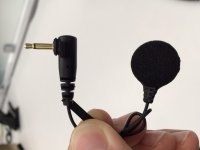
Here's a picture of the mic end, just one ring it looks like. I'm not entirely sure what that means, this is all new to me. Based on your description it sounds like it might work. Just placed an order for some adapters with B&H to test next week hopefully.

But yeah it's a bummer about the bluetooth communicators. I actually just got back from testing Cardo's new PackTalk, where the devices loop off each other to extend the range. They even seamlessly disconnect/reconnect if someone goes out of range and back in which is a cool feature. We were still only getting about half a mile though, and has to be a clear line of site no matter what. With the Sena's, the crackling issue was incredibly random. Sometimes they would work flawlessly, but most times there was persistent crackling that is incredibly distracting when directing, doing camera work, etc.

IMG_5039.jpg
 
Beard noise, makes sense now seeing Lemmy on there.

Looks like you are doing a lot with chase cycles vs. chase car... Or you get to ride in the back of a pickup and slide from side to side depending on the angle you want.

I'd probably opt for a Sony, JVC, or Panasonic on the forward looking helmet cam (attached to the side), that big thing on the chin must not be comfortable. The little 4K Panasonic might be the nicest here because of the tethered "lipstick" camera.

In order to see more face, something like a Bell Mag 9 3/4 helmet might be nice, should give plenty of beard room too. Might be able to keep the shield down and still see him well vs. having him open the visor to address the camera.

Believe it or not, I'm shooting almost exclusively off the back of a Harley Street Glide. We remove the saddlebags and I sit backwards, rigged up a seatbelt too so I can hang out and get real close to the host. Although if we ever go down and I can't hit the release quick enough, I become a frame slider pretty quick :|

I'm working on hiding the GoPros more now too so you don't have distracting stuff hanging off his helmet. We always cut out the camera crew anyhow, so his forward facing cam really just has to do one run without the crew in front.

And I wish! We never have a choice over helmet selection, that's a decision out of my teams control. All depends on the style of the bike and what we want to sell that week!
 
And actually my other question is how do I adapt a male 2.5mm connector ultimately to our Lectrosonics TA5 input, or perhaps a Zaxcom 3-pin micro Lemo input? I ordered some adapters to get me to 3.5mm to at least test with a portable digital recorder. Yet, I still couldn't find an adapter that will get me from 3.5mm to TA5, but I don't know all the technicalities that go into the wiring, or if that's even possible.

I'm not a big fan of having a ton of adapters anyway because there's more fail points.
 
Ok, now I have some gear to work with. I don't have any of that, but I can look up specs. Been building custom stuff like this since about 1986, shouldn't be too big a challenge.

Does your audio recorder supply power to the microphone? Going to need at least a volt, and most that I've seen won't send power to a mini plug mic circuit. Your wireless stuff definitely does. Too bad you aren't using Sennheiser wireless, would be pretty much plug and go.

On the Lectro, normally you need a small resister from the bias pin soldered onto the audio pin. The mic would connect between the audio pin and ground pin. I would ask Sena support to make sure the tip of their connector is audio, and the sleeve is ground, and how much voltage the element needs. If it sounds easy, to me it is. You probably need either figure 1 or figure 4 in the diagrams way down at the bottom of the page. If yor transmitter is new enough, then figure 9 or figure 10 might be what you need. http://www.lectrosonics.com/Support/Microphone-Wiring/uhf-transmitter-5-pin-input-jack-wiring.html I can look around on monday to see of I have any ta5 connectors, but I don't think I do.


Electra Glide is a good choice for this type of work. Too bad the helmet is part of product placement, especially since they aren't really reviewing the gear. I have an Electra Glide Ultra Classic I just bought that I'm working on now, also have a Buell XB9R that I put a 1050cc top end in a few years ago.

hopefully photobucket will be working next time you read this

DSCF1321_zpsckm03cdi.jpg


DSCF1325_zpspbow2sni.jpg


DSCF1327_zpsbpnukjip.jpg


DSCF1331_zpsz5rtpebl.jpg
 
Ok, now I have some gear to work with. I don't have any of that, but I can look up specs. Been building custom stuff like this since about 1986, shouldn't be too big a challenge.

Does your audio recorder supply power to the microphone? Going to need at least a volt, and most that I've seen won't send power to a mini plug mic circuit. Your wireless stuff definitely does. Too bad you aren't using Sennheiser wireless, would be pretty much plug and go.

On the Lectro, normally you need a small resister from the bias pin soldered onto the audio pin. The mic would connect between the audio pin and ground pin. I would ask Sena support to make sure the tip of their connector is audio, and the sleeve is ground, and how much voltage the element needs. If it sounds easy, to me it is. You probably need either figure 1 or figure 4 in the diagrams way down at the bottom of the page. If yor transmitter is new enough, then figure 9 or figure 10 might be what you need. http://www.lectrosonics.com/Support/Microphone-Wiring/uhf-transmitter-5-pin-input-jack-wiring.html I can look around on monday to see of I have any ta5 connectors, but I don't think I do.


Electra Glide is a good choice for this type of work. Too bad the helmet is part of product placement, especially since they aren't really reviewing the gear. I have an Electra Glide Ultra Classic I just bought that I'm working on now, also have a Buell XB9R that I put a 1050cc top end in a few years ago.

Hmm now this stuff is definitely getting over my head! So to answer your questions, yes, something like our Zoom H4n provides power via XLR (48V or 24V), but not to the additional 3.5mm input. So in theory I guess I could use an XLR to 3.5mm adapter to power the mic?

However, I do have a semi-busted Sennheiser set back in the studio I could at least use to test. The transmitter has some issues at the jack connection point due to normal wear and tear over many years of use.

I'll get in touch with our guys at Sena, but manipulating the Lectro pack, if I'm understanding correctly, sounds daunting to me considering their price tag.

Digging your Buell, that thing is slick. Looks like you have your work cut out for you on the Ultra Classic. I'm currently sporting an '06 SV650 as my daily and my '81 Honda CB750 I built a few years back for when the sun is out.

CB750_SV650.jpg
 
Back
Top