Log Gamma and Light Meters

sk85

Member
I have a theoretical question about Log Gamma curves. Lets say I am using a camera in log with 1/48 shutter at ISO 800. I set up nine 18 % grey cards with nine different lights. I take a reflected reading of each grey card. They come to F2, F2.8, F4, F5.6, F8, F11, F16, F22, F32. I put the aperture on camera to F8.

I know that if shoot the F8 card it will come out as 18% grey. My questions is the following: When I move the camera to the brighter or darker stops will the camera read them as one stop brighter or darker. For example my camera is set at F8 and I am filming the card at F22 then move to F32. Will the camera see the cards as three and four stops brighter than the F8 card? If put them on F2 and F2.8 will the camera see the the image as four and three stops darker.

Put another way with the aperture at F8 is 5.6 twice as bright, F4 four times as bright, F2,8 eight times as bright ect. Does the answer change depending on whether or not you have corrected the footage? This is basically asking the same question twice but I wanted to be as clear as possible.

I would like to thank all of the members of this forum. I have learned a lot since I started coming here. Also Alister Chapman's articles on Log gamma curves have been very informative. I should probably be able to answer my own question from these articles but I can' quite wrap my head around log gammas.

Thank you for any information or responses
 
I think what your really asking is does LOG gamma have a linear response in reference to using a light meter? The short answer is NO.

The long answer will make both yours and my head explode.

This book covers log gammas and density in depth: http://www.barnesandnoble.com/listi...otInStock_26To75-_-Q000000633-_-2691715301469

Basically all log gammas are different due to camera manufactures and sensors and codecs, they exist to cram as many stops as the sensor can see into a video signal meant for 7-8 stops.

Easiest way to approach log gammas IMO is to just know the cameras native exposure index (iso/asa) in its log gamma setting- and how many stops you have over or under until it clips. Then when you meter what you want middle grey to be in your scene, you'll know where everything will fall. Again, remembering the last few shadow stops and highlight stops will probably be rolled softly during color correction to make the image more pleasing.

Hope that helps!
 
I have a theoretical question about Log Gamma curves. Lets say I am using a camera in log with 1/48 shutter at ISO 800. I set up nine 18 % grey cards with nine different lights. I take a reflected reading of each grey card. They come to F2, F2.8, F4, F5.6, F8, F11, F16, F22, F32. I put the aperture on camera to F8.

I know that if shoot the F8 card it will come out as 18% grey. My questions is the following: When I move the camera to the brighter or darker stops will the camera read them as one stop brighter or darker. For example my camera is set at F8 and I am filming the card at F22 then move to F32. Will the camera see the cards as three and four stops brighter than the F8 card? If put them on F2 and F2.8 will the camera see the the image as four and three stops darker.

In the theoretical sense yes, if you maintain the F/8 setting, then moving the camera to the greycard+light that read F/11 the grey card will appear 'one stop' brighter in the resulting image.

However... It is not clear to me how camera manufacturers 'rate' their ISO values for each of their camera models. Perhaps in the $10,000+ camera price range, they use standards to come up with a number... but from the 3 DSLR manufacturers, Canon, Nikon, and Panasonic Lumix, that I polled at NAB last week, none of the booth people had any real technical information... other than 'here's how to set the ISO on the camera'...

I did speak with someone who was pretty knowledgeable at the Black Magic camera booth, but again, he was somewhat vague about specifics.

None of these manufacturers seemed to have a clear 'white' paper detailing their technical process of determining ISO values for any of their cameras.

From the person at Black Magic this is what I 'gleaned' from the conversation.

One approach to coming up with a 'personal' Exposure Index (EI), would be to shoot a grey card under sufficient light to allow for a 'low noise' image, say 200-300 footcandles. With a shutter speed of 1/50 (or 1/48 if the camera has that option...), and for a given ISO value dialed into the camera, say, 400, use the F-stop values given by an incident lightmeter for different ISO values, starting with 400.

Then use an NLE and determine which ISO value yielded an image where the 'grey' card was between 40%-50% IRE on a waveform display.

I've been using 50% IRE as my target level for a 18% grey card. This usually results in requiring that I set the lightmeter ISO value to about 1.5 stops 'higher' than the camera setting for my Panasonic Lumix GH-1. For my Nikon D600, about 2/3 stop 'higher' is required.

This yields a setting that allows for about 2.5 stops of 'brighter' values, and about 2.5-3 stops of darker values. The astute will note that's about 5-6 stops of 'effective dynamic range'.

That also 'just happens' to be about the same dynamic range as Rec 709... which is the standard for HD material.

As it is, 'display' technology has not remotely kept up with 'high dynamic range', and so, while with better cameras one can capture wider ranges of levels, those have to be mapped back into Rec 709 limitations for distribution for HD, or even DCI-P3 for theaters, which I think is about 8 stops of DR.

The use of 'Log' representation of intensity is one method of 'compressing' the values coming from the sensor and 'fitting' them into the display capability.

And so if there is a 10% IRE change for each f-stop around 50%, say open up one stop yields a brightness of 60% IRE, as one opens up further, say to 70% IRE, there will be only a 5% change in the level for opening up one f-stop. (one of these days I'm going to make a graph of this...).

However, for IRE values above 85-90% the output display may not register a visibly significant difference.
 
Last edited:
Following what Hunter said, for example slog on Sony camera's maps out certain reflectance values like this:

Screen Shot 2014-02-15 at 6.53.31 PM.jpg

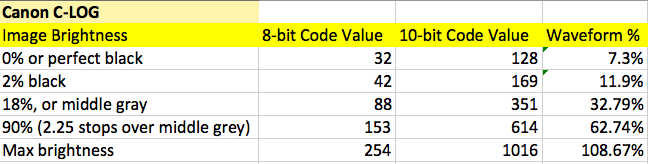
Canon like this:

canon_c-log.png


So using a waveform monitor generally it is best to work by using the mapped value for middle grey, then either let everything fall into place or as the DP you decide if you want to allocate more range towards the highlights by placing middle grey low on purpose or conversely place it higher which can be used to reduce noise in dark areas since in post you would bring the overall level back down. There's also nothing saying you have to use the full dynamic range offered by the camera to shoot your scene. You can chose to narrow down your contrast ratio between any specific scene elements.


Regarding your question about corrected slog footage however;

The way I see it, the full stop values on the lit grey cards from your example and where they end up later in post does have a bit to do with the grading process and how adjustment curves will be applied to it. So for example f2.8 to f4 on your lit grey cards don't necessarily end up "one stop" apart later on in post, plus as pointed out everything ends up being crammed back into REC709 space for the most part anyways.

Just as an FYI a big advantage of using a log gamma is that it provides far more equalization of data bits per stop throughout the entire dynamic range being captured by the camera, and this gives you more room in grading throughout the entire tonal range where as other types of gammas can waste data bits or at least be very inefficient with the image data.

Hope this helps,
 
Last edited:
you'll know where everything will fall.

I was with you until this line. I don't follow. Sure, if you know the clipping points, you'll know how to get middle gray and will know that everything between the clipping points is THERE. But (and this is an honest question) how can you possibly know exactly where they'll fall? If log isn't linear, and I haven't tested out and memorized exactly every stop on my camera, how can I know if I want the background to be a stop darker than my subject? Since a stop in log isn't a stop on my light meter.
 
Back
Top