
Ok guys, I'm hoping to make a live chromakeyer similar to this here. Only difference, is we can build it ourselves, and create a useful, cheap alternative for checking a key live during a shoot. The main purpose for this is adjusting lighting on the subject/green screen without having to render out a sample of video, then adjust lights, and try again, hoping that you didn't over expose your previously under exposed shot. Of course, using a light meter would ensure great results. But I think this could be useful in more than just one way.
So, before I get to this next part, I want to share that this should be made available for ALL users, with very explicit instructions, which I can type out, unless others get to it first. Also, that this should be able to me made with minimal professional equipment, I see several projects on here that often require the use of CNC machining, or other more advanced tools. That said, somethings, like a soldering knife, will be more specialized and advanced.
Ok, below is the design. First, I will explain the principles, then below the design, I will explain how these principles are shown within the design.
A video signal comes in, that signal is split into the three separate colors. In computers, these colors are rated 0-255. Then the 256 (because you must add the "0" to the 255 as an option) shades of each color travel down paths eventually coming to a "gate," this gate can be open or closed. If the gate is open, that shade continues down the path, is converged with the other shades and colors, and sent to the monitor. However, the one shade option that is closed is therefore not sent to the monitor and becomes blank, allowing to see what is being keyed and what is not.
DESIGN:
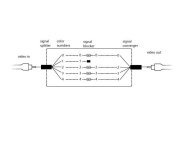
In this design, I focused on one color. That is split into 5 channels, 0-4, they reach the gates, 4 are open, represented by the open boxes, one is closed, represented by the black box. This channel, 1, is no longer present in the video out, becoming the alpha channel. This is done for each of the three colors.
I know this is nothing easy to accomplish, this is the most basic and simple design I can come up with. It will most likely require programming, soldering, and much more. I hope to share the programming with other users, and explicit instructions on which integrated circuits, transistors, and fuses to use, how to use them, where to find them, and how to operate. I would like this to have a composite video in and out, as HD/SD-SDI cords can use a BNC to Composite adapter, and most cameras have a composite out on them. However, after it is completed with composite, I would be open to the idea of reworking it for HDMI, which may be like starting from scratch because the signals are so different. Hopefully, after designing the initial prototype we might be able to then add a feature to insert a flash drive with an image, that outputs in the alpha channel. Again, I could be being too hopeful. But I really am eager to hear other input on this. My step-mom's uncle is a programmer and I believe he will help. But his experience is not with video.
So, before I get to this next part, I want to share that this should be made available for ALL users, with very explicit instructions, which I can type out, unless others get to it first. Also, that this should be able to me made with minimal professional equipment, I see several projects on here that often require the use of CNC machining, or other more advanced tools. That said, somethings, like a soldering knife, will be more specialized and advanced.
Ok, below is the design. First, I will explain the principles, then below the design, I will explain how these principles are shown within the design.
A video signal comes in, that signal is split into the three separate colors. In computers, these colors are rated 0-255. Then the 256 (because you must add the "0" to the 255 as an option) shades of each color travel down paths eventually coming to a "gate," this gate can be open or closed. If the gate is open, that shade continues down the path, is converged with the other shades and colors, and sent to the monitor. However, the one shade option that is closed is therefore not sent to the monitor and becomes blank, allowing to see what is being keyed and what is not.
DESIGN:
In this design, I focused on one color. That is split into 5 channels, 0-4, they reach the gates, 4 are open, represented by the open boxes, one is closed, represented by the black box. This channel, 1, is no longer present in the video out, becoming the alpha channel. This is done for each of the three colors.
I know this is nothing easy to accomplish, this is the most basic and simple design I can come up with. It will most likely require programming, soldering, and much more. I hope to share the programming with other users, and explicit instructions on which integrated circuits, transistors, and fuses to use, how to use them, where to find them, and how to operate. I would like this to have a composite video in and out, as HD/SD-SDI cords can use a BNC to Composite adapter, and most cameras have a composite out on them. However, after it is completed with composite, I would be open to the idea of reworking it for HDMI, which may be like starting from scratch because the signals are so different. Hopefully, after designing the initial prototype we might be able to then add a feature to insert a flash drive with an image, that outputs in the alpha channel. Again, I could be being too hopeful. But I really am eager to hear other input on this. My step-mom's uncle is a programmer and I believe he will help. But his experience is not with video.