LIVE audio: console to mixer

drapeama

Well-known member
This is probably a very simple question, but I'm not much knowledgeable and I haven't find a direct answer to it yet.
I have a little mixer from SHURE, model FP42:
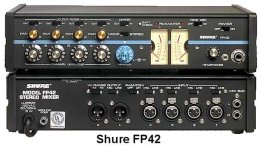
fp42.jpg
Not bad, preamp are ok for me and it has 4 inputs, stereo output.

Let's say I have a LIVE event to cover, and I can get a stereo signal from the console via XLRs on ch1/ch2, and two other microphones for "ambiant" sound from the crowd. The microphones requires phantom power to operate.

My problem is that there's only one switch for phantom power for all channels, and I'm pretty sure I can do no good to the console that way. So it's either using the console with the mixer, or the mics, not both.
Do you guys would think of a solution?
 
Switch the inputs that are connected to the live console to LINE and the phantom power will not be an issue as it is not there on line inputs!

The output from the live mixer will probably be at LINE level anyway.

Great little mixers and I have one of the mono ones, the limiters are very good too!
 
The mixer has mic line switches so you can leave the phantom power on for the mic's but when input 1+2 is selected to line no phantom will be present on those inputs!
 
"Note that phantompower cannot be applied to the inputs with the Mic/Lineswitches in the Line position;"
http://cdn.shure.com/user_guide/upload/870/us_pro_fp42_ug.pdf page 2
This manual specifically states on page 2 that phantom power is applied ONLY when the input is switched to MIC-LEVEL. So you have the solution already in your hands. The problem doesn't exist with THIS mixer.

So you can use inputs 1 and 2 for line-level input and inputs 3 and 4 at mic-level input with phantom power without the phantom voltage being applied to any input which is switched to line-level.

However, for other gear lacking that feature, one could use something would "break" the DC connection without affecting the audio path. For example, isolation transformers or a gadget with AC-coupling / DC-blocking capacitors, etc.

However, those older-design Shure mixer products have proper transformer coupling on both inputs and outputs. So, for example, if you were feeding the OUTPUT from this Shure F42 mixer into an INPUT with phantom power present (for example, the mic inputs of some other mixer), the F42 is fully protected via transformer coupling.

In fact those old Shure mixers (and similar vintage gear) were designed to operate directly into an analog telephone line for remote broadcasting, etc. And the manual further states that the outputs (and the metering) are designed even to operate into destinations with DC voltage present. Note that most modern designs do NOT have this feature!
 
Last edited:
Right, Phantom Power is not present on an input channel set the line.
FWIW, I have FP32 the was subjected to all kinds of abuse in the 1990s and is still working.. though it's a little noisy by today's standards, but it still worked the last time I checked it. The limiters and meters are adjustable as well. I assume the 42 is the simular, except the 32 has individual Phantom or A-B power.
 
This manual specifically states on page 2 that phantom power is applied ONLY when the input is switched to MIC-LEVEL. So you have the solution already in your hands. The problem doesn't exist with THIS mixer.
[..]
However, those older-design Shure mixer products have proper transformer coupling on both inputs and outputs. So, for example, if you were feeding the OUTPUT from this Shure F42 mixer into an INPUT with phantom power present (for example, the mic inputs of some other mixer), the F42 is fully protected via transformer coupling.

1) I remember having checked the manual, but don't remember that part. Maybe I haven't been looking at the right place in it either.
2) That's an excellent news! I was afraid not to be able to use both the mics and the feed to record the stereo mix "in-camera" from the mixer. Will save me some time in post mixing the "crowd" and the clean feed from the console.
3) That's a very interesting fact! That's why I asked, because I'm not much knowledgeable in that department. Started working with Phantom power very recently!

Right, Phantom Power is not present on an input channel set the line.
[..]
though it's a little noisy by today's standards, but it still worked the last time I checked it. The limiters and meters are adjustable as well. I assume the 42 is the simular, except the 32 has individual Phantom or A-B power.

1) This is something I wasn't aware of, but always a good thing to know. Thanks!
2) It is, but still, an improvement as I don't have to rely solely on the internal preamps of the DR-40. I can use both, and adjust them so it's not too noisy.

I bought this mixer for the price, but mostly to cover LIVE events, after I tried a couple ways to mic the gig (ch1 from the console, ch2 from an external mic... / same + 2 portable recorders for ambiance [internal clock issues with Playback]...).
So with this setup, I'll be able to get a decent stereo mix directly in-camera, so I won't spend much time in post working on the audio. I'll have to make some tests though, but if I can edit the video with a good audio mix directly on the timeline, this will make my job a lot easier!


Thanks again guys!
 
Another question:
I've read the manual, but still not sure if I'm right or no. The MIX BUS is intended to connect two mixer together, multiplying the 4 inputs into 8, from what the manual states. It also states that the MIX BUS have a 6dB drop in gain:
SHURE FP42 MANUAL said:
Mix Bus L and R Phono Pin Jacks: provide direct access to theleft and right output channel mixing buses. This facilitates stackingor “multing” FP42s to achieve additional input capacity without losingany inputs. With two FP42s connected at their mix bus jacks, forexample, the left and right mix buses of each unit are directly connected,providing two independent (ganged) master gain controlsand two isolated line amplifiers with eight individually controlled inputs.Since the buses are directly connected, a 6 db drop in the gainof each output channel will occur, and the master or input controlsmust be increased to compensate

My question, can it be used to get an actual "audio output" with RCA cables? Let's say, RCA to 3.5mm in order to record with a small recorder as well as recording "in-camera" with the two XLR output?
 
Yes, the RCA "Mix Bus" connector CAN be used as an additional audio output.

HOWEVER, note that it has at least four peculiar properties:

1) It is UNBUFFERED. So if you short the node, it will kill the audio in the mixer and you will get nothing from the proper output. Likewise, if you overload the output it will lower the level of the entire mix.

2) It is "PRE" or before the Master Level

3) It is of an "intermediate" LEVEL. It is rather likely to be somewhat lower than line-level. Even lower than consumer line-level.

4) It is also an INPUT. So any audio that gets connected to that node could easily go INTO the mixer.

Of course all of these properties are exactly what you want in a MIX BUS link node.
But if you re-purpose it as an extra output, beware of the special concerns with using it.
 
Yes, the RCA "Mix Bus" connector CAN be used as an additional audio output.
Ok, thanks for clarifying this! I wan't sure enough to try connecting something into those connectors!

HOWEVER, note that it has at least four peculiar properties:
1) It is UNBUFFERED. So if you short the node, it will kill the audio in the mixer and you will get nothing from the proper output. Likewise, if you overload the output it will lower the level of the entire mix.
By "short the node", you mean shorting an electric circuit or..?

2) It is "PRE" or before the Master Level
So, adjusting the Master Level won't affect this output?

3) It is of an "intermediate" LEVEL. It is rather likely to be somewhat lower than line-level. Even lower than consumer line-level.
Being lower than LINE level, means that it'll be noisy if I record from there, right? Like, the noise floor will be higher than from the XLRs.

4) It is also an INPUT. So any audio that gets connected to that node could easily go INTO the mixer.
But if I connect a double RCA > 3.5mm cable, plugged in the Mic input of my Tascam DR-05, shouldn't get any audio INTO the mixer from the MIX BUS, right?

But if you re-purpose it as an extra output, beware of the special concerns with using it.
So, all in all, it's possible, but will be noisy if I want to use that track in post.
 
CORRECTION: Re-looking at the schematics, the RCA Jacks are connected to the inputs of the STEREO OUTPUT AMPS! I have corrected this post.

Kind of an interesting mixer, huh?

The only thing to worry about phantom powerwise is using a mix of dynamic and pp'd condenser mic's. Shure's dynamics have transformers in them (at least the SM57 and SM58 do) so that is not a problem, but some cheaper dynamics are direct coupled and the phantom power may damage them.

As others said Line In does not have phantom power. It also will not have enough gain to use with a microphone. Well maybe a crystal mic.

Those inter connect RCA jacks, I do not understand; and from other mixers I have used they are likely to be weird as hell.

OK, just looked at the schematic. They are connected to the inputs of the stereo line level amps. They have a capacitor to keep them from passing DC current. My guess, from that, is that they are intended to take a signal from an external preamp (Most likely from a turn table) and feed it to the line outputs.

You might be able to bring in a signal from the front of house mixer, but you would either have to be able to trust the sound guy; or have someway of controlling the level yourself, maybe a passive 2 channel mixer.

PLEASE NOTE: The channel gain on the FP42 has no control over the input levels from the RCA jacks.
 
Last edited:
What I wanted to make sure, is that I could output from both the 2x XLRs and the 2x MIX BUS at the same time.
XLRs feeding the camera, and having a backup audio from the MIX BUS into a 3.5mm input on a portable recorder.
 
What I wanted to make sure, is that I could output from both the 2x XLRs and the 2x MIX BUS at the same time.
XLRs feeding the camera, and having a backup audio from the MIX BUS into a 3.5mm input on a portable recorder.

See my corrections to my post above.

You would be outputting a low level, but preamplified signal to your recorder. Whether that would work would depend upon your particular recorder. It is possible that that signal may be as high as -10db, but likely lower than that.

And, YES, you should have the same signal on the RCA's only at a lower level.
 
And, YES, you should have the same signal on the RCA's only at a lower level.
All right, I'll test it out tonight, see if it's good or not.
I just wanted to know if I could use it as a backup track, in case something goes wrong with the camera.

But since I got myself a FP33 for 350$CND, I'll be able to use one mixer for the console, the other for the condenser mics. Probably the FP33 with the camera, the other for the recorder, using the XLR inputs on the DR-40.
 
Addendum: As I now understand it, if you use the RCA's to connect two FP42's you would get all 8 inputs on both stereo outputs. As I said these kinds of things tend to be weird. I think one just has to try it to find out exactly how it works.
 
As I said these kinds of things tend to be weird. I think one just has to try it to find out exactly how it works.
Simple enough. You use a second mixer to "feed" another 4ch into the first mixer, via the 2ch mix bus.

I tested it earlier this week end, and it definitively works. You can use the MIX BUS as an additional output. The sound is clean, but the volume can only be affected by the channel knob. The Master Volume doesn't change anything for the MIX BUS, only the XLR output/headphones. And the headphones are noisy as hell on the FP42.

That being said, I received my FP33 today! Sweet deal, 349$ used vs 1995$ brand new! Viva Ebay!
The preamp in it is crystal clean (to what I'm used to work with!). If you can find a good deal on such model, grab it! Will use it for filmmaking/audio booming mostly, but for a 3ch input/stereo output, it's an excellent preamp/mixer!
 
A MIX BUS connection is by definition BOTH an input and concurrently an output. It is a way to directly connect the internal mix bus of one mixer over to another identical mixer. It combines ALL the inputs from both of the mixers together and makes them available to BOTH of the interconnected mixers. If you are using the MIX BUS connections for some other kind of input or output, then you should remember that these are NOT proper inputs or outputs.

Note that because of the intermediate impedance and level of the MIX BUS it is possible that the mic input of a recorder or camcorder could present enough of an impedance load that it would compromise the mix bus and lower the level (and the signal-to-noise ratio) of ALL the inputs and outputs.

Do not assume that you can use this as an output (or an input) until you actually TRY it before you need it.
 
Do not assume that you can use this as an output (or an input) until you actually TRY it before you need it.
I tested it, and it's kind of tricky as even the cable can connection can cause hazard in the audio.
Good thing I asked and tried first. Too bad the headphone (1/8" output) can't be used as backup audio recording, being too noisy. I could have monitored the audio from there using the 1/4" output.
 
There is another option. An XLR splitter (Sometimes called a microphone splitter). They take an XLR input and give you 2 XLR outputs. NOTE: these are a box with some circuitry in them.

With 2 of those (one for each channel) you could run your XLR outputs to both the camera and to the recorder.

An aside: A real mixing deck has a mic input gain control, a channel fader, and main mix faders. It may also have aux output faders. Mine also has USB in/out to the computer in additition to the the 4 mic/line and 2 stereo line inputs and main 1&2 + aux 3&4 outputs. Unfortunately, they also need AC power, so do not make good field mixers, but they should work fine in a indoor venue.

Actually, drapama, I wanted one of those FP33's, but a series of car problems has put me in a no money available possition. The FP42 seemed like a viable temporary solution, but mine works so well, it may just wind up being a semi-perminent solution for my needs.
 
Last edited:
If the channels are panned to center, both L&R outputs the same signal and a simple XLR 'Y' (or 1/4) cable can mult a line output yielding four outputs This is not recommended for microphones.
With the aux 3&4 outputs (typical of Mackie VLZ series) it's either aux 3&4 or main, an input channel cannot normally be fed to both.. works good for a mix-minus feed though. The channel insert connection can also be used as an unbalanced direct out.
 
Back
Top