Lighting up a bridge in the middle of nowhere at night?

this is probably going to sound really off-kilter, but i have used it before with great results for photography.

there are automotive lights called HID's, consuming 35 watts outputting quite a bit more, 2.5x the light of a halogen, a pair costs anywhere from $100 to $300. car batteries cost maybe 30-80 USD. couple that with a few reflector bowls and cheap softboxes, and you will have ALL the light you will need, and use the generator and a trickle charger to keep the batteries fresh (you should get about 30 mins from each car batt for each pair of HIDs used so you might be able to skip the generator). they are DC current and have a ballast/ignitor system and do not flicker (unless a bulb is dying), and they last a VERY long time. i moved on to real lighting long before the HID's faltered or failed.

plus the bulbs come in temp ratings from 3300K, 4350K, 5000K, and up (though i recommend sticking with the 4350K's)
 
. So, based on the advice from everyone on here, taken as a whole, I will make do with the 2000 watt quartz lights and the 1000 watts worth of shop lights I have for fill and bounce lighting. Thank you everyone for your help.


Good choice! You will have sufficient level if you supplement the string lights with your two 1k lights. And, if you make up your own string lights using carnival sockets (available online at http://www.barbizon.com/catalog/detail.cfm?Prod_ID=1927&series=4&brand=29) it will be cheaper and you will be able to place the bulbs where they will be most effective. I wouldn’t worry about how the CFL bulbs will look on camera. The bulbs themselves will be so over-exposed that you will not see the glass spiral. But, you will have to be careful if you take Kholi’s suggestion to use twenty five 25W CFL bulbs in place of 25W incandescent bulbs.

First off, twenty five 25W CFL bulbs will not draw the 5.2 amps that you would think (625W/120V=5.2A) but more likely 10.5A. With the two 1ks your total load will be about 27.3 Amps, so you will overload the generator and likely overheat it’s neutral bus bar. You can also expect power problems (not flicker) because this set up will generate severe harmonic distortion in the power supplied by the generator.

I know I can have a tendency to go on too long in my posts. But, I find again and again that because of the brevity of the posts, online forums like this are filled with blanket assertions based upon erroneous assumptions or conventional wisdom. Since a little knowledge can be a dangerous thing when it comes to handling electricity, I feel it necessary to explain briefly why Filmkid needs to be careful. What Filmkid has to take into account is that CFL bulbs usually have a power factor of .5. Since power factor is commonly overlooked in the design and implementation of lighting systems in motion picture production applications, I would like to take this opportunity to explain it in detail and show how it effects Filmkid’s set up.

If we look at the technical specifications for a representative 25 watt CFL bulb we find that with a power factor of .5 the bulb in fact draws .43 Amps. The difference between the actual current drawn by the bulb (.43A) and the .0215A a 25W bulb should draw using Ohm’s Law (W=VxA), is the difference between what is called “Apparent Power” and “True Power.” In this case, if you were to measure the actual current (using a Amp Meter) and voltage (using a Volt Meter) traveling through the cable supplying one of the 25W CFL bulbs and multiply it according to Ohm’s Law (VxA= W) you would get the “apparent power” of the 25W bulb (120V x .43A = 51.6W). But, if you were to instead, use a wattmeter to measure the actual amount of energy being converted into real work (light) by the ballast of the CFL bulb you would get the “true power” of the bulb which in this case is specified by the manufacturer as 25W. The ratio of “true power” to “apparent power” is called the “power factor” of the bulb.

A favorite analogy electricians like to use to explain power factor is that if apparent power is a glass of beer, power factor is the foam that prevents you from filling the glass all the way up with beer. When lights with a low power factor are used, the generator and distribution system must be sized to supply the apparent power (beer plus foam.) Where the apparent power load of the twenty five 25W CFL bulbs will be 1290W (120V x .43A = 51.6W x 25 = 1290W), Filmkid’s total load will be about 27.3 Amps with the two 1ks. Since, according to the Honda website, the Honda EB3000 that Home Depot rents is only rated for a continuous load of 21.7 Amps (2600W) , Filmkid’s total load of 27.3A will severely overload the generator and overheat it’s neutral bus bar. Filmkid can also expect power problems (not flicker) because this set up will generate severe harmonic distortion in the power supplied by the generator.

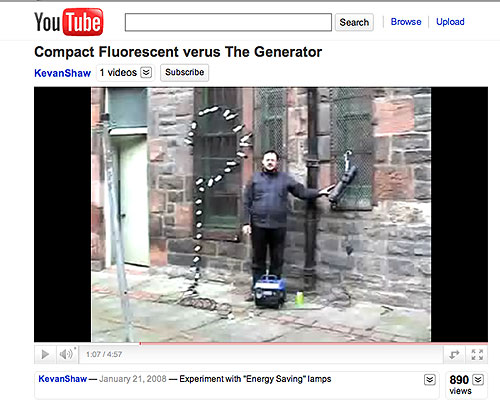
CFL_vs_Gen_Dem.jpg

For a rather amusing demonstration of the greater current drawn by CFLs for the same wattage of light check out this You-Tube video “Compact Fluorescent verses The Generator” (http://www.youtube.com/watch?v=LeCqreRMzKM) In this video, lighting designer Kevan Shaw, first operates a 575W ETC Source Four Leko with Quartz Halogen bulb on an 850W two stroke gas generator without problem. However, when he tries to operate an equivalent wattage of CFLs (30 x 18W bulbs = 540W) on a light string like Filmkid’s, the generator goes berserk. Kevan then turns off the 18W CFL bulbs one at a time until the generator stabilizes. Only after turning off half the CFL Bulbs does the generator operate normally with a remaining load of 15 - 18W CFLs (270 W.) What accounts for the erratic behavior of the generator in this video under the smaller load of CFLs? It is a combination of the poor Power Factor of the CFL bulbs and the harmonic currents they generate. Even though the 15 CFL bulbs have a True Power of 270W, the Watt indicator on Kevan's generator indicates that they draw twice that in Apparent Power (535W), or have a Power Factor of .5 (270W/535W =.504.)

Kevan Shaw’s You-Tube video “Compact Fluorescent verses The Generator" is informative not only for the point he sets out to make, but also for the point he makes unintentionally. Lighting designer Kevan Shaw set out to demonstrate that CFL bulbs have a poor power factor (.5) and consume double the energy (Apparent Power) for the 18 Watts of light (True Power) they generate. However, his video also clearly demonstrates the severe effect that heavily harmonic loads can have on the governing systems of generators.

When Kevan turns off the 18W CFL bulbs one at a time until the generator stabilizes, he is not only demonstrating that 15 – 18W CFL bulbs has roughly the same Apparent Power (535W), according to the generator’s Watt meter, as a 575W incandescent light; but, also that the maximum Leading Power Factor load a 850W conventional generator can operate satisfactorily is 270 Watts (15 – 18WCFL bulbs). Looked at another way, 576 Watts of Apparent Power with a Leading Power Factor (16 - 18W CFL bulbs) overloaded the generator, while 575 Watts of Apparent Power with a Unity Power Factor (the 575W Quartz Leko) did not. What accounts for this difference? Since the load is almost the same (576 & 575 Watts of Apparent Power respectively), the only factor that can account for the generator going berserk with the equivalent load of CFL lights is the harmonic currents that they generate - that the Quartz Leko does not. Without a doubt, Kevan Shaw’s video is a clear demonstration of the adverse effect that harmonic currents can have on the governing systems of generators. For the same reason that Kevan Shaw was not able to operate more than 270 Watts of CFL bulbs (15 – 18W bulbs), it has never been possible to reliably operate more than a couple of 1200W HMIs with non-PFC electronic ballasts on 6500W conventional generators. The adverse effects of the harmonic currents they generate, so graphically demonstrated in Kevan’s video, limits the total amount of Leading Power Factor loads, as compared to Unity Power Factor loads, that can be reliably operated on conventional generators.

Another potential problem that Filmkid faces is that according to the Honda website, the Honda EB3000 that Home Depot rents is a “CycloConverter” type generator. “CycloConverter” is Honda’s trade name for a modified square wave (MSW) type of inverter generator. These generators use inverters to produce not a true sine wave, but a modified square wave that more or less resembles a squared-off sine wave. A modified square wave will cause sensitive electronic equipment (computers, hard drives, video cameras) to overheat. While, equipment that depends on peak voltage (battery chargers) will not operate effectively. For these reasons “CycloConverter” Generators are less than ideal for HD digital cinema productions.

Given the wide variety of generators manufactured for different markets, it is important to understand the benefits and drawbacks to each when it comes to their use in motion picture production. Especially, given that the increasing use of personal computers and microprocessor-controlled recording equipment in HD production has created an unprecedented demand for clean, reliable power on set at a time when the trend in lighting is toward light sources like CFLs that generate dirty power.

For a more detailed description of “CycloConverter” generators, how the continuous load ratings of generators are determined, and how harmonic loads affect generator governors, I would suggest you read the article I wrote for our company newsletter on the use of portable generators in motion picture lighting. In it, is a more detailed explanation of the basic electrical engineering principles behind power factor and how it can adversely affect generators. The article is available on our website at http://www.screenlightandgrip.com/html/emailnewsletter_generators.html.

- Guy Holt, Gaffer, ScreenLight & Grip, Boston, MA
 
Thank you, Guy, for that very informative in-depth reply. The good news is, I decided to go with the incandescent 25W bulbs (I actually bought them before I saw your post) and a 5,000 watt generator one of my actors will be bringing along with his motor home. The bad news is, I don't know if it will cause problems with my GH1 camera or not because I'm not an electrical engineer and I have very little to no knowledge on this stuff. Hopefully, everything will work out okay at the shoot because I don't have the money to do a test rehearsal beforehand.
 
By the way, I have changed the location from a bridge to a narrow tunnel about 5 feet wide and 10 feet high. The tunnel is only designed fo and big enough for pedestrians, not cars. Hopefully that will make lighting the "set" easier. I should be able to light everything up a lot easier bouncing the 1,000 watt lights off of the ceilings and walls of the narrow tunnel than I would bouncing the light off of the ceilings and walls of the bridge.
 
Generator sets on motor homes are usually very stable and reliable. Most are Onan, not a choice I would pick for portable generators but completely adequate for what you are doing.

Best of luck. Let us know how it works out.
 
Back
Top