Lighting that won't heat up the room

drPHk

New member
What type of lighting would be the best for working in a small room? I plan on putting 4 lights in the room, approx 500watts each. I don't want the room to overheat, but then again I don't want it to have a fan because it will make noise, and this is for video work.

What type of light should I go after?

Thanks
 
Flourescent lighting is your best bet if heat is your main concern.

But, you're looking at spending a bit more money than you would for Tungsten light (whether you're buying or renting).
Also, depending on what sort of setup you wanted, you may give up a little bit when it comes to control.
Most flourescent fixtures throw a good amount of soft light - but are not anywhere near as focusable or controlable as other types of lighting.
You'll have to use flags, nets, etc to cut the unwanted light.
 
I agree that fluorescent lighting is your best bet for cool lighting but it's not always expensive ;-). We're a site sponsor and we offer very attractive prices on professional level fluorescent lighting. We've sold to well over 100 DVXuser's and there are plenty of happy customers here.

www.coollights.biz

The 4x55w unit is equivalent of 880 watts of light and only draws 440w of power. The 2x55 watt unit is equivalent of 440 watts of light and only draws 220w of power, etc. No fans necessary and they are completely silent. No flickering and come with your choice of 3200K or 5600K free, high quality bulbs. The fixtures come with barndoors also to help in cutting the light from where you don't want it to go.

This is definitely a soft light option. We'll have some metal halide hard lights in the fall to complement the fluorescents for when you need a cooler hard light too.

My email is richard@coollights.biz if you have any other specific questions.
 
im just waiting to get some money, when i haev, im all yours cool lights.

but then it becomes a question of what to use them for? Key lighting? Fill, what else does fluoros act as, generally speaking.
 
Well it all depends upon the situation. What are you mainly shooting? Interviews? Dramatic stuff?

The answer is the same as for a hot softbox really. Think of one of the softlights like a softbox.

Sometimes you can use the softbox (or flo like a 2x55) as a key (maybe when you are only shooting one subject in a static, sit down interview) and a reflector or a smaller CFL (like 30 to 40w maybe) as fill with same color temperature. Or maybe you have two or three people you're shooting and a larger flo (4x55) for key and a second (4x55) or a smaller one (2x55) for fill.

So, really it depends upon the area you're shooting and effects you want to get. In all these cases you may want a hard light for background and rim lighting. Fluorescent could be used for rim lighting but the effect is far more subtle and is easily washed out than with a hard light like that coming from an HMI or tungsten fresnel.
 
Richard, I'm confused about the mounting method of your lights. Your site says this about the soft flo fixtures:
"Mounting method: Yoke (5/8" thick hollow tubular steel construction) with 3/8" hole for stand to yoke adapters."

Does this mean that they will fit onto a standard 5/8" stand? Part of my confusion comes from the picture, because it doesn't appear that the flo lights are using the same kind of mounting that you might find underneath an arri light. Thanks!
 
Hi,

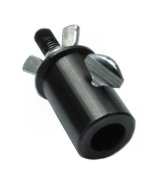
The stand-to-yoke mounting adapter is a separate option (a drop down box at the bottom of the product's page) and adds $11.99 to the order for each light you add it on with. Some lights come with a stand adapter and some don't. The reason we don't sell it with the light is that some have their own stand adapters already, some buy our stand which includes a stand adapter as part of it and some use it in a situation where it's hung high on a pipe with a pipe clamp.

So that's why we make the 5/8" stand-to-yoke adapter optional. For instance, if you bought the stand-to-yoke adapter + our stand then you wouldn't need it and it would by lying around since the stand already includes it. This way, the fixture is a bit less expensive depending upon what option you choose. I've included a picture of the adapter at the bottom. Hope this helps...
 

Attachments

  • CL-B2Y1a.jpg
    CL-B2Y1a.jpg
    18.2 KB · Views: 0
Last edited:
Thanks Richard, that cleared it up, but I do have some more questions.

How do you think one of your company's soft fixtures would compare with something such as this Chimera softbox? It was recommended in a thread from a while back, and I had originally planned on waiting until I had enough funding to get it. But now, I'm finding much to like about your company's fixtures. What features do they lack compared to the Chimera, and are there ways to mediate those losses?

Your website mentions that the fixtures have slide-in adapters. Where would I be able to find accessories that fit in them?

Thanks for all the effort you've been putting into helping the prosumer crowd.
 
Well surface area is the main difference in the lighting other than heat or lack of it in one or the other product. The chimera softbox link you gave has a surface area of 24x32 inches of light off the surface of the silk. Silk is not normally necessary on our units but you only have a surface area of about 21 x 11 inches with a CL-455, 21 x 5.5 on a CL-255 and we're out of stock at the moment on the CL-655 but its surface area would be 21 x 16.5. Our mirrored barndoors also help a bit in increasing the surface area depending upon how you set them. It's one reason most manufacturers are putting mirrors on the barndoors which normally would be just for cutting light from where you don't want it to go.

You don't always need "smoothing" or extra diffusion, but when you do, the slide-in adapter comes in handy for things like prismatic or cracked ice diffusion panels like those you get from home depot in 2x2 or 2x4 sheets. They are easy to cut to measure to fit in the adapter just behind the barndoors. And they're pretty inexpensive too; usually under $6 for one panel which could serve several units.

Basically a translucent styrene which transmits most of the light but smooths it out--smoothing and diffusion without light loss. We will be selling an eggcrate attachment for it later in the year also. Black eggcrate with a 1/2 x 1/2 x 1/2 size cell structure.

You should be able to dim the chimera with an incandescent dimmer but you can't dim our current model fixtures other than turning off the banks of lights 2 at a time or applying more silk in front or backing the fixture up--all of these are the normal methods you cut light in a flo fixture when it doesn't have a dimming feature. I'm not aware of any other features an incandescent softbox would have. They're usually pretty simple--even a chimera.

Another type of diffusion you might use to get a larger surface area would be silk in front of the unit to make its lighting surface area larger like the chimera. But you don't always need this large of an area. Comes in handy for product shots or larger, shiny black objects for instance.

A 2x55 or 4x55 by itself should be fine for most common uses though.
 
Back
Top