Lighting suggestion needed

David Evans

Well-known member
Hey guys,

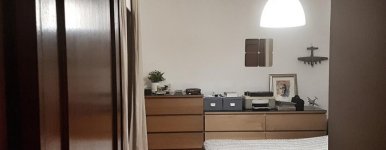
I need to shoot an indoor scene that takes place late in the afternoon / dawn. The framing will be close to the photo shown below and there will be a man sitting on a chair on the center / right, working on his laptop (there will be a desk in there). There will be a lamp left of him which should appear to be the main source of his light. Left of the frame there is a big space where I can put a 1k fresnel and a large diffuser. I was also considering flagging the top of the light in order to be able just light our actor. I should avoid lighting the lamp as well, otherwise it will cast shadow and that would be weird. Unless I would somehow simulate a window with late afternoon light. Maybe get some haze in there to get some mood. From a storytelling point of view, it's important the man appears back against the camera.

I was hoping maybe get some creative suggestions :)

Here's the frame (this shot was taken with a cell phone and, of course, lighting is all on just to show everything).
Escritório Still reduced.jpg

thanks!
 
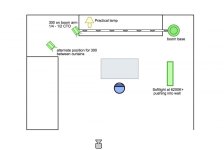
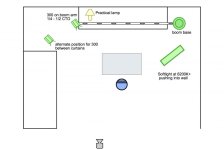
Based on your description and time of day, I'd make the lamp the motivating light source. Assuming it is a table lamp that would sit on the sideboard, it would suggest a 3/4 backlight for your actor. I'd rig a unit above the lamp pointing back towards the actor to give him a warm edge. Size of instrument depends on what stop you are looking to shoot at, but perhaps it's a 300 fresnel, with 1/4 or 1/2 CTO to duplicate the practical's color, depending on how much you dim down the bulb and the color of the shade. You'll need to flag or blackwrap it tightly so that it doesn't reflect in the wood panels to the left. If you have difficulty rigging that fixture (would need a 6' or more boom arm from off camera right), you could possibly get the unit in what looks like a closet to the left with the curtains around it (or is that a window?), which would force the actor downstage/closer to camera to be able to get that unit to be a 3/4 edge vs a sidelight.

In terms of ambience, I'd push a soft light into the wall off camera to the right to give an even, overall glow, and gel it up to 6200K or more (daylight aka full blue plus 1/4 or 1/2 blue on top of that to simulate late afternoon or dawn light). On the actor that will play as a soft wrapping side light countering the edge from the practical. I'd let that be a good stop less than the practical, maybe even less than that, depends on how dramatic you want it to look.

room.jpg
 
Last edited:
Great diagram, thanks Charles!

Budget will only allow to use tungsten, though. Practical is dimmable so it will be easy to balance with the tungsten light. Considering the softlight to the right is a tungsten, all I'd need would be a full CTB, maybe 1/2 more? Would you flag it so it wouldn't cast a shadow of the actor and get some weird mixed color temperature with the practical? Camera white balance should be 3200k right?

Thanks
 
Hi David:

Yes, 3200 on the camera.

Indeed, you can gel down your softlight with CTB as I noted. I'd recommend having a few flavors available (full, half, quarter) so you can play around and see where you like the color to land. Dusk/dawn ambient light is extremely blue, up to 10,000K, but that may start to photograph too cool for your taste. A good calibrated monitor is important for this sort of thing! To put a fine point on it, if I was replicating a pre-sunrise or just after sunset look I'd probably do full plus 1/4, but if it was 10 minutes later than that I'd go full plus 1/2.

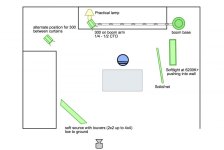
As far as flagging it, I'd let it play across the whole space to give it natural looking ambience as if a window source. Because you have white walls you may want a little less on the back wall than on the actor. Placing nets upstage (towards the top of the diagram) to slow down the return onto the back wall would achieve that, but they'd need to be sizable, probably two 4x4's. You could also try moving your bounce upstage a little as seen here, which will take down the back wall some.

bedroom 2.jpg

If you preferred the walls to be darker, you could just push the unit directly at the actor rather than bounce off the wall. That would suggest more of a night look.

Given that the walls are white, a little will go a long way with that bounce. If you have too much it will feel like daylight. Having just enough for it to read as dusk/dawn is the key, and this will effectively silhouette your actor against the wall. This may result in not enough sidelighting him for your taste--you could always add another instrument just for him coming from the same direction if this was the case.

Mixing the color temps is part of the goodness in this sort of lighting scheme! It shouldn't be weird, as it is duplicating what happens with real light in that scenario. My favorite time of day is post-sunset when there is that deep blue ambience inside a house mixed with the warm glow of incandescent light. The reason for bouncing a softlight is to make that source feel as large as possible to replicate the super-soft look of low ambient daylight coming through windows...you may get some shadows of the practical etc. but if they are soft, they should feel real.
 
Charles, thank you so much for taking the time to help with this and doing those helpful diagrams. I'm just worried about the white wall and how close the actor will be to it. Perhaps instead of using grids I could flag the top so that it would light maybe half of the actor. Of course that would feel strange as dusk presumes that the sun is low and so any light entering the windows should light everything. Maybe getting the softlight as far back as possible. I think a bit of haze might help as well?
 
Charles, thank you so much for taking the time to help with this and doing those helpful diagrams. I'm just worried about the white wall and how close the actor will be to it. Perhaps instead of using grids I could flag the top so that it would light maybe half of the actor. Of course that would feel strange as dusk presumes that the sun is low and so any light entering the windows should light everything. Maybe getting the softlight as far back as possible. I think a bit of haze might help as well?

As I noted, you just set the level on the wall to be where you want it and the actor will silhouette nicely against it, with just a little level coming from that side push. If those are windows on that right wall, you'd need to black them out with visqueen or something similar, and then hang some white material from the curtain rods for the bounce.

Not sure what you were saying about getting the softlight back as far as possible--which direction is that?

Haze would be nice, although it will "give up" the backlight by showing the beam from above.
 
Not sure what you were saying about getting the softlight back as far as possible--which direction is that?

Haze would be nice, although it will "give up" the backlight by showing the beam from above.


When I said getting the soft light as far back as possible, I was refering relative to the actor. The idea would be that the light would hit the white wall with less power. Maybe I could get the haze to stand just close to the camera. I hadn't consider what it would do to the backlight. I really have to be careful not to put haze in there...

Thanks!
 
Sure. Various ways to minimize the level on the back wall vs what plays on the actor as I detailed above (nets, bounce angle, adding a second unit for actor).

Haze is not very well behaved, it will be tough to ask it not to fill the room! Nice thing is, if it's not working for you, open a door.

Please post stills of your results when you do shoot this scene!
 
Thank you for all your help Charles. I will post a still of this scene as soon as it's shot. One question out of curiosity. How do you deal with skin tones in this kind of situation where you mix different color temps? Let's say, for example, in this specific situation, the actor would be facing forward towards the camera. Wouldn't his face be too blue?

Thanks

This is just a hypothetical, yes? Since you said in the first post "From a storytelling point of view, it's important the man appears back against the camera."

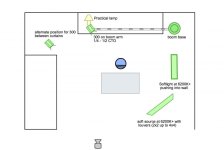
OK so if he was to face camera, I would probably opt to continue the sense of the table practical by wrapping a soft source from the camera left side, suggesting that light bouncing off a surface back onto his face. Ideally this would be a half-light, but you have those cabinets over there in the shot so there wouldn't be room...I'd position it just out of frame left, keeping it low to the ground and maybe 1.5 - 2 stops under key. Grid/louvers important here to keep it from washing out the back wall. The blue daylight bounce still plays but I'd cut it way down on the other side of his face, using a net or solid to take most of the sidelight out but keeping a little of the 3/4 to the rear part of the bounce in play. Again since you want this instrument to be very low level to just tone the back wall a little bit, you may not even need to worry about knocking it down on the subject.

bedroom 3.jpg

Another approach would be to do essentially the opposite, wrap the window light further around to the right with a similar source to the one described above so that the window becomes the primary source in the room. Yes, he will be quite blue in this instance--but that is a look and a choice, and if it fits the emotion of the scene, then it may work well. If the idea works but it's just too much color contrast, you can try it with that source at 5600 instead of bluer.

lighting bedroom 3.jpg
 
Amazing Charles, thanks! Yes, it was just hypothetical, the actor will be back against the camera. But I curious into knowing this as my next shot is of a girl looking from the perspective of the camera and in order to keep the overall color consistency, I need to keep the camera at 3200k and light her with the same blue tint as the original shot of the room. So I was worried about skin tones becoming blue, especially on a close up as I'll be doing of the girl watching the room.

Thanks
 
Gotcha. If it's a turnaround onto the girl, then based on the original lighting scheme she'd be looking towards the practical so you could key her with a matching source (2800K or so, i.e. 3200 with 1/4 CTO) against the blue ambience. I'd do a softlight through a 4x4 frame of diffusion or a medium chimera as a 3/4 frontal light from the right side, net it down on the walls if necessary, and slide the wall bounce upstage to retain the sidelit look.

The idea is that once you establish your color scheme and basic lighting direction, you can jockey the sources around quite a bit to serve the individual shot.
 
Last edited:
Hi again Charles,

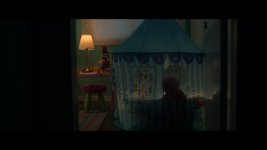
I wanted your help on a similar subject, if I may. Like I said, the other shot is of a little girl watching the man (her father) working on his laptop and then she goes to her room and hide on her favorite hideout. I was trying to do a similar lighting setup to mantain consistency. But the way I want to shoot it, is making this hard to light properly.

I did a test with a toy (it will be the girl, in the day of the shooting and we would just see her silhouette). But even though I like the framing, it's not easy to light this. First of all, I think I need to have a little more daylight to make that silhoette more believable. And next, I'm not sure if I can get away with the backlight (that creates the silhouette) placed in the frame (even though it's hidden behind the toy). But I'm not sure where I could place here to create that effect...

Here's a test I did:

tenda_1.13.1.jpg
 
Looks really nice as is! Nothing bumps me there. I like the level of daylight ambient, it's subtle which is the key.

If you felt you needed to try to place the backlight unit elsewhere, you can go just off frame left to motivate it from the practical, although it will start to wrap around the little girl so she won't be truly in silhouette.

But you don't have to be a slave to motivation. If the piece is dramatic as it clearly is, you have license to make pretty pictures without the light always being justified. It think you are going in the right direction with all of this! Looking forward to seeing the results.
 
Thanks Charles, that means a lot! I guess you're right as to motivating light. I may try some haze to see how it plays out.

Thanks for all your help!
 
Back
Top