Lighting setup for this film

David Evans

Well-known member
Hi guys,


I was hoping to get a bit of help. I'll be shooting a short film next month, that takes place entirely inside a room. In short, the lighting, the mood, the colors that we are trying to achieve are very similar to the room scene of Leaving Las Vegas. Here is the video for those who didn't see / remember:


We have a room with one or two practicals (haven't decided on that yet), and that will be the main motivation for the lighting (big practicals with a big shade). I was wondering what kind of lights and grips would you take to achieve that kind of lighting and mood. Our short film will also star one actor and one actress. I was thinking on painting our room with the same color (dark red) as the one in the clip above and getting some light brown furniture. Not just because we want to follow that look, but mainly because that look makes all the sense for our film.

Our actress has red hair, so not sure if that will be a problem with dark red walls...


You can see a photo of the room (completely raw) here:


87d8aa9722387f77754b2e5f759e0d30.jpg


So the walls will be painted the same way as in the clip of Leaving Las Vegas and we will place some curtains to isolate the windows completely. Furniture will be replaced with something lighter in color. This will be a night scene.

Let me know what your lighting setup, grips and general approach would be. Hoping to get some refreshing ideas. I think controlling light spill will be the order of the day, so I'm counting on a lot of egg crates.


Thanks !
 
Are you shooting at night? This opens options for th windows having lights outside maybe a subtle wash.

If you are shooting day I guess you dont have the resource to box the windows.. build a dark tent outside which you can place subtle lights.. that would be cool.

On the two practicals I tend to remove the practical and throw in a movie light as soon as it is not in shot.

For CUs I have no worries about bringing in a movie light close on the talent

As for red and red that could take a bit of thought.

Incedantally the clip has 'a flaw' in the light by the bed is obviously not the source as the shade is doing odd things.

For the preacticals Id go for really low watt bulbs.
 
You defiinitely want to lean on your practicals. If you can avoid shooting one wall, you can leave it white/beige for bounce fill. Otherwise you'll need the extra space for cards when needed.
I'd also focus your efforts on the windows. Having a little bit of motivated cooler light can help avoid the forgot-to-white-balance look when you go warm for the final look.
It looks like there might be a few spots overhead in the LLV setup. Do you have much room on the ceiling? If you're spending more than a day in there, you probably don't want to deal with armed-out backlights the whole time.
Get art department to give you some motivated points of light to break up your background as needed. A lot of times a lampshade is too bright and too big to stay in a shot, or the height is wrong. Even little stuff like an alarm clock, candle, or phone with a glowing light can help give you things to break up beige walls in the background.
 
Are you shooting at night? This opens options for th windows having lights outside maybe a subtle wash.

If you are shooting day I guess you dont have the resource to box the windows.. build a dark tent outside which you can place subtle lights.. that would be cool.

On the two practicals I tend to remove the practical and throw in a movie light as soon as it is not in shot.

For CUs I have no worries about bringing in a movie light close on the talent

As for red and red that could take a bit of thought.

Incedantally the clip has 'a flaw' in the light by the bed is obviously not the source as the shade is doing odd things.

For the preacticals Id go for really low watt bulbs.

Thanks morgan! Great insight.

I'll be shooting during the day, but the scene takes place at night. So both windows will be ND'd or closed and curtains will be added for visuals. What kind of lights would you use? Kinos? And wattage wise? I really need some very soft lighting that is flattering on the skin. I will also have some very beautiful clothes where I want to see detail. Walls will probably be dark blue (they will contrast better with red hair).

Why did you say you'd go low watt on the bulbs?

Thanks once again!
 
A large or close source creates soft light.

Hence moving your movie light in close during CUs

Id use low wattage in the practicals because the practicals are not used for lighting but only when the appear in shot.

Condsider two positions A and B

In the viewers mind there are two practicals at A and B

But when the frame shows point B (but not A) you remove the practical that was at A and replace it with a movie light and vice versa.

As for movie lights, I doubt Id use a kino. (I dont have any!)

Your movie lights diffusion (or not) need to be motivated by the practical.

So the practical will drive which movie light is chosen.

When Ive shot bedroom stuff I usually have a practical with a shade and replace it with a panel being shot through a 4.4 silk

I might even consider a redhead with 1/2 CTB, because they are better on skin.. but being in a closed blacked out room with reds, crew and little air is (literally) not cool!

S
 
Thanks morgan!

I'm always biased on lighting choice. I love tungsten fresnels with softboxes + eggcrates combo. It's the most versatile lighting equipment I know. The problem, as you say, is the heat they generate and also the space they take. Any ideas about rigging? There will be a lot of backlighting in this film, because of the practicals. I love backlights but using fresnels in light stands are always a pita to rig without getting them in the frame. What would you suggest doing?

Thanks!
 
You defiinitely want to lean on your practicals. If you can avoid shooting one wall, you can leave it white/beige for bounce fill. Otherwise you'll need the extra space for cards when needed.
I'd also focus your efforts on the windows. Having a little bit of motivated cooler light can help avoid the forgot-to-white-balance look when you go warm for the final look.
It looks like there might be a few spots overhead in the LLV setup. Do you have much room on the ceiling? If you're spending more than a day in there, you probably don't want to deal with armed-out backlights the whole time.
Get art department to give you some motivated points of light to break up your background as needed. A lot of times a lampshade is too bright and too big to stay in a shot, or the height is wrong. Even little stuff like an alarm clock, candle, or phone with a glowing light can help give you things to break up beige walls in the background.

Thanks for your tips!

Just two questions. What did you mean by "lean on your practicals" and the forgot to white balance when go warm? I mean, i understand the second one, but I'm not sure about the relation with the moon light / cooler look.

Thanks again!
 
I mean, if you can use your practicals to actually cast the light on the walls and faces, it will be much easier than to just use your practicals for motivating light. I guess maybe shooters now don't have to think about things the same way? At 100 ISO, a 40W bulb didn't count for much. But if your camera is relatively sensitive, you can put sensible practical fixtures where they serve your story and visuals, and then make sure the blocking and camera movement make the best use of the light to tell the story. It's really freeing to not have a room full of stands and cards when you're trying to dance the actors and camera around each other.

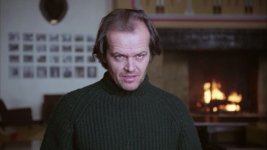
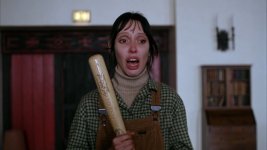
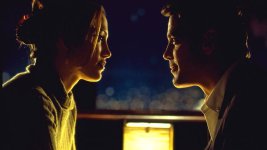
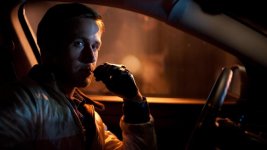
I know that not all cinematographers and colorists agree, but I am of the opinion that in a "yellow" scene there should usually still be something white (or past white, toward blue). Just like a night scene needs something, however small, to be exposed near 100%, to feel properly exposed.

e.g. If your lights are all 3200k, and your camera is set to 3200k, it can look unnatural and like a soap opera. If your lights are all 3200k and your camera is set to 4500k, it can look like a mistake. If 90% of your lights are 3200k, the rest are 4500k+, and your camera is set 3200k-4500k, the color will feel most like a conscious artistic choice. Your mileage may vary. Of course the color of what's in the scene will have at least as big an impact, and single-source scenes are an exception.
John Alcott totally does this (but backwards) in The Shining. He gives skintones a pallid look but then uses something in the scene to "anchor" the color, so it doesn't seem like the print is bad.
shining-main.jpg
mv5bytm5mthmmwytztm5nc00ytdkltlknjktnddjmtjim2jknzk3xkeyxkfqcgdeqxvymdu5ndcxnw._v1_.jpg
In modern films with colorists, it's possible to get much more aggressive with the technique, basically widening the spread between what's yellow and what's blue (or turning up the saturation). It works at any brightness, as long as you have something on either side of the camera's color temp. Stills from Out of Sight and Drive.
out-of-sight.jpg
drive_2011_6.jpg
 
John Alcott totally does this (but backwards) in The Shining. He gives skintones a pallid look but then uses something in the scene to "anchor" the color, so it doesn't seem like the print is bad.

It is really impressive in the historical timeline when The Shining was shot (late 70's) to see what a naturalistic look Alcott delivered in this film. Few realize that the hotel was entirely constructed on stage, with those tall windows in the great room lit by a huge bank of photofloods (either dichroic or gelled to daylight, I forgot which).
 
I'd like to thank all of the great input I got on this thread. I just finished shooting this. Here are a few stills with just a regular normalizing rec709 LUT

798853ef974839b75361326030f64ec5.jpg

806f98deaa6a685c0efcd47b288bde5a.jpg

3e4ffc902e3699fd70ec1148608bafba.jpg

9add30cc2e2de8d90c2f5d7ccb1b90e0.jpg

f2c2a914d80708da946f71ac56d32b85.jpg

82608e2d1ec396daeed044debd2f6662.jpg
 
Last edited:
Back
Top