Lighting Problems... Picture very Orange...

Spops

Member
Hi Everyone,

We just started to film our independent feature film the past weekend. We have a very very low budget. Here is what we are using to film with first of all:

Panasonic DVX100B
Letus 35mm Extreme Adapter
35mm Lens
50mm Lens
Other lens sizes if/when we can find them for cheap enough

For lighting we are mostly using work lights from home depot / lowes. We have heard / read that it is what most people are using. We have tried to diffuse the light with wax paper or gels but can not seem to get the lighting to look right. Whatever we do the scene's always have a very orange overtone. Skin color does not look natural by any scope of the imagination.

Does anyone know how we can try to correct this? I need to find some answers before out next shoot date that is this Saturday.

Also on a side note... What is the best thing to use to light up outdoor areas?

Thanks in advance, any / all help is appreciated. Just remember that with our very small budget we can not afford anything that is overly expensive.

Often, wax paper creates a yellow cast on lights. Also, I wouldn't suggest using wax paper on worklights for diffusing them. #1 it can be flamable #2 even with two sheets of wax paper you get very little diffusion of the shadows. The yellow cast should be able to be fixed by custom white balancing with the camera as long as you aren't mixing color temperatures. (work light vs work light w/wax paper will be different color temperatures). It's usually best to white balance to the key unless your looking for a specific mood that calls for otherwise.

Honestly if you can just go and get some cheap Britek lights, they aren't as bad as what people say and will save you a lot of pain. If not though, get some black wrap and frost/diffusion gels for those work lights.

Your best bet for lighting outdoors is to you use the sun. Pick up some bounce boards and cutters. (foam core black + white) It's also good to have one of those 5-in-1 reflectors that has a diffuser in the middle.
 
Thanks...

I looked up the Britek lights but they are 200-500 dollars a light. This film is very low budget and all of the money is basically coming out of our pockets. My savings account has been drained between the camera (over 4k when I purchased it) that is being paid off on my credit card still, and the 2k for the Letus 35mm extreme that was just purchased. So unfortunately I am looking for very cheap lighting equipment / tricks that will give us a decent effect in the end.

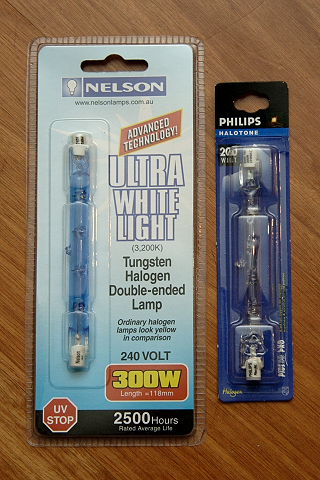
I was reading [url="http://www.shuttertalk.com/articles/diylighting]this article[/url] and it shows this:

image005.jpg


Do you think replacing the work light bulbs with something like that would help? I'm not even sure if I can find it because the article says it is from Australia. I was going to go and look at Home Depot / Lowes but figure that I would post here first.

Should we also try some flourescent fixtures? I have heard that some people say that flourescent flickers to much and the camera will really pick it up. Any truth to that?

Thanks in advance. I really appreciate the help... You have no idea.
 
Yes, consumer flourescents will often show flicker. I have used them for light in small nooks before (cars, small rooms, etc) but never as a key or even fill, just as accents.

I've not seen those ultra-white lamps before. Check the websites of the stores or just call if you don't want to make the trip.

Diffusion sheets aren't expensive. Invest in some. And don't leave them on your work lights for very long at all... they will burn.

Salils has some good points about white balance and using the sun with bounce cards outside.
 
Thanks...

I looked up the Britek lights but they are 200-500 dollars a light. This film is very low budget and all of the money is basically coming out of our pockets. My savings account has been drained between the camera (over 4k when I purchased it) that is being paid off on my credit card still, and the 2k for the Letus 35mm extreme that was just purchased. So unfortunately I am looking for very cheap lighting equipment / tricks that will give us a decent effect in the end.

I was reading [url="http://www.shuttertalk.com/articles/diylighting]this article[/url] and it shows this:

image005.jpg


Do you think replacing the work light bulbs with something like that would help? I'm not even sure if I can find it because the article says it is from Australia. I was going to go and look at Home Depot / Lowes but figure that I would post here first.

Should we also try some flourescent fixtures? I have heard that some people say that flourescent flickers to much and the camera will really pick it up. Any truth to that?

Thanks in advance. I really appreciate the help... You have no idea.

The Nelson bulb look like it's 3200k, this is good if you're mixing with other 3200k sources, other wise it's not very useful when shooting video since you can white balance.

I'm not sure where you were looking, but Rostroncis has lots of Britek lights for under $100. You can get a focusable 300w w/barndoors and stand for around $100:
http://rostronics.com/index.php?main_page=index&cPath=29_1
You can also check out their flood lights which are a bit cheaper.

Fluorescent lights meant for video don't flicker, and a lot of the new ones not meant for video don't flicker. (meaning not enough for the camera to capture the flicker) I wouldn't go with fluorescent lights because your on such a tight budget unless you wanted to do something like Walter Graff does for interviews using Home Depot fluorescent lights (they look very soft, but aren't very powerful):
http://www.bluesky-web.com/broadcastvideoexamples-30bucks.html

Just a last tip, try to accent your existing light if there's enough, don't over light especially since the lights you are working with are difficult to control.
 
Last edited:
I'm not sure where you were looking, but Rostroncis has lots of Britek lights for under $100. You can get a focusable 300w w/barndoors and stand for around $100:
http://rostronics.com/index.php?main_page=index&cPath=29_1
You can also check out their flood lights which are a bit cheaper.

Those do not look all that bad price wise. Which would you recommend that we get? They all look like they are Halogen also, will we still have a problem with to much Yellow / Orange colors?

Also what is the best technique to white balance a room? Or maybe I should say what is the proper way to white balance a room? Do you do the white balance with all of your lighting setup? or do you do it before you set up your lighting?

Sorry for all of the questions, I am very very new to all of this. My brother is making the film, but I am the one who is doing all of the research for everything.
 
Sorry to say this, but it looks like your priority is just off. Having an expensive camera and 35mm adapter and not budgeting for a decent light kit to work with is a recipe for disaster. Most people simple aren't using Home Depot lights; I have two that I bought a while back, never used them and now I'm ready to throw them out. There's just no way to get decent results with them as they are not focusable, the light beam cannot be shaped and they're often the wrong color temperature.

The reason skintone looks orange is because those lights are around 2800K so it's very yellow. Manually white balancing will turn the light white. But I would seriously suggest that you find a way to get your hands on real lights, even Briteks (I have a few and they're not bad in a pinch). If you're serious about making a film (a feature no less) good lighting should be priority #1 and not so much short DOF.
 
The reason skintone looks orange is because those lights are around 2800K so it's very yellow. Manually white balancing will turn the light white. But I would seriously suggest that you find a way to get your hands on real lights, even Briteks (I have a few and they're not bad in a pinch). If you're serious about making a film (a feature no less) good lighting should be priority #1 and not so much short DOF.

I completely understand what you are saying. Unfortunately, the decision to purchase the letus 35 extreme was not mine. This movie is my brothers baby, and I think that he really got talked into purchasing that piece of equipment. A few people told him that he NEEDED it to really give the movie a "Film" look. Personally I think it was a waste to get it because he is very limited with it right now. He can not afford a broad range of lenses so he is trying to film everything with a 35mm and 50mm lens. I think he would of been much better off just using his DVX100B and picking up some nice lights.

Unfortunately what is done is done. We just need to look to the future and do the best that we can. With that said...

I could really use some recommendations on new "CHEAP" lighting that would do the trick. I am open to all suggestions... Please point me in the direction for specific pieces of lighting.

As I said in the past, any and all help is appreciated.

Thanks.
 
I'm not sure what style you're looking to create for the film, but picking up some china balls would be a great, cost-effective way to create some soft light. At very least you could use it for fill.

Additionally it's not just the lights you have but how you shape it. Buying a roll of cinefoil is cheap and can help a lot, also buying some white/black foamcore from your local Fred Meyer (Walmart, whatever) can serve as bounce/flags in a pinch. I'm not sure exactly how you'd attach them without stands (maybe Hollywood it if you have the manpower), but picking up a roll of gaff tape might come in handy.


Overall though the most valuable tool will be your brain. When you approach a scene figure out how you can use the available light to your advantage and work to supplement that. Also something that's forgotten quite a lot is to consider the art direction. The way a set is dressed and the way you dress your talent can help hide your lack of gear (by breaking up ugly flat backgrounds, helping to create separation, avoid black on black shots, etc) and make your film look a lot more professional.

Good luck!
 
Those do not look all that bad price wise. Which would you recommend that we get? They all look like they are Halogen also, will we still have a problem with to much Yellow / Orange colors?

Also what is the best technique to white balance a room? Or maybe I should say what is the proper way to white balance a room? Do you do the white balance with all of your lighting setup? or do you do it before you set up your lighting?

Sorry for all of the questions, I am very very new to all of this. My brother is making the film, but I am the one who is doing all of the research for everything.

Try to get a variety of fixture wattages. I would get atleast 650w for the light you would often use for the key. Then get a small light (150/300w) for backlight/kicker and another 2 fixtures for fill and background. (I'd recommend 300-650w) That's the basic fixture wattages that I use. Oh, and get a soft box or some really tough diffusion unless you are going for super hard shadows.
 
Ok, let's start over...

I just had a long conversation with my brother about lighitng. I made him read this thread and than we talked about everything. We did a little research about Britek, and the general concensous is that they are more trouble than they are worth. At this point we really have no budget for lighting. I know that is a really bad thing because it could make or break this movie. So me and him are going to take $250 out of our savings to go towards lighting. That will give us $500 to play with to get some decent pieces.

Can you point me in the right direction as to specific pieces that we should pick up. I really know nothing about lighting companies, and am unsure which pieces of lighting to pick up. Are there some decently priced kits that come with stands and a few good pieces?

I really do need all the help that I can get. I am sure that I am one of the more "Needy" posters on here. I do apologize for that but this is all new to me. We tried to find a Gaffer to help us out but they all wanted $300 - $500 a day. So we are stuck doing it all our selfs and trying to figure everything out.

Thanks again in advance for any / all help
 
Try to get a variety of fixture wattages. I would get atleast 650w for the light you would often use for the key. Then get a small light (150/300w) for backlight/kicker and another 2 fixtures for fill and background. (I'd recommend 300-650w) That's the basic fixture wattages that I use. Oh, and get a soft box or some really tough diffusion unless you are going for super hard shadows.

I find that usually having that many lights does more harm than good. Simplicity is key!

Just get a 1k softbox and maybe a bunch of china balls, bounce card, and some high wattage fixtures to put in practicals. I would like to see you try and overlight something with that light kit.

Eek. Then again. You do have a letus extreme...ughhh. I usually use a 2k zip light and that works good. A 1k softbox is sorta pushing your luck exposure wise.

Arri makes good, albeit expensive, stuff. You can probably find the 1k softbox to be in your price range, and the china balls, bounce cards, and high wattage fixtures can all be found at ikea/home depot/art stores.
 
Spops,

Congrats to you and your brother on what you're about to do. I think you'll find that this is one of the hardest (and coolest, and most fun) things you'll ever do.

It's good that you realize that the (mostly very good) advice you're getting here is given with the best intentions. No one is placating you with easy answers, but at the same time no one is trying to bust your balls or make your film more difficult out of spite or cruelty. We sincerely want to help, and you seem to recognize that.

I'm not going to go into what the $2k that letus cost could have gotten you instead. You've already acknowledged that it's a missed opportunity and what's done is done.

I am, however, going to try to honestly advise you on what I feel is going to help you guys out the most.

The bottom line, and I think you'll understand this, is that at the moment you guys are unprepared to make a feature. It's not that you're not capable of it, but that you haven't done the preparation necessary to accomplish the task. We all kind of started this way - get a camera and try to jump right in only to realize there's a whole mess of stuff we didn't know.

The only remedy to that is to stop, research, and learn.

There is only one way to make a good movie without really knowing what you're doing, and that's money. If you can afford to spend your way out of any problem, you never really have any problems. However, for those of us who don't have that money, the only alternatives are time, knowledge, and preparation.

I could help you spend that $500 on lights that may or may not get you what you need, but then what are you going to do about sound?

There are other things you guys will absolutely HAVE to spend money on, but, with a little preparation and knowledge, there are lots of things that the big budget Hollywood films pay for that you won't.

My honest advice, for you and your brother to make the best movie you can for as little money as possible, is this:

Put the production on hold for six months. I know, that sucks, but it's necessary. During those six months, do the following three things:

1) Spend that time devoting every spare moment to learning everything you can about making a movie. About lights, sound recording, camera angles, direction, blocking, pacing, editing, and all the other gazillion things that go into making a film.

The first thing you should buy before another single piece of gear is this book. There are literally hundreds of great books you can learn from, but if you only get one, get that one. Make sure it's the 2008 edition. Used copies are cheap, so buy it, and read it. Then re-read it, til you and your brother know it inside and out. Put it in the bathroom and flip to a random chapter whenever you're in there. That book will give you the basic technical foundation necessary to use the equipment you're spending thousands of dollars on.

Also read online. I highly recommend JR Hudson's cineobscura blog for learning how to think about how you shoot your movie; you can find the link in his signature a couple replies above mine. Read lighting tutorials and sound recording tutorials and anything else you can. Go to Youtube and look up the video tutorials from Videomaker magazine and DigitalJuice TV.

2) While you're doing that, put time into getting your film ready for production. Polish your script until it gleams like a razor, and storyboard each shot (even if it's stick figures) so you know what you need to do BEFORE you get to the set. It's your first day of filming... what pages of the script are you going to shoot? Where are you going to shoot it? How are you going to shoot it? What do you need (props, lighting, etc) to shoot it? Who do you you need (cast, crew) to shoot it? When does shooting start, when is lunch, when are you done?

Knowing exactly what and how you're going to shoot before you turn the camera on is the absolute best way to get great results and not waste your or anyone else's time.

Six months is a lot to ask. However, in that time you can get a good idea of how to really make a movie, and better yet, how you plan to make YOUR movie. Justin Evans spent 10 months preparing to shoot A Lonely Place for Dying, and he's an experienced indie filmmaker.

3) So, what about the original question? What about your lighting? Well, here's the best part... when you really know what you'er doing, you know exactly what you need. That $500 you have will have grown to include an extra six months of savings and you'll have the money you need to get the job done (bare bones done, but at least done!). And the knowledge and preparation will keep you from spending money on stuff you don't actually need or that won't actually work (like the work lights).

Making movies doesn't have to cost a ton of money, but like I said, if you don't have money the ONLY trade off is time, knowledge, and preparation. Six months from now, having that knowledge and preparation is the best way to save money on gear. It let's you get the most out of your budget by effectively using the tips and tricks for low-budget film making on sites like this one, which is all about putting together low cost lighting kits.

Bottom line is this; you're putting a lot of your effort and money into this, why would you not try to prepare yourselves to do it the best that you can?

Your choice (yours and your brother's) is this: either take the link to Scott Spears' site I just gave you, buy some cheap lights, and go make a movie that won't be as good as it could have been, or take the six months and be much more knowledgable and prepared filmmakers.

Either way, I wish you the best of adventures.

Sincerely,

-Jeff
 
Jeff thank you very much for informative post. Unfortunately stopping production of the movie is not an option for my brother. He has an excellent cast of actors, and has many locations secured (mansion, club's, Parking garage, etc...). If he were to stop he would loose all of that and have to start from square one.

So instead of loosing everything, we both think that it is best that we learn everything about lighting as quickly as possible. Get a few decent lights that are within our budget of $500 and get on with the show :)

My brother does know what he is doing, he went to school for video production and film. We just thought that we could use the work lights, because we are on a budget, and have seen / heard many people were using them.

So back to the question at hand....

With a $500 budget for lighting can someone help us find specific pieces that we "Should" and "Need" to get to make this movie work?

Thanks
 
I understand. If that's the case, I'm wondering what you're doing to record sound for the movie? That answer will determine what I recommend for spending out of your budget for lighting.

-Jeff
 
Jeff thank you very much for informative post. Unfortunately stopping production of the movie is not an option for my brother. He has an excellent cast of actors, and has many locations secured (mansion, club's, Parking garage, etc...). If he were to stop he would loose all of that and have to start from square one.

So instead of loosing everything, we both think that it is best that we learn everything about lighting as quickly as possible. Get a few decent lights that are within our budget of $500 and get on with the show :)

My brother does know what he is doing, he went to school for video production and film. We just thought that we could use the work lights, because we are on a budget, and have seen / heard many people were using them.

So back to the question at hand....

With a $500 budget for lighting can someone help us find specific pieces that we "Should" and "Need" to get to make this movie work?

Thanks

What kind of look are you going for generally through out the film?
 
As far as I understand your initial question, it seems like you're trying to mix the worklights with daylight, right? Because if you're only using worklights, it's not a problem to white balance them without getting extremely yellow/orange colors.

If you are mixing daylight and tungsten fixtures, you will always have an either blue or orange cast in your shots, there are only two options to get rid of that:

1. gel the lamps with ctb gel to the same color temperature as the daylight (usually a 3/4 ctb will be good, even 1/2 ctb will do sometimes - you have to try that on location)

Pros: you only need gels for your lamps, you can also use the lamps outdoors as fills.
Cons: the ctb reduces the light output of your lamps, so they are even weaker compared to the daylight.

2. gel the daylight with cto to make it the same color as your lamps.

Pros: You can use your lamps un-gelled, no loss of light output.
Cons: You need huge pieces of gel to cover all the windows. If you're outside with daylight all around, this is not possible at all.
 
Back
Top