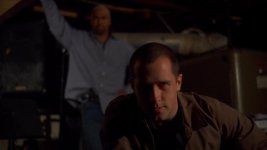
Lighting for exposure

Trust me, I'm far, far from being accomplished in the art of lighting, but one thing I've noticed here is that some (not all) of the trailers/grabs posted seem to be rather flatly lit. It's as though the scene has been lit solely for exposure, rather than for a desired dramatic effect. I'm guess i'm speaking more particularly about the horror genre, where I feel darkness and light are very important elements of an image. Somtimes, I've noticed an entire room/location has been flood lit, when I feel the scene would have benifitted greatly from simply lighting the character and very little/nothing else.

Of course, I'm speaking generally here, and not singling out any particular person/production.

Has anyone else noticed this, or am I alone?
 
Last edited:
Lighting can be flat or dimensional, it depends on how the DP/Director wish the images to effect the audience. With that said, sometimes DP/Directors fail to achieve what they want, because lighting is a skill, and some don't have it or they don't have enough experience.

I guess I agree with you, and must simply say that not everyone can be awesome at it! :)
 
.
There are three things lighting has to do. It has to provide for sufficient illumination to record the image on film. It has to make up for the difference in contrast between our eye and the film. It has to enhance the illusion of third dimension in a two dimensional medium... Ok. Well that is what it has to do. What it can do…
-Bill Dill, ASC (From Cinematographer's Style)
The way the older cameramen worked was first they’d get a long shot of the set, showing a character entering and walking over to a desk, say. Then they’d move in to a closer shot. To avoid the lighting being too symmetrical they might use a couple of arcs on one side, and three on the other. That was all. Otherwise the image was absolutely flat, just a flood of light. There was no attempt at artistry. There were some cameramen who used to keep a book, and they’d note down the lighting they’d used – how many arcs, how many feet away from the actors- so when they got to the next set they could refer to the book and do the same. You couldn’t really call it lighting, it was just illumination.
- Freddie Young, BSC. From “Seventy Light Years; A Life in the Movies”
 
Lighting is my thing, having lived and breathed it as a still shooter for 18+ years.
If audio is the king of motion pictures, then lighting (of the visuals) is the queen! In stills, lighting is queen, right after composition.
Every visual concept is an opportunity for a creative brief from the AD & CD.
Lighting is heavily discussed and massaged throughout a project.
Flat light is beautiful and since composition is primary, a properly composed flat shot should still work. But the language of light begins to take shape when light changes, as it does in nature, from flat to dramatic, from high key to low key. From cool hues with warm accents to warm hues with cool accents and so on. Lighting type underscores the principal intent of the creative director's objective in a shot.
So my rule is outline the objective and then list the mood characteristics that I wish to convey through composition and lighting.
One obvious reason for the flat light genre in recent DSLR shoots is the fact that it removes the need for complex lighting in the first place and then, even more complex lighting changes in the second place. Further, digital photography and motion pictures have benefited from the increased scale or range afforded by flat lighting. It allows you to capture full highlight detail AND shadow detail as well. Then, in theory, you could change gamma, contrast and brightness in post to ADD drama. The reverse is NOT possible.
What surprises me is that too few enthusiasts have been watching modern films or TVC's and not enough have studied the 'classics' - that are excellent lessons in the language of light.
From an artistic standpoint- fluency in lighting types is key to command of the scene and intent.
 
Is AUDIO king of motion pictures?! I'll leave this question be before I argue.

Poor audio will ruin a film (and an audience's ability/willingness to engage with it) faster than poor image quality will. Of course it's nice when you have great artistry behind both :)
 
Poor audio will ruin a film (and an audience's ability/willingness to engage with it) faster than poor image quality will. Of course it's nice when you have great artistry behind both :)

You ever hear of "Silent Films"? Yeah. You ever hear of "Pictureless Films."? No. Of course not. It's called radio.
 
Trust me, I'm far, far from being accomplished in the art of lighting, but one thing I've noticed here is that some (not all) of the trailers/grabs posted seem to be rather flatly lit.


What I see a lot of, is 'natural' lighting, or if artificial, essentially 'practical' lit scenes. I have attributed this more often than not to 2 reasons, 1) the filmmaker doesn't have enough money, and so, can't acquire the lighting that would give a more dramatic look, and 2) whether lighting was available or not, doesn't know how to 'light' for 'film'.

For me, since I'm in the no budget category, I would have to look for locations with 'natural' light, but with cheap items like bounce cards, and screens, even out the lighting, while still maintaining visual depth in the image... (I might also be able to afford ND gels for windows to cut daylight to match interiors...)

Oh, and by the way, I'm also tending to think about only presenting my 'serious' efforts in monochrome, so that I won't have to worry so much about color balance... another area that I see 'some work needed' in some of the short films that people post.
 
This was unintentional because we had a light switch go out just as we were about to record but it turned out pretty dramatic so we kept it. I guess thats a good lesson. Light for Effect as well as exposure.
 

Attachments

  • fd1.jpg
    fd1.jpg
    27 KB · Views: 0
You ever hear of "Silent Films"? Yeah. You ever hear of "Pictureless Films."? No. Of course not. It's called radio.

Silent films are a completely different medium than what we're talking about here, which is sync-sound narrative filmmaking for the most part.

And yes, there are some pictureless films. Branca de neve by João César Monteiro, for instance. Or Derek Jarman's Blue, arguably.

You guys know it all, though - so go ahead and try shooting something that looks great and accompany that with poorly recorded audio (clipped, distorted, lines of dialogue not discernible, etc). I'm sure the audience will let it slide because the shallow DOF is so pretty.
 
To the OP.... yeah, there is a lot of posted images that are, lit flat and over lit. I don't want to dis anybody, but I believe that this is mostly due to inexperience with lighting. IMHO, the absolutely essential element to lighting for dramatic effect is the understanding how your camera, or film stock of choice processes light. You have to know at what level something is overexposed and peaks on a digital senor and you need to know at what level something is underexposed and looks like useless mud. Once you have an eye for how your camera "Thinks", you can adjust your lights for the dramatic effect you want.
 
Back
Top