How would you light a character that stands very close to a wall? Would you use soft light only to eliminate the shadow that ends up on the wall no matter what you do? Or would you reposition the blocking so that it's not right up against a wall? Or are there any other options?

Navigation
Install the app
How to install the app on iOS
Follow along with the video below to see how to install our site as a web app on your home screen.
Note: This feature may not be available in some browsers.
More options
You are using an out of date browser. It may not display this or other websites correctly.
You should upgrade or use an alternative browser.
You should upgrade or use an alternative browser.
Lighting an actor in front of a wall
- Thread starter morisato
- Start date

MalcolmOng
Veteran
Maybe you could light how you want, then use a fill light for the wall behind, so that the shadow is eliminated. Either that or shine a strong light against the wall that'll bounce off and act as a backlight as well for the actor....

filmat11
Well-known member
Soft light will diminish the shadow, however, you have to ask yourself if it's necessary to remove it in the first place. Could it be sunlight from a window, what to you have planned for the actor to communicate as far as the mood is concerned? Is the shadow appropriate ,is it unwanted, ?
Moving the actor further from the wall will certainly create less of a problem. Light type and its position is important..
Moving the actor further from the wall will certainly create less of a problem. Light type and its position is important..


taubkin
Veteran
No way to take away the shadow, if the character is VERY CLOSE to the wall, as you said. You can try lighting your guy sideways, so the shadow gets further from him, but gets hard to flag the wall so you don't stain it with your beam.
A high top light will help getting the shadow lower, and directly behind your subject, but sometimes toplighting can make some weird shadows on your actors. Still it worked quite well in "lost in translation".
The only thing I think is actually ugly, is when you shoot someone aggainst a wall, and you can't separate the shadow from the actor. Like a dark halo around the poor guy's/girl's face. But if you manage to get your actor one step or more from the wall, and close your lens a little so it feels as if if he's closer, it can be accomplished easily...
ChillaVision
Member
Having absolutely no experience whatsoever, but having viewed a video about lighting and read a few articles, I'd like to make a fool of myself and try to take a stab at answering this question. People who really know can correct me and give you better info. and we can both learn.
Since your actor will be right next to a wall there will be a shadow. From the context of the scene should this could be a hard shadow or a soft shadow. The shadow itself might be used for dramatic effect. Assuming, however, that you want to minimize the shadow and not call attention to it, you will want to create a very soft shadow. This can be done with a softbox, using an "eggcrate" so that the light can be focused towards the actor without a lot of light spilling back onto the wall. Using a softbox of some sort should help to lessen the harshness of the shardow.
The real problem as I see it, from a theoretical point of view, is how to keep the actor from just being a flat image and blending into the wall. You need to give the actor some three demensional depth and seperate him, to the extent possible, from the wall. By lighting from the side and using reflective light back from the opposite site you can give your actor that 3D look. I think the real trick will be pulling the actor out from the wall. This means backlighting, even though the actor is right next to the wall.
A highlight on the hair and shoulder will serve to separate the actor from the wall. Getting that highlight may mean using a small "kicker" or two pushed right us against the wall with a narrow snoot or carefully adjusted doors. Not much light is needed, only enough to to create a bit of an outline that will effectively separate the actor from the wall and thus create a bit of depth where there really isn't any.
Also, I think it might be more visually appealling to shoot from a bit of an angle to create a little perspestive rather than dead on against a flat wall.
(LOL... I almost sound like I know what I'm talking about. Please remember to consider the source.)
Soft lights and very tall lights are nice as are ones very far to the side. If your key light is soft and directly facing the same way as the camera you can hide the shadow behind the subject or minimize it at least. Zooming in further makes the wall look closer so you can cheat a bit.
Rule of thumb: one shadow (or no shadows) on the wall will look good; two or more will get distracting and "unprofessional." I like to have my key light cast a shadow and nothing else. If I have to use multiple shadows, I like to keep them far apart and from distinct motivated sources.
Rule of thumb: one shadow (or no shadows) on the wall will look good; two or more will get distracting and "unprofessional." I like to have my key light cast a shadow and nothing else. If I have to use multiple shadows, I like to keep them far apart and from distinct motivated sources.

Justin Kuhn
Veteran
Knowing absolutely nothing about your situation other than "subject stands against a wall" I can only tell you what I would do. Assuming we're starting with pitch black, I'd put one instrument on the side, as a kicker. That's it. From there, play with the instrument; is the source level with the subject's head, as if from an artificial source? Is it higher than the subject's head? Is it unfocused like a streetlight, or is it focused like a spotlight? Both could look very cool. I'd probably end up shooting for a streetlight that's suggestive of a spotlight, with as distinct a shadow as possible stretching away down the wall. Could be cool. Might want to play with the camera's relationship to the subject--instead of a 180 degree angle, perhaps more of a 120, letting that shadow add some dimension to the shot--and then consider low and high angles. But of course angles are something you should get more than one of, so get that 180 too. But, again, that's just me.
Why, yes, I did love Sin Cty. However did you guess?
Why, yes, I did love Sin Cty. However did you guess?
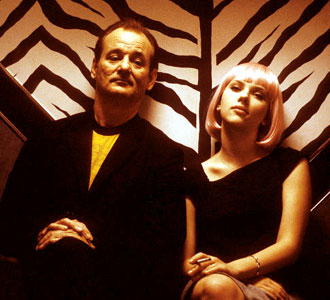

dustino
Well-known member
Notice how Scarlett J. gets washed in a flattering light from the side that smooths out her porcelein skin while crusty Bill Murray gets a much smaller light from directly above. That's good art direction! (emphasizing the beauty in a scene while de-emphasizing the "mundane")
EDIT: Also emphasizes the difference in their ages/experience which I'm sure was intended by the director
EDIT: Also emphasizes the difference in their ages/experience which I'm sure was intended by the director
Last edited:

I think you will find both are lit from above in that scene but on a varied angle. But does bring up a good point that you need to consider. What looks natural?
Justin Kuhn
Veteran
I've always thought it was better to light for effect than realism, because it's going to look unnatural no matter what you do--your camera is not the human eye, after all.