Lighting advice?

gaddster

Active member
Hi All

I have just finished several online tutorials on lighting.. Was astounded at the amount of situations where i could film better. All I have used so far is an 'on-camera LED Light'

As I work alone, I wondered if there was a 'starting setup' you could recommend to do some basic 3 point lighting e.g.:reflectors (soft and hard), backdrop system (for doing some promo interviews I have been asked to complete), led lights (aputure led lights), soft boxes etc

Not sure what I need but would like to make a positive start. :undecided
 
What kind of work do you find yourself doing? Is it a mix of a lot of different types of productions?
 
Hi

Its a mix bag at present, got some interview/Business Promo work coming up, corporate conference, weddings etc.. Really its for the interview and 'product promotion' work I am looking for
 
I would start by picking up a 4 x 55w Biax Fluorescent light with both 3200K & 5600K tubes, transport case for extra tubes, eggcrate grid, 1/8 minus green gel, opal Frost gel, light stand, 25' stinger, handful of C-47s, roll of gaff tape.
 
I'm firmly of the opinion that you should NEVER buy lights until you actually need them, because 3 point lighting is a useful technique that has a decent success rate - BUT - every project you work on will be different - so you'll need different intensity levels, different beam widths, let alone the combinations of hard, Fresnel and soft light. When I first started in the 80s, I bought a red head kit. I thought it was great until one day I used a Fresnel instead of one of them, and liked it better, then I tried a real soft light and liked that better than a redhead and diffuser. Then I had a job that needed more oomph, so an HMI came in, then another job where physically space was tight and I went back to the red heads!

If I had to pick the most useful light source I have - it's 1K Fresnels. Mainly because I often work slightly bigger spaces, and the 650W does;t quite cut it. My least used piece of kit is a rubbish compact flu fitted pair of soft boxes, bought to light a green screen. Horrible colour rendition, and far, far too dim. My favourite one, is an old Mole Fresnel - huge big lens, and lovely light - and a nice pneumatic stand.

I would not spend any substantial sum until you get the first job where you need proper lighting, and then buy the most appropriate kit. I have far too much equipment bought because I expected to use it, but didn't.
 
Thanks Paulears/David

Yes i agree completely that in a short time I am buying equipment 'I Think' I need but actually haven't used yet.. However I said this year i would upgrade my audio (wired Lavalier to Senneheiser wireless) and some LED lighting etc.. But because I work on my own it needs to be compact and affordable.

I like the look of the 1k Fresnell, do they produce a lot of heat? Do I need special stands and fittings etc?
 
I will tell you what works a majority of the time as lighting plan/setup in interview situations like you've described, in the most general terms, and hopefully it'll guide you as to what to consider buying:

If you're not trying to reinvent the wheel, typically in an interview/talking head shot, you will key (primary light source on the face/subject ) with a larger soft source (2x3' is a good size to start with). To keep the unlit side of the subject from going too dark, you will use a flll light, which doesn't have to be a light at all. I often do this with a 42"silver reflector, which bounces the key light back onto the dark side of the subject's face. If you want the key/fill ratio really flat, might need to bounce a separate light into that reflector, a lower wattage (150, 300) Fresnel will usually do, also another softbox will work.

Most folks will usually use a hair or edge light from behind and off to the side to give the subject a rim of light. A Fresnel with diffusion will work here, as will yet another soft box or similar large soft source.

Lastly you will generally want to throw at least one light on the background. A Fresnel with a pattern on it or with the barn doors used to make a shape is pretty common, sometimes with a colored gel.

That's the minimum I would recommend, but as your lighting knowledge grows and your tastes evolve you can make those relatively simple setups as complex as you want or as much as you have time/room for, or what the client allows. To reiterate: large soft source for key, reflector for fill, a low watt Fresnel for an edge/hair light, and a higher wattage (650s are good) Fresnel for background is a very common setup.

Tungsten/hot lights currently, according to most people, give the best color rendition and PER LIGHT are the most affordable when you're talking about the really nice stuff (Arri kit). Drawbacks are power draw and that they put out tremendous heat, especially in small offices and conference rooms that are typical of many corporate shoots.

Florescent lights are the next best for color, output little heat and draw far less power compared to their output, but are hellaciously expensive for quality lights.

LEDs right now have the worst color of the three types, are also very expensive for the quality units, but can be very fast to set up, run off batts, generate little to no heat or power draw, can switch between color temperatures and dim on some higher end units.
 
Thanks Josh, thats really really informative..

Funnily enough I have 14 LED up lighters (americandj megapanels) I use in my other Job but they are useless for this kind of work (RGB mixing).

I had seen this on ebay (from china) but looks too cheap to be decent plus it doesn't give me the variety of which you have advised
 
I've been thinking about this lately. . .

With gear, there are certain things that have a fairly short shelf life, that is, they become outdated/obsolete and need to pay for themselves fairly quickly because of that to be profitable purchases.

On the other hand, there is gear that, eve when new technology comes out that may be bettexcer, the older gear is NOT obsolete (except in some extreme cases.

Cams and computers fall into the first category. . .depending on who your clients are/what your needs are, you may find your camera that was top of the line five years ago now has a soft image/poor colors etc. compared to the new stuff, and this could cost you business. Similarly your computer may get to a point where it can't handle some new kind of high end footage or a new codec won't work with the newest OS that computer can use, necessitating that you buy a new one.

However, lighting, audio and support gear like tripods/handheld rigs don't really fall into that category. Yes, technology evolves and LEDs etc. have advantages over tungsten lighting, but those old hot lights will still make great images when used properly (probably better than flos or LEDs).

What I'm getting at is think about the fact that if you buy lighting that seems outrageously expensive but is higher quality than something cheap, you may not have to replace it for a long, long time. When you work with those expensive-ass LEDs or Flos you will forget how much they cost and marvel at the look they produce and how well they're made, and eventually they'll pay for themselves. With cheaper LEDs you may find they look OK but the mount for the light stand sucks, they're hard to adjust, whatever.

Having said all that, my tota light I'd been using with a softbox crapped out, and instead of getting an LED or Kino Diva like I'd been considering (expensive), I pussed out and ultimately went with an arrilite 750 (hot light). I really don't use lights that often and have other things I want to blow big money on right now that are more important (wireless mic, small monitor, an actual CAMCORDER).
 
Ha Josh its so true, a year ago I spent £2500 on a TOTR iMac 27".. never considered thunderbolt storage devices and their expense!.
The wireless audio is a definite for me and at some stage I will need to upgrade my Camera to a better spec model (but I have spent the last year using a Panny AC90 in manual mode before i upgrade). The post editing side is where i am most comfortable (FCPX)

But Lighting (video and film) is relatively new to me yet can make some footage look so much more professional.

Again I have to think of portability so I am going to get some 'reflectors', then decide how much I want to spend on lighting and possibility just build it up gradually with some of the ideas proposed here

I was naive in thinking there was a simple starter solution to buy that would suffice ;-)
 
Well there are complete light kits for sale with all the stuff I mentioned. You just have to decide which is right for you.
 
I would start by picking up a 4 x 55w Biax Fluorescent light with both 3200K & 5600K tubes, transport case for extra tubes, eggcrate grid, 1/8 minus green gel, opal Frost gel, light stand, 25' stinger, handful of C-47s, roll of gaff tape.

Quoted for truth… it really doens't take much. I was out shooting an interview yesterday and used two biax lamps; one for augmented daylight and the other for a bit of edge against the darker background on the opposite side of the keylight.

But the thing that I think stands out in nice looking interviews is what you never think about as the viewer…. that it was styled for the purpose.
I wanted the background wall and the natural light falloff it had, but I didn't want the nasty looking cafe tables in the background, so I removed all of them and got what I wanted. It's not only about lights… it's about setting up the shot completely. And of course the delivery of the interviewed person… short, precise, interesting with passion. Nothing makes me turn off an interview clip faster than an interviewed person who almost seems like they are falling asleep… practice getting them in their best possible form while on camera. (hard skill I find difficult harnessing myself… :/)

If you want a good reference of what works great, check out Errol Morris' docs; IBM Centenial, Known unknowns, etc. He basically uses the same background for all his work, and it just works :)

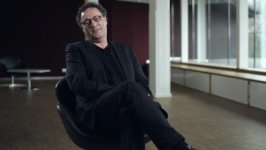
Here's a screengrab from my job yesterday. The area behind him was littered with high chairs and cafe tables. The other end of the room had nice low tables and Swan chairs. So we cleared the cafe area and used the other chairs.
Lighting was two biax lamps with KinoFlo tubes 5500k… looking back, I think I might choose to turn down the rim light a little bit.

Screen Shot 2014-02-28 at 20.39.23.jpg
 
Last edited:
Back
Top