Light meters...

Agreed 100% with post #19, all across the board. That's how it should be done, and if you go to the effort to profile your camera like we used to do with film stocks, then I have no problem with it.

What concerns me is folks who pop up and say "what ISO is such-and-such camera, so I can use my light meter?" To me that's just asking for trouble, and why I say "if that's your approach, just use a calibrated monitor and a waveform monitor". That's why I try to point out to them that the variables involved mean you can't just grab a light meter and say "okay, set the camera to f/2.8" -- just asking for trouble. Not that a light meter is bad, but using one properly with a video camera takes a lot of forethought and preparation, whereas if you just use a calibrated monitor you can see what the camera's doing to the signal, what the gamma curves and contrast/pedestal/knee settings are actually doing to the image, and make on-the-spot adjustments that a bare reading might not have prepared you for.

I have a 508C and have been thinking about going up to the 758DR, just so I can have all the various cameras preprogrammed in. That way I don't have to try to keep the characteristics of all these cameras running around in my head! :)
 
I understand what you're saying here, although I'm not clear on the process's used to calibrate ACTUAL ISO compared to the ISO stated by the manufacturer...

The same sort of uncertainty with that goes with the digital end of things. Like Barry said, is you open up the HVX200 to f/1.6, it's rated at about ISO100, at f/11 ISO800.

How exactly are these rating tested for in that respect? I just feel like the more I understand WHY some piece of equipment do this or that, the better I will become at handling it on location.

I'd have to go to the 'way back machine', but as I recall the official ISO/ASA rating for film was based on what the film response to a given amount of light interms of density above the film base + fog. This density may or may not give a visible difference in the final print, given one's development process, paper used, etc.

So, the process of developing an 'effective' ISO/ASA rating for one's own process was to start with the given ISO/ASA rating, then through a series of exposures, find where the first 'distinguishable' print threshhold was, that set the ISO value to use, and then via changes in developing process, find the last difference in the print from the white print material base. that set the 'standard ISO and developing times'.

With movie film one was more constrained to whatever the lab (who did home lab movie film development???) would produce, but still one could find the effective threshholds for a give process. Even still one could 'under expose' movie film, then ask the lab to push process to get back contrast... and attendent grain.

The analogies to digital video, as far as I can tell, would be the use of 'gain' to 'push', as well as setting various 'gamas', that is the slope of the exposure curve. In any case, the digital analogy to 'grain' is 'noise' in the image. So, I've seen references to 'crushing' the blacks, which seems to me to be changing the gama curve, to reduce 'noise' in those low lit areas.

Since I have not spent years in 'video', and in those applications where I've worked with 'video' sensors, they have not been broadcast applications, the way I think about the sensor response (either tube or CCD arrays), may be quite different from how broadcast people may think about them.

For example, and this wasn't my idea..., in order to get 'square' pixels, the scientists just adjusted the horizontal scan of the camera to make the resulting digitized image, as presented on their displays, 'square'... since these apps were never for broadcast, it really didn't make any difference, other than the calculations for measurement were much simplified and thereby sped up... back in the olden days when such considerations were paramount...
 
Good LORD! A full stop! What were you developing with? I rated my Tri-X and TMAX on the numbers. I usually used Microdol for my stuff, though the school cheaped out and used HC110. Seems like another lifetime ago.

-P

I used Agfa Rodinal, then later HC-110, both in very delute concentrations mostly. The Wife used D-76 1:1 always. When last I was printing, I used a brand called Seagull. The Wife used Ilford, and later Ilford RC polycontrast papers for her wedding work. (The biggest problem there was not so much the RC paper and polyconstast, by then she was using a rental lab, and the guy didn't really maintain the developing machine he had bought... so we got a couple of albums several years later back because the images hadn't been fixed properly...)


Goes to show you... individual differences...
 
Wow this thread is bringing back memories! I am young person who graduated in 2007 from film school and I actually got to shoot on 16mm. So I know the importance of a light meter for film but I never thought to use one for video.

I also used Ilford paper for my still photography I really liked the texture of it an they way it rendered blacks. I do miss going to the darkroom while in school and just staying in there for ours developing and printing my pieces. It was quite relaxing and a wonderful escape even while I am tearing my hair out trying to make the perfect print!
 
Wow this thread is bringing back memories! I am young person who graduated in 2007 from film school and I actually got to shoot on 16mm. So I know the importance of a light meter for film but I never thought to use one for video.

Well, that could be part of my 'problem'... I don't think of digital video cameras as 'video'... more like shooting digital reversal film...
 
I shoot on video for the most part (though I have played with film in the past, and I have extensive still film background). I, too, haven't really thought of light metering with video.

However, recently, I've become interested in picking up a meter as a way of bettering my understanding of light values and relationships, contrast, exposure, and so on. I've been using a nice display lately, and I watch my highlights with zebras and just use my eyes in general to find what looks nice, but the footage still never quite looks the same way whenever I bring it into post. It's often lighter or darker than I still supposed. A waveform can help here, but like Perrone mentioned earlier, it can be heavy, bulky, and at times impractical.

I feel like a meter might help me quickly move about a set and establish the appropriate settings so as to save time and feel more confident about the footage in general. I think it would also help me think more actively about light values, to pay closer attention. Add to that it would prepare me for film--the medium I ultimately hope to work on professionally. By learning these things, I'd develop a greater understanding overall of light, methinks.

Or maybe this is all crazy talk. What do you guys think?
 
I think it would also help me think more actively about light values, to pay closer attention. Add to that it would prepare me for film--the medium I ultimately hope to work on professionally.

Or maybe this is all crazy talk. What do you guys think?

For many years I did photojournalism. Then I did headshots. Then I moved to sports photography, and lastly landscape and nature stills. Wen I started doing nature and landscape stills, I bought a tool very few photographers need or use. A bulb release. Until you shoot with a wooden tripod, the mirror on your SLR locked up, and a bulb release, you don't really know what "sharp" is. It looked as good as some of the 6x7 stuff I had done.

I say that to say this... the bulb release slowed me down. I began to be VERY deliberate in my preparation of shots. The framing, the light quality, everything. I see a tool like a meter much the same way. The artist works with brushes and oils, we paint with the meter and the light. You can't paint with a waveform monitor and a vectorscope, any more than an artist can paint with roller. It's a broad tool with a different purpose.

Barry mentioned earlier that the subtlety of a third stop might be lost on video. That may be true. But it's not lost on film, and it may not be lost on something more sophisticated like a RED or a Genisis or Viper. I wish I had more time to craft some of the shots I am doing for this small film, but right now I don't. I'll see if I can't get a still capture from something to give an idea.
 
I offer two examples.

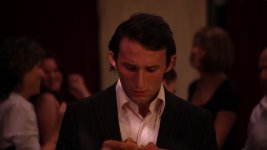
In the first, We see our character dressed to the nines in a nightclub. This was shot on location in a real local nightclub. There are probably a dozen dance floor lights hitting our character in this scene, and three of our own. The object for me, was to get some subtle modeling on his face (about 2/3 of a stop) drop the dancers behind him by a stop to a stop and a half, and not blow out anything! Mission accomplished. By the way, this was lit at T2 so the disco ball would read. When I read the ambient at his position in pre-lighting I got 1.1 FC.

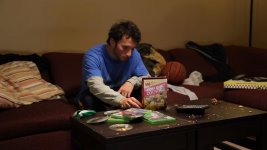
The second picture is of our charachter in his messy, dingy apartment. He completes a transformation later in the movie, so the object was to make this place about as unappealing as possible. My lighting design called for soft toplight, minimal fill, allowing the shadows to drop to nearly nothing, and to keep the highs below 80 ire. His face looks sunken, the shadows are harsh, the light color is sterile... you just don't feel "good" there.

What is remarkable about both these shots is that they are untouched, native footage from the 5Dmk2. Neither has been touched in an editor. And neither is clipped top or bottom. All with no monitor, no histogram, no zebras, and no waveform. I have worked up some looks from them both, but I thought I'd share how they started.
 

Attachments

  • Travis_nightclub1.jpg
    Travis_nightclub1.jpg
    57.8 KB · Views: 0
  • Travis_crappyapt.jpg
    Travis_crappyapt.jpg
    94.8 KB · Views: 0
You've said you verify these tests, but how do you know for sure if the exposure is correct? Is it just eye-work once it's in your computer? If I meter something indoors or outdoors, when am I sure that I've figured out the ASA for sure?
 
Once it's in the computer, I am able to use the waveform to see where the face of the character falls. I can see what the darkest parts of the screen are and how they show up on the waveform. I can see if anything exceeds 100 IRE and if so, by how much.

The idea on set is not to get perfect exposure. It's to get as much latitude as possible without clipping.
 
So what do you do when you have no zebras? And no waveform? Like on the 5Dmk2? For me, this is like a throwback to shooting film. And I rather like it.

I just take a picture, look at the histogram, and then just expose to the right.
 
Back
Top