Letus V2 Rod/Baseplate Pics/Short Review

Tim Naylor

Veteran
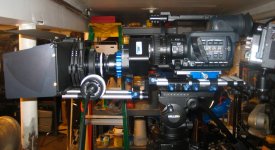
Got the V2 Rods/Baseplate about a month or so ago. Only used with the HVX on its own - no adaptor. Loved the build and the adjustability of it. Finally set it up with an adaptor (Ultimate). I plan to take it to New Orleans for a week long job down there and I figured I'd build it up and get everything tweaked out. Up to this point, I've only used the Ultimate with my Zacuto / Z Riser setup.

So here's the review:

Build:
Very Good. Next to no twist or flex. Well machined. Knobs could be a bit bigger but not a deal buster. All threading works well. Very close to Zacuto quality.

Design:
Excellent. I love the fact that the block that attached to the tripod is separate from the sliding baseplate system that attaches to the camera. This allows considerable for and aft adjustment to get perfect balance. This is critical as different lens swaps often require rebalancing. Between the tripod block and the sliding quick release baseplate, you've got perhaps five inches of travel. Real nice.

The Riser (or Step Down depending whether you go snorkel up or down) is very simple in design and has no flex. It comes with an extender bracket if you need more travel (I didn't). No play whatsoever. One end clamps the rods while the other end, threaded rods screw in. It's compatible with Zacuto threaded rods.

Another nice touch is the raised camera platform is enough to keep my monitor bracket from bumping into the HVX battery.

Adjustability:
Excellent. Adjusting X or Y was as simple as loosening two allen bolts for side to side and two more for up/down. There are additional holes tapped in the block that will allow you to accommodate just about any camera's layout.


Price:
At 700 for Rods, baseplate, and riser it's a good deal. I would recommend additional rod lengths to accomodate long lenses.

Summary: everything about this set up is really well conceived for 35 adaptor set ups but it also works extremely well for just a naked camera. The best feature without a doubt is the separate tripod block from a sliding quick release plate for camera.

Strong recommend.

Tim Naylor - DP
www.timnaylor.com
 

Attachments

  • Letus Rig.jpg
    Letus Rig.jpg
    184.3 KB · Views: 0
Thanks for a great write up!! Great job!

I've been comparing this with the Cinevate rod setup. The main difference is that the Cinevate rods are straight, where as the Letus uses the stepped setup.

On the one hand I like the Letus, because it keeps the camera closer to the pivot point of the tripod.
On the other hand I like the Cinevate because when I'm not shooting with the Ultimate, I can slide the matte box up to the camera lens. But the camera ends up sitting much higher from the pivot point of the tripod.

I'm still undecided on which rods to go with. (Sony EX3, Letus Ultimate, Red Rock microMatte Box)
 
Not sure what threading the rods together gets me. You need to step down or up at some point to align the mattebox/follow focus. One way to achieve this is by raising the camera up (cinevate). Z riser or V2 riser keep the camera low but raise or lower the mattebox (depending whether you're snorkel up or down). The riser essentially keeps the CG of the entire rig lower (and even lower in the snorkel down position) by keeping the camera lower. Low CG is not only makes for better / smoother tilts but also good for hand held. Cinevate has a very clever handheld set up. Has anyone tried it?

re: Mitch

This system works great without an adaptor as well. I can go at least a half inch lower than what you see here. Balancing adjustment is endless. Also, the build on this is truly pro stuff - no flex, all metal. As I intimated before, I'd say it's close to Zacuto quality with some design advantages.
 
Last edited:
I asked Tim on Mitch's behalf to see if he could use this system with his EX-3 and a mattebox standalone without an adapter if he wanted.
 
I forgot to mention, you can also put velcro on the bottom of the block that supports the quick release. Now you can velcro on a knee pad for easy on/off hand held with out having to spend a fortune on some of the overpriced shoulder pads out there.
 
Here's some questions I've got Tim. I'm trying to compare this to the baseplate systems I have from Redrock and Zacuto. This might also help anyone out there trying to decide which system is right for you.

Do you think this system is aimed specifically at tripod use?

I mean how do you do handheld on it? Is velcro pretty much the only option?

In regards to other accessories from Letus, do they have any monitor mounts, power accesorries, grips, shoulderpads, or anything in the works that you might know of?

I know they have foam case inserts for the Letus Ultimate itself, but do they sell foam case inserts for full rig setups?
 
The number one thing I like about this setup is that the tripod mount is seperate from the camera mount. That way you can slide the camera all the way back and still keep it centered on the tripod. I think thats the one big advantage of it over the Zacuto. With the Zacuto, you have to add weights to the rear to counterbalance it. Who wants to add weights? But you can't beat Zacuto's warranty.

One last question Tim.....so you can thread the rods together? (to lengthen them if necessary)
 
I own both the Zacuto and the V2. I set up basically two configurations. Snorkel down if I use an external monitor. That way I can us it to counterbalance. Both the Z and V2 will balance nicely this way. However, if I'm using an EX1, because of the better viewfinder, I can use it without the external monitor. In snorkel down, the Zacuto will be front heavy. The V2 can get closer to being balanced. in Snorkel up, without a monitor in the back the V2 will be able to balance not the Zacuto.

In terms of performance with 35 adaptors they're quite close with the V2 having better fore/aft as well as easier x/y adjustment while the Zacuto has a better quality build plus a lifetime warranty (it's built that good). I find the V2 Riser has a longer extension.

Concerning handheld, I'm not doing ENG work with an adaptor so I don't need it on my shoulder for real long. I'm pretty simple, I use Cavision grips and a kneepad for my shoulder. The grips work well when they're cranked down but the amount of torque to make them safe with weight is a pain. I'll be saving up for Moose Bars. I like the Snorkel down position for hand held for the lower CG.

Letus does not make monitor mounts. I use an old SG pro 15mm bridge plate with 3/8" thread to Arm Bones to Manfrotto Heavy Duty Ball mount. I love this set up. Cheaper than Zacutos and never buckles. You can see it in the pic.
 
I know they have foam case inserts for the Letus Ultimate itself, but do they sell foam case inserts for full rig setups?

Don't know if they have full rig set ups. What I do is I just build the camera fully on the rails and put the whole thing in a long ENG porta brace. All that I have to attach is the monitor and mattebox. Nobody has time to watch you build it from scratch. Also, you don't have to check in an ENG camera soft case at the airport.
 
Thanks again Tim. Great information. Very helpful. (don't know where else I would find this info)

Can you give me the model number (part number) of your Porta Brace Case? Philip Bloom told me that the biggest problem with the EX3 is that the viewfinder makes the rig really wide so it doesn't fit well in most camera cases. (that's my next hurdle)
 
A few words about my Zacuto Design

A few words about my Zacuto Design

The Letus system is a tripod setup and definitely has improvements over their previous tripod setups.​

Our setup is a bit different.
Zacuto designs take into account much more then the tripod. Things like Balance in all configs. Ease of handheld use. Speed to unpack. Future cameras. Damage to camera or other components. Lifetime warranty. Never going into obsolescence and more. The Zacuto system is a total turnkey system for tripod, handheld & traveling via our case. Our package goes into the case fully assembled. That's a huge time saver and it also protects you equipment. There will be X? amount of breakage with every 100 assemblies and disassemblies, that's a given. Keep it as one assembly, it's faster and it protects it your equipment. It could take 30 to 40 minutes to assemble that entire package once disassembled. We build it once and stick it in the case assembled, so time to shoot and at each company move is less then a minute to start shooting. see video

Two other features that are very important. When using a follow focus with a Letus DOF or any other DOF adapter. Since the follow focus is driving a gear on the lens, it tends to twist the DOF adapter from the lens. We incorporate solutions to prevent this:​

1. The Zacuto Z-Riser has two purposes. One to adjust the rods and secondly, the DOF device actually sits on the Z-Riser taking tension off of the plastic threaded HD camera lens. This is a big stress reliever and I wouldn't attempt to transport the system assembled in a case without it.

[SIZE=+0][SIZE=+0]2. When you turn your follow focus it has so much tork that it tends to unscrew the DOF adapter from the lens and rock the DOF adapter back and forth when follow focusing. The Zacuto Locking Lens Support not only gives you a second support for you DOF but it has a strap that wraps around DOF adapter and prevents and twisting or rocking. The image below shows both the DOF adapter resting on the Z-Riser base and the Locking lens support straped on so it can't rock.

[SIZE=+0]
p735220336-2.jpg

[/SIZE]

We mount the Zacuto baseplate to the tripod and let our DoubleMount/Red Plate/Wireless mic plate/battery module act as the counter balance. Both on tripod and handheld.
[/SIZE]It's a simple proposition. If you add more weight to the front of the camera package, you need more weight added to the back or you need to slide the counterbalance farther down the rods. This sliding on the rods gives you quick fine balance adjustment in both tripod and handheld. I also gives you the DC power you need for accessories like monitors, on-board lights, hard drive, wireless receivers, video transmitters and more. I'm not a big fan of putting batteries on the monitor because in handheld mode it makes the camera more front heavy. We run a cable from the batteries in the back to power the monitor when it is up front in handheld config. By having the batteries mounted in the back you get the power you need as well as the counterbalance weight. Below you can see a collage of balanced tripod & handheld configurations as well as in use and in the case.

p47727541-3.jpg


Additionally, the very same equipment you would buy for this camera will work with any other camera or future cameras. We use the same setup with the RED camera as with the HPX170 and the DSLR cameras. Some systems may require an additional part, but they are virtually the same. See http://www.zacutocamera.com to see pictures of 15 different cameras all set up on this same Zacuto baseplate system.

All Zacuto products have a lifetime warranty. This includes if you run it over with a car. Our customer service is unmatched in the business. So to sum it up, most people who buy Zacuto realize it's a buy once, last a lifetime proposition. It's not a tripod solution, it's a system, designed by industry pro's, not engineers. It's not cheap, but I believe is the best. Plus as I have mentioned to Mitch, we believe in our products so much, if you are unsatisfied, you can return it for a full refund. Try it out, I know you will be thrilled. And be sure to ask Mandy@zacuto.com if we have any used or demo gear that can be discounted. It still carries the full lifetime warranty.

Steve
[/SIZE]
 
Last edited:
I forgot to add - I plan to keep my Zacuto for the reasons above it can work with several other camera configurations. I plan to use it with my forthcoming RED package. It's build is good enough and configurable enough for RED. Also, the other item worth mentioning is the Zacuto lens support, it is without a doubt peerless as not only a lens support but also to support your Letus. I do believe especially for travel that more than one support point is a good idea.

So if you want to know "which is better" there's no straight answer. For versatility and buying something once and for all - Zacuto is hard to beat. The V2, I plan to leave my Letus set up for what it was designed for and use my Zacuto for RED, solo camera, etc. Though I may mix and match parts as I quite like the configuration above. Looks rock solid.

At the end of the day, you need a system that's not just metal but has no twist, solid as hell, well built and configurable. Once anything goes on a baseplate system, it's useless. Any weak link will curse you. Because you'll have it longer than your camera, view it like a tripod or mattebox - don't skimp.
 
The Riser (or Step Down depending whether you go snorkel up or down) is very simple in design and has no flex. It comes with an extender bracket if you need more travel (I didn't). No play whatsoever. One end clamps the rods while the other end, threaded rods screw in. It's compatible with Zacuto threaded rods.

Tim,

Are you able to change out the stock rods on either the Letus or Zacuto risers? If so, how would the new rods be clamped to the riser?

Thanks!
 
On the Zacuto riser, you could potentially extent the rod length using any of Zacuto's small threaded rod extensions. On the Z-riser, you can change out rods very easily. What about the V2 Tim?
 
Back
Top