I have tried finding this all over in a way that I understand, but could not anywhere. I am completley new to all of this and really need someone to help me understand lenses what do the diffirent measurements mean, how do you now what #lens you need for closeups, wideshots. I really just dont know anything and could really use some help. As I said I have searched and reakky have not found the awnsers that I have. Thank You DVXcommunity in advance for any help.

Navigation
Install the app
How to install the app on iOS
Follow along with the video below to see how to install our site as a web app on your home screen.
Note: This feature may not be available in some browsers.
More options
You are using an out of date browser. It may not display this or other websites correctly.
You should upgrade or use an alternative browser.
You should upgrade or use an alternative browser.
Lens Explanation
- Thread starter bnewb123
- Start date

Ryan Patrick O'Hara
Veteran
A lens has many factors.
1) Focal length:
The focal length is the perspective of the lens. It's a mathematical formula that gives you examples such as 50mm, 35mm, 100mm, 18mm and etc. The wider the number the more of the world the lens sees. Wide numbers are considered wide angles, while greater numbers are telephoto. You can get a close-up and wide shot with just about any lens, so long as you have the room to get close to the subject or very very far away. What lens you use is based on what kind of compression you want the background to receive and the compression the subject receives. For instance... many people think wide angle lenses are just for wide shots... but you can get a close up with it. When you do you will see lots of the background, but you run the risk of possibly distorting the face (depending on the lens) and being unflattering. However, to the extreme, this can be used to effect, like the 10mm Zeiss Standard Speed used in Fear and Loathing.
On the flip side, you can simply use a longer lens, say a 50mm or a 85mm. That lens will give a different compression of the face, more realistic and flattering by many's opinion, however you will see less background and it will appear larger. You can also get a wide shot with a 100mm lens if you are far enough back. As you see there are no rules to what lens is for what. There are typical conventions, but those are broken all the time for the same of sending visual context to the audience.
If we are discussing the motion picture industry, S35mm celluloid film, F3, FS100, RedOneMX, Alexa, F35, F65, 7d, Nex-5n, Nex-7, etc.... these are all in the same neighborhood.
A typical lens set would be:
18mm: The 18mm lens is the standard 'very wide' on most cinema lens packages. Some require more wide and go to the Zeiss Ultra 8R (8mm) or the typical 10mm or 14mm. These are expensive and rare. Most productions don't need them and they are specialty. The 18mm is the widest common focal length. It is very wide. You see lots of background. Can be used very well for wide shots, or for shots in cramped quarters. It can be used for close ups, however when very close to someones face, it can look funny and exaggerated... which is humorous and surreal... not pretty and flattering. Even in a close up, the background will be very visible. You'll see lots of it and get a good sense of the area around the lens. This lens also exaggerates movement of camera or of subjects close to the lens.
24mm/25mm: These are usually the next focal length in a set. They are wide, but not nearly as wide as the 18mm. They can be used for wide shots and close ups, as any lens can. This is a good lens is the 18mm is just too wide or if the effects of the 18 are too much.
32mm/35mm: This is considered either the first of the wide lenses, or the last of the 'normal' lenses, depending on who you talk to. This lens has a decent amount of wide view, but has the qualities of a normal lens. Meaning it can do wides fairly easily, and on close-ups the effects on the face are not apparent much. You still get a nice amount of background in the shot, but it starts to close in.
40mm: This lens is common on big productions, but not smaller ones. You can say it's a specialty for the most part. I love it. It's the perfect lens. It is flattering on close-ups because it looses 99% of the distortion wides lenses have close up, but it shows a nice chunk of background. It let's the viewer focus on the subject but shows enough background that the orientation of the world and surroundings that any questions in the viewers is answered. Wonderful portrait lens if the background is something nice to include.
50mm: Considered the most 'normal' lens by most. It is not wide, nor is it telephoto. Many say it is closest to what the human eye see's regarding recreating perspective... however some argue it's 40mm and some say it's even 35mm. Who knows. What this lens is good for is about everything. Wides get more difficult as you need to move back... but if you want a wide shot that shows less background, moving back and using a longer lens is a good choice. Close-ups are great on this lens. Distortions to the face won't be an issue and the background is even tighter, magnifying what is right behind.
65mm: Like the 40mm, this is a specialty lens found on big professional film lens sets. It's just a nice option between 50 and 75/85.
75mm/85mm: Probably considered the portrait lens. This is the first of the long lenses or last of the normal lenses, again, depending on who you ask. This lens is good for portraits when the background is not important... because it does not see that much. It magnifies the background thus you don't see nearly as much as a 50mm, 40mm, 35mm and certainly not below that. When depth of field is shallow, these lenses also magnify the out of focus elements making it look 'more' out of focus. If you are trying to hide bad set design or a cheap location. Shallow DoF and long lenses can do that. Why do you think indie people love it? Turns that white walled Ikea nightmare friend's apartment (who's letting you shoot there for free) not look like a bare-white walled ikea apartment. If you want obscurity in the background, the 75/85mm is a good place to be.
100mm: Unarguably, we are in telephoto world. The 100mm is a lens that is tight, tight, tight. Getting a wide shot is possible, but requires you to be very far away. There are many perspective advantages to this, compressing background, seeing heatwaves, getting atmospheric haze, etc. But largely this is not used for wides. The 100mm can be used effectively for close-ups, or for extreme close ups. The 100mm lens can also be used to hide perspective. At this magnification, the size differences between subjects that are different distances away are not exaggerated. For instance, if using a 18mm, if close, a person standing 10 feet from camera will be much bigger than a person standing 10 feet further. On a 100mm, the will be represented as being nearly the same size. Background is magnified and you'll see less than any other length so far discussed.
135mm: Telephoto again. Like the 100mm but even more so.
2) Aperture:
I'm sure you know about aperture. The scale is F/1.4, F/2, F/2.8, F/4, F/5.6, F/8, F/11, F/16, etc. T-stops are simply more accurate measurements of light transmission and are on cinema lenses. F-stops are just formulas, not real world performance, so expect half or quarter stop of less sensitivity from F/stop rated lenses. Regarding the scale just listed, every time you move up the scale you need twice as much light for the same exposure. So if you have a lens that is T/2.8... and you have a lens that is T/4, you'll need twice the amount of the light for the T/4 lens. Almost all lenses have aperture blades inside which you can adjust, but all lenses can only open so far. This is called maximum aperture (since it's the most you can open up) and that is generally what the lens is rated.
So a 35mm F/2.8 lens is a 35mm lens that can open up to a F/2.8 at most. It will be able to stop down from there to a F/4, F/5.6 and further.
1) Focal length:
The focal length is the perspective of the lens. It's a mathematical formula that gives you examples such as 50mm, 35mm, 100mm, 18mm and etc. The wider the number the more of the world the lens sees. Wide numbers are considered wide angles, while greater numbers are telephoto. You can get a close-up and wide shot with just about any lens, so long as you have the room to get close to the subject or very very far away. What lens you use is based on what kind of compression you want the background to receive and the compression the subject receives. For instance... many people think wide angle lenses are just for wide shots... but you can get a close up with it. When you do you will see lots of the background, but you run the risk of possibly distorting the face (depending on the lens) and being unflattering. However, to the extreme, this can be used to effect, like the 10mm Zeiss Standard Speed used in Fear and Loathing.
On the flip side, you can simply use a longer lens, say a 50mm or a 85mm. That lens will give a different compression of the face, more realistic and flattering by many's opinion, however you will see less background and it will appear larger. You can also get a wide shot with a 100mm lens if you are far enough back. As you see there are no rules to what lens is for what. There are typical conventions, but those are broken all the time for the same of sending visual context to the audience.
If we are discussing the motion picture industry, S35mm celluloid film, F3, FS100, RedOneMX, Alexa, F35, F65, 7d, Nex-5n, Nex-7, etc.... these are all in the same neighborhood.
A typical lens set would be:
18mm: The 18mm lens is the standard 'very wide' on most cinema lens packages. Some require more wide and go to the Zeiss Ultra 8R (8mm) or the typical 10mm or 14mm. These are expensive and rare. Most productions don't need them and they are specialty. The 18mm is the widest common focal length. It is very wide. You see lots of background. Can be used very well for wide shots, or for shots in cramped quarters. It can be used for close ups, however when very close to someones face, it can look funny and exaggerated... which is humorous and surreal... not pretty and flattering. Even in a close up, the background will be very visible. You'll see lots of it and get a good sense of the area around the lens. This lens also exaggerates movement of camera or of subjects close to the lens.
24mm/25mm: These are usually the next focal length in a set. They are wide, but not nearly as wide as the 18mm. They can be used for wide shots and close ups, as any lens can. This is a good lens is the 18mm is just too wide or if the effects of the 18 are too much.
32mm/35mm: This is considered either the first of the wide lenses, or the last of the 'normal' lenses, depending on who you talk to. This lens has a decent amount of wide view, but has the qualities of a normal lens. Meaning it can do wides fairly easily, and on close-ups the effects on the face are not apparent much. You still get a nice amount of background in the shot, but it starts to close in.
40mm: This lens is common on big productions, but not smaller ones. You can say it's a specialty for the most part. I love it. It's the perfect lens. It is flattering on close-ups because it looses 99% of the distortion wides lenses have close up, but it shows a nice chunk of background. It let's the viewer focus on the subject but shows enough background that the orientation of the world and surroundings that any questions in the viewers is answered. Wonderful portrait lens if the background is something nice to include.
50mm: Considered the most 'normal' lens by most. It is not wide, nor is it telephoto. Many say it is closest to what the human eye see's regarding recreating perspective... however some argue it's 40mm and some say it's even 35mm. Who knows. What this lens is good for is about everything. Wides get more difficult as you need to move back... but if you want a wide shot that shows less background, moving back and using a longer lens is a good choice. Close-ups are great on this lens. Distortions to the face won't be an issue and the background is even tighter, magnifying what is right behind.
65mm: Like the 40mm, this is a specialty lens found on big professional film lens sets. It's just a nice option between 50 and 75/85.
75mm/85mm: Probably considered the portrait lens. This is the first of the long lenses or last of the normal lenses, again, depending on who you ask. This lens is good for portraits when the background is not important... because it does not see that much. It magnifies the background thus you don't see nearly as much as a 50mm, 40mm, 35mm and certainly not below that. When depth of field is shallow, these lenses also magnify the out of focus elements making it look 'more' out of focus. If you are trying to hide bad set design or a cheap location. Shallow DoF and long lenses can do that. Why do you think indie people love it? Turns that white walled Ikea nightmare friend's apartment (who's letting you shoot there for free) not look like a bare-white walled ikea apartment.
If you want obscurity in the background, the 75/85mm is a good place to be.100mm: Unarguably, we are in telephoto world. The 100mm is a lens that is tight, tight, tight. Getting a wide shot is possible, but requires you to be very far away. There are many perspective advantages to this, compressing background, seeing heatwaves, getting atmospheric haze, etc. But largely this is not used for wides. The 100mm can be used effectively for close-ups, or for extreme close ups. The 100mm lens can also be used to hide perspective. At this magnification, the size differences between subjects that are different distances away are not exaggerated. For instance, if using a 18mm, if close, a person standing 10 feet from camera will be much bigger than a person standing 10 feet further. On a 100mm, the will be represented as being nearly the same size. Background is magnified and you'll see less than any other length so far discussed.
135mm: Telephoto again. Like the 100mm but even more so.
2) Aperture:
I'm sure you know about aperture. The scale is F/1.4, F/2, F/2.8, F/4, F/5.6, F/8, F/11, F/16, etc. T-stops are simply more accurate measurements of light transmission and are on cinema lenses. F-stops are just formulas, not real world performance, so expect half or quarter stop of less sensitivity from F/stop rated lenses. Regarding the scale just listed, every time you move up the scale you need twice as much light for the same exposure. So if you have a lens that is T/2.8... and you have a lens that is T/4, you'll need twice the amount of the light for the T/4 lens. Almost all lenses have aperture blades inside which you can adjust, but all lenses can only open so far. This is called maximum aperture (since it's the most you can open up) and that is generally what the lens is rated.
So a 35mm F/2.8 lens is a 35mm lens that can open up to a F/2.8 at most. It will be able to stop down from there to a F/4, F/5.6 and further.
Ryan Patrick O'Hara
Veteran
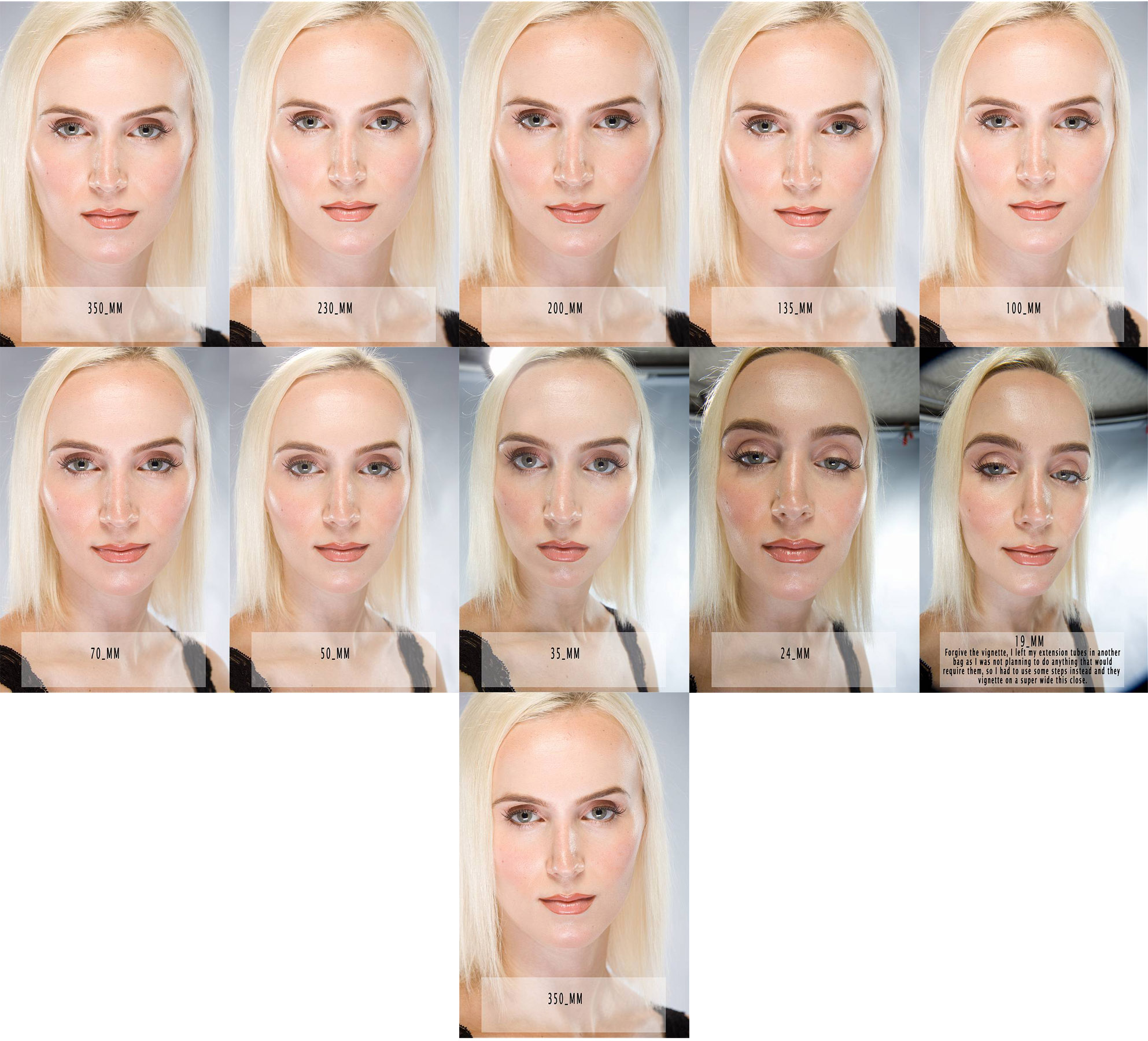
This is a great test I found online. You can see that around 50mm, they start to look similar, but on wider lenses, especially the really wide lenses, you get facial distortion. That is because the lens is wide and very close to the subject. However you can see why this might be useful in a silly or surreal situation. You can also see how we see more background on those. Also, this was done by a photographer and likely a FF camera, so imagine if what you see is a bit tighter in FoV. But you get the idea. Don't take this as proof of what every 18mm lens looks like or every 35mm lens looks like. Just understand there is that effect to some degree.
Ryan Patrick O'Hara
Veteran

This is a FoV chart for what different lenses see if you DON'T move the camera and just change lenses. This shows you the difference in their Field of View. Remember though, you can move the camera. So use a long lens and move back for a wide, or use a wide lens and move in for a close up. Just know that the perspective will be different and how.
Also there is still some difference in perspective between 135mm and 200mm lens, 200 is more orthographic and i like it on cars more than 135mm which still shows some roundness on cars corners while on 200mm car becomes more blocky and classy looking.
*Also when doing close ups dont go closer from portrait shot*with 50mm to frame fingers with the same 50mm, zoom in instead and dont move closer , it looks more natural, lot of amateur filmmakers tend to jump back and forth with 50mm, it distracts me cause it looks fake and wrong, dont know how about others.
*Also when doing close ups dont go closer from portrait shot*with 50mm to frame fingers with the same 50mm, zoom in instead and dont move closer , it looks more natural, lot of amateur filmmakers tend to jump back and forth with 50mm, it distracts me cause it looks fake and wrong, dont know how about others.
Last edited:

DavidBeier
Veteran
GREAT info Ryan. I've seen that test before as well and it really helped me think about what type of lens kit I wanted to put together for personal use.
TO THE OP: When looking at those focal lengths, divide them by 1.6 to get a rough equivelant of how they would function on a 7D, RED, F3, or Super 35mm camera. So, if you like the way the model's face is compressed in the 135mm example, keep in mind that an 85mm lens would give you that look on the cameras mentioned above (and most high-end HD ones) where-as an actual 135mm lens would give you something in between the 200mm and 230mm pictures.
TO THE OP: When looking at those focal lengths, divide them by 1.6 to get a rough equivelant of how they would function on a 7D, RED, F3, or Super 35mm camera. So, if you like the way the model's face is compressed in the 135mm example, keep in mind that an 85mm lens would give you that look on the cameras mentioned above (and most high-end HD ones) where-as an actual 135mm lens would give you something in between the 200mm and 230mm pictures.

LiamR
Well-known member
Here is a very simple explanation of Aperture/IRIS/F Stops.
The Aperture is the hole in which light travels through the camera and onto the sensor. You can either have a very wide aperture which is indicated by lower numbers, f/1.4,2,2.8 for example, and then you can have a very small aperture which is indicated by larger numbers, f/8,16,22 for example.
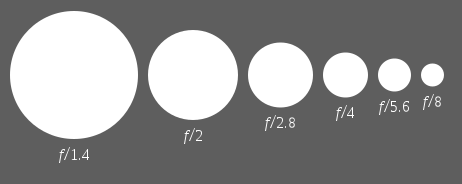
As mentioned earlier, controlling the aperture let's you control how much light hits the sensor, so you can either have f/1.4 where a lot of light is hitting the sensor (better for darker situations, where external light is not viable) or in a very bright situation where light is uncontrollable (like the beach for example) you can have 'higher' f stop.
You will often hear people refer to lenses as either 'slow' or 'fast' this refers to the f stops, as a lower f stop f/0.95 is very fast and f/22 is very slow
Another atribute that f stops give toward the final picture is what and what not is in focus. for example, a lower f stop (f/1.4) will give you a result of something referred to as Shallow Depth of Field, see here in this first picture I took, the aperture was set to f/1.4 and I got the foreground in focus and the backfround very out of focus.

and here in this picture I achieved what is called Deep Depth of Field, the aperture was set to f/22 and both the background and foreground and relatively in focus.

Hope that made some sort of sense.
The Aperture is the hole in which light travels through the camera and onto the sensor. You can either have a very wide aperture which is indicated by lower numbers, f/1.4,2,2.8 for example, and then you can have a very small aperture which is indicated by larger numbers, f/8,16,22 for example.
As mentioned earlier, controlling the aperture let's you control how much light hits the sensor, so you can either have f/1.4 where a lot of light is hitting the sensor (better for darker situations, where external light is not viable) or in a very bright situation where light is uncontrollable (like the beach for example) you can have 'higher' f stop.
You will often hear people refer to lenses as either 'slow' or 'fast' this refers to the f stops, as a lower f stop f/0.95 is very fast and f/22 is very slow
Another atribute that f stops give toward the final picture is what and what not is in focus. for example, a lower f stop (f/1.4) will give you a result of something referred to as Shallow Depth of Field, see here in this first picture I took, the aperture was set to f/1.4 and I got the foreground in focus and the backfround very out of focus.
and here in this picture I achieved what is called Deep Depth of Field, the aperture was set to f/22 and both the background and foreground and relatively in focus.
Hope that made some sort of sense.