LED to tungsten

Polaroid22

Well-known member
Hello,

I would like to be able to make my Aputures ls1s 5500 kelvin temperature the same as a ARRI 650W 3200 kelvin temperature light. Would a full CTO filter do the trick? Or what is the precise formula or what would you recommend?

Thanks!
 
Yes. That's it exactly.

Now the CTO gel is going to lower your color temp by a fixed amount, so there is the chance that your LED won't perfectly match the tungsten light because the LED itself might be putting out 5800K or 5400K or something "close" to 5600.
The Aputure stuff is generally pretty darn close so it should be fine.

Since gels are so cheap - you should get the whole set of CTO's.
Full CTO
1/2 CTO
1/4 CTO
A couple of each and you can dial in exactly what you like.
(I didn't put 3/4 CTO because that's just a 1/4 over a 1/2. But if you don't mind buying them all you won't regret it.)

You can even get a 1/8 CTO for really fine tuning your temp.

I LOVE gels.
I even have the lights in my home gel'd.
I find it one of the easiest and cheapest ways to create beautiful looking scenes before you ever even bring the camera in.
 
Last edited:
Great Thanks, I am thinking about ordering some CTO and other gels in one buy. I already got CTB's, but do you have any recommendations of any color gels that really are too good to pass up?
 
Great Thanks, I am thinking about ordering some CTO and other gels in one buy. I already got CTB's, but do you have any recommendations of any color gels that really are too good to pass up?

There is an alternate to CTO called CTS - the "S" stands for Straw.
It is a little more yellow while the CTO is a little more orange.
The Straw can mimic sunlight effects a little better.

For straight light conversion I use the CTO's, but when I want the effect of warm sunlight pouting into a space I like the CTS better.

Also "Rose" is a color that can add a certain very pleasing cast to scenes you want to look very romantic or "light-hearted" or child-like. It's a mild filter but it has a very interesting effect.
 
Look for a "Party Gel" pack, Rosco and the others make them. They have all of the wild stuff in them, deep purples, weird greens, pinks, etc. Fun for BGs or a stylized interview back drop for certain things. Gels are a lot of fun. To me, every shooter, at a minimum, should carry a full CTB, CTO and diffusion pack, these are lighting 101 basics of a kit.
 
The other line of nuts-and-bolts gel is plus and minus green which continues to be relevant when shooting with mixed sources. 1/8, 1/4 and 1/2 of both flavors will take care of most situations.
 
I carry 1/8 to Full in CTO, CTB, minus green and plus green. And even though I don't use them much anymore(and they changed the name), I still carry some GAM naked cosmetics gels in Warm Hint and Tan Hint. The GAM's practically lived in my Keys for interviews back in the Beta days.
 
Hello,

I would like to be able to make my Aputures ls1s 5500 kelvin temperature the same as a ARRI 650W 3200 kelvin temperature light. Would a full CTO filter do the trick? Or what is the precise formula or what would you recommend?

Thanks!


While I have no personal experience with the Aputure LED, I suspect that it is green compared to the Arri tungsten fresnels. Also, if the bulb in the ARRI has any age to it the color temp it is producing may be down around 2800k.

I recently mixed a LitePanel LED with Arri tungsten lights and I could see the green spike in the Litepanel when it was mixed with the hot lights. You may need to add some minus green to the LED and even then it will only do so much to get rid of the green. Best case is not to mix LED and tungsten unless the LED is one of the higher end LED's. And even then the two will only mate so much. You are still mixing two types of light technologies that are more unalike than are tungsten and fluorescent. LED has a high convenience factor and low power consumption but it just isn't a nice light source and manufacturers have to work very hard in the attempt to make it less garish and unflattering.

Likely someone will rebut to say I am being overly critical of LED lighting or have made some statement that is flat out incorrect. I admit I am not a fan of LED lighting. Particularly not a fan of the LED lighting being so widely used in consumer and commercial applications. It makes for a garish, punchy, over saturated world. The LED lights on police cars are so bright and intense in color as to be a road hazard when a cruiser is parked on the side of a road at night with its blue lights strobing. Same with those LED billboards at night.
 
While I have no personal experience with the Aputure LED, I suspect that it is green compared to the Arri tungsten fresnels. Also, if the bulb in the ARRI has any age to it the color temp it is producing may be down around 2800k.

I agree with you, when I need to light models and or talent who really care what they look like, especially skin tones, I still reach for my Arri tungsten lights. But the bulk of my shoots are with LEDs these days simply because I shoot in a lot of smaller rooms and tungsten makes the room temp unbearable for the crew and the talent. FWIW JP, the Aputure LS 1S are rated a legitimate 95+ CRI, no green spike. I have some Coollight panels I have traveled with for years and they came with the resin, built-in minus 1/2 green panel and they definitely have the green spike. I am taking delivery of a pair of the LS 1S in a few weeks and will test them to see if there is a green spike but so far reviewers like our own Erik Naso report excellent color reproduction and they have much higher output than all of the competitors and these Aputures cost less. Since most of us punch our LED panels through softboxes, Chimeras, etc. the quality of the light isn't as much of a factor as bare bulb use is. I think tungsten looks better, but then again, I think film looks better than all of the digital cameras we all use and I am not shooting film. Sometimes the compromises with one facet are outweighed by several other factors that add up to more. Such is the case with LED lights IMHO.
 
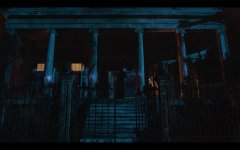
Does anybody know what filter this is? Is the lee "ocean blue" filter? Cause I dig the look. I have a party mix filters, but honestly every filter in that pack is ugly. So I rather buy 2 or 3 good ones like these. (I would love a thread where users are posting up frames and all filters and lights they used).
2i9pdkx.png
 
Does anybody know what filter this is? Is the lee "ocean blue" filter? Cause I dig the look. I have a party mix filters, but honestly every filter in that pack is ugly. So I rather buy 2 or 3 good ones like these. (I would love a thread where users are posting up frames and all filters and lights they used).
2i9pdkx.png

Good chance that "filter" is from someplace like Company 3 with a colorist like Stefan Sonnenfeld http://www.company3.com/artists/stefan-sonnenfeld/ look at his credits and reel. Not that gels aren't used in big time production, they are, but achieving a look like this is typically achieved in post, not on set. Everything in production these days is about shootling flat as heck with Log, adding LUTs and high end grading. That's where, "the look" is achieved. Not typically in camera. I see rain machines, big Muscos or lots of 18ks or 20ks on cherry pickers for a lot of backlight. The tint and vignette would easily be achieved in post. It's becoming rare for DPs to use much optical filteration anymore for the same reason, often, the effect can be better controlled in post instead of burning in, "the look" in production. Directors and producers like options and doing a grade/DI gives them a lot more options.
 
Last edited:
Good chance that "filter" is from someplace like Company 3 with a colorist like Stefan Sonnenfeld http://www.company3.com/artists/stefan-sonnenfeld/ look at his credits and reel. Not that gels aren't used in big time production, they are, but achieving a look like this is typically achieved in post, not on set. Everything in production these days is about shootling flat as heck with Log, adding LUTs and high end grading. That's where, "the look" is achieved. Not typically in camera. I see rain machines, big Muscos or lots of 18ks or 2oks on cherry pickers for a lot of backlight. The tint and vignette would easily be achieved in post. It's becoming rare for DPs to use much optical filteration anymore for the same reason, often, the effect can be better controlled in post instead of burning in, "the look" in production. Directors and producers like options and doing a grade/DI gives them a lot more options.

Yep. Likely just HMI source with no gel. The hue and saturation created in post.

I rarely see DP's use anything but straight HMI's when backlighting night scenes like that one.
 
Yep. Likely just HMI source with no gel. The hue and saturation created in post.

I rarely see DP's use anything but straight HMI's when backlighting night scenes like that one.

Most of the shows I shoot on, you'll rarely see anything but an ND, ND grad or polarizer put in front of the lens. One of the magazines had a big write up on a DP because he was committed to using Tiffen Black Pro Mists on set, in camera, in front of the lens. Ha, ha, like it was unheard of. That used to be the standard back in the day for film or video, we all owned huge boxes of glass filters. Now it's mostly just done in the grade. The only glass I have put onto my cameras the past few years are variable NDs.
 
Much of the time I have some flavor of Glimmerglass or Black Diffusion F/X up front. I'm not one for the vintage lens fad so it helps take a little edge off the modern lenses.

I've done different flavors of blue for moonlight over the years--Steel Blue, Congo Blue, Alice Blue. These days I'm more apt to make it straight 5600K against a 3200 color balance as that is the most naturalistic, but of course given a stylized project I'd be apt to play around again.
 
Well I have seen a behind the scenes pic of that setup. And it was a big HMI with some blue gel on it. I asked the DOP but did not get any response. So thought maybe somebody here might have a good guess.
And yeah you could grade it when you are shooting a RAW cinema camera. Only I will be shooting with an A7S II, so I will need to get the image as good as I can get in Camera as A7S footage falls apart really easy.
 
If he used HMI, then it is a compound of the color temp of the head plus the gel, making it harder to identify. Essentially the equivalent of Full CTB plus the color gel. Fair amount of green in that color but I wouldn't want to hazard a guess, there are too many out there amongst multiple manufacturers.
 
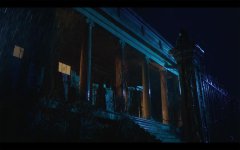
It looks a bit like the color I had on a condor for "Hell Baby"...and of course I'll be damned (pun maybe intended) if I can remember what it was, four years on. So, I'm useless.

Hey JPNola, your neck of the woods? Lower Garden District.

HB house 1 copy.jpg

HB house 2 copy.jpg
 
Last edited:
It looks like Roscolux Electric Blue to me. But I'm going back 30 years when I was lighting for music acts.

A color I have always liked on caucasian skin is Chocolate. Kind of earthy rose.
 
Last edited:
I would caution the OP to observe the transmission level of the gels he is considering, as his light storm LED just doesn't have the output level of the large HMI sources in the above still. As an example.... Using something like a Night Blue gel will only give you 4% transmission. Which means your light output will really be cut down. While something like Sea Green will give a 26% transmission rate, providing a stronger light output. Sometimes when my source is limited, I find that using a lesser degree of filtration gel is the key to keeping the light output needed for the intended f-stop I'm shooting at. When funds are limited, sometimes a compromise is the appropriate choice.
 
I would second this comment on light transmission. LED's don't throw a lot of light for any distance. Put a heavy gel on them and you might as well turn them off. Theses example look to me like they cranked the color temperature all the way down to the minimum (usually 2600K) on the camera (see car headlights that look fairly white instead of orange) and then lit blue areas with HDMI's or some other 5600K light source (multiple daylight LED panels or pars).

I think 1x1 LED panels work best in fill lighting scenes with daylight ambient. Set up for the ambient and then use a dimmable LED to fill faces, dial it up just enough to to cut contrast in the available light (often w diffusion), then add a rim with another (bare) panel if you need to separate subject from background. Makes for a quick and easy setup, breakdown, and no heat in small interiors. I use Dedo's Feloni 1x1's with V mount batteries. They will usually last 6-7 hours without charging. No wires to string, no fuses blown, light weight stands OK for indoor work. Dial the color balance down a bit for warmer skin tones, back up for harder look.
 
Back
Top