Led rgb

rob norton

Veteran
I'm looking into strip lighting for RGB purposes alone - how do you choose between the Litegear Literibbon or some cheap DJ equipment?

Does it come down to DMX/controller units etc.?

Are all RGB LEDs created equal as far as colour quality? If it's not for lighting talent but instead for small accents/hidden strips etc. does it matter?

Thanks,

Rob
 
Be very wary mate, I had a film where the art department (against my recommendations) built cheap RGB strip lighting into the sets, instead of the proper 'film' stuff. And it was a nightmare, we had massive issues with flicker in any setting but pure Red, Green or Blue. We couldn't get white or any inbetween colours at any shutter angle.

After that experience, I would strongly suggest sticking to the Litegear stuff, since the drivers have been made with film camera shutter angles in mind.
 
That is correct. Inexpensive RGB LED will present a flicker at standard shooting speeds. There may be functional alternatives to the Litegear stuff out there but I haven't seen it yet.
 
I've had the same issues with the RGB bulbs like the Philips Hue--they don't so much flicker as create a hum/roll in their output. May be phaseable out in the shutter but it's not ideal.
 
The problem isn't the strip, it's the drivers. The strip is just a bunch of LEDs and resistors. At full power the pulse width is 100 per cent, so it's full on and it works. Otherwise...

I have built several dimmers for LEDs based on simple DC to DC converters, which have constant, variable voltage rather than pulsed output, and do not provoke flicker. The RGB strip is tricky because it is common anode, that is, all the positive sides of the LEDs are tied together and the channels are controlled by pulling the negative sides low. This is an engineering choice based on the way the mass-market controllers are made (using cheap and effective N-channel MOSFETs to do the PWM) and it isn't generally possible to simply use three conventional dimmers to achieve colour mixing. I have recently been looking into the possibilities of doing it but I'd need a good reason to fart about with all that electronic design work.

In any case I'd recommend the RGB plus white stuff. You'd think it ought to be possible to desaturate, say, a yellow by bleeding blue into it, but it doesn't quite work like that. Metamerism doesn't quite fool the eye on all subjects. Having white, even an inaccurate white, is useful.

P
 
For anything other than slight accent lighting, I am always very wary of using RGB LEDs in my shoots. You're generally working with very narrow wavelengths of light and it is very easy to end up with color channel clipping which might not be immediately apparent in-camera but looks downright nightmarish when the time comes to grade.

Whenever possible, I use gelled tungsten or high CRI COBs to add color to a shot. Quite apart from the technical considerations, they produce much deeper colors (due to the wider range of wavelengths emitted) than RGB chips.
 
Thanks everyone for all the input.

Otaku+, your preference to avoid LEDs for colour goes against Charles embracing LEDs. Charles, do you not find this to be a problem? Does the Zylight IS3 bypass this problem?

Is it better to gel an LED with a higher CRI than use something like a LED wand like this?"]RGB LED stick like this?[/URL]

I'm obviously pretty ignorant in this department but am interested in experimenting with different colour solutions on a small scale.
 
The issue of individual colour channels clipping while the light doesn't actually look very bright is quite legitimate but really only depends on proper use of test-and-measurement displays. Mainly, this comes from the fact that RGB LEDs have, in effect, an exceptionally wide gamut and extremely high contrast, to a point that even the best cameras can struggle to accommodate. Often they aren't clipping exposure, they're clipping gamut. Many of the problems of RGB LEDs are mitigated or solved by the use of RGB plus white LEDs, often notated RGBW, as here. It becomes easier to produce (metamers of) less saturated colours, pastel colours are more accessible, and there is less of an offset between the power of the light as apparent to the eye, and the power of the light as observed by the camera.

Filtering white LEDs, even types with good colour performance, is an uncertain game. With the exception of Lee's Zircon range and perhaps some others, the filters are generally designed around more complete-spectrum sources than even the best LEDs. With experimentation, worthwhile results can be achieved, but I've found many filters absorb massive quantities of the output from LEDs, end up looking a very different colour to that which one might anticipate, and don't reliably produce satisfactory results, at least very efficiently.

Colour mixing LEDs is a fine enough thing to do, especially given the current interest in saturated background colours, but it needs to be done with care. This doesn't, by the way, imply that I'm in any way down on the low-cost approach. If we're not interested in producing accurate whites, the cheap LED ribbon from eBay is probably fine (albeit probably a bit inconsistent between batches, but we're tweaking by eye anyway at this point). The issue is driver electronics. It's almost a weekend project to make a flicker-mitigating, mains-powered, four-channel controller for RGBW LED strip, but for complex reasons there aren't really any off-the-shelf modules available that would make it easy to do battery power.

P
 
Thanks Phil, I never would've thought about gamut clipping vs. exposure clipping.

So lights like the Arri Skypanels are using the RGB+W gamut and that's the biggest difference because of the reasons you mentioned..

Are there any RGBW LEDs that are in a similar form to the icelight?
 
Thanks everyone for all the input.

Otaku+, your preference to avoid LEDs for colour goes against Charles embracing LEDs. Charles, do you not find this to be a problem? Does the Zylight IS3 bypass this problem?

Certainly any time you use saturated color you risk overmodulation and color clip (can happen with gels too), but that's why I use a vectorscope on set and keep the values within the lines while monitoring 709. I don't know if there's some voodoo involved with the limited spectrum of RGB LED's, but I haven't had any notable issues in this regard so far.

In terms of not being able to recreate all of the colors that you could possibly create with gels: that may perhaps be true, but I've found that the tradeoff of being able to dial in the hue and saturation on set is well worth it against having to test multiple gels and hope that on the day everyone will be happy. Now I can create the color and if the director doesn't quite love what they are seeing on the monitor, we can tweak it until he/she does. Good example of that would have been the Aerobics Meltdown sketch on Key & Peele; we needed to create a background wash and the effect of neon on the set. Colorblasts against the cyc and RGB Literibbon built into the set provided both. Director Peter Atencio came into the tent after we had dialed in the planned color scheme and he wanted to experiment, and we ended up with nearly the opposite of what we had first talked about it (which worked great)! Would NOT have been possible without RGB.
 
I don't know if there's some voodoo involved with the limited spectrum of RGB LED's, but I haven't had any notable issues in this regard so far.


If you think about it, you can still be clipped in gamut even if the level is extremely low. In practice this doesn't seem to be too much of an issue, though; it is in theory still happening, but it isn't objectionable. The side-effect of it is that RGB LEDs tend to look wildly different to the eye to the way they look on camera. This effect is often visible in places like news studios where the LED video walls look great on air, but generally end up a surprisingly deep and saturated sepia brown in person. I think this is because the problem largely pertains to the way the red and blue filters on cameras typically cross over.

in short, it works, but it is highly counter-intuitive.

P
 
Not cheap but you might look into the qolorpoint line of fixtures from CityTheatrical. You might also find them in rental houses if you don't want to buy
 
I am currently using Skypanels for a current project. The plus white is really key. But you don't have to use skypanels for this. It is mostly a matter of not going fully saturated...so pump some "white light so that at least you feed the other color chanels with enough light for a decent exposure. So for me, the rule of thumb when I can, is never go fully saturated...even if that is the desired look. Instead, go mostly saturated, but also feed the other channels as well. This way you get more fidelity and texture, then in post you can push the image to full saturation.

In short, pump white in there! :)

Specially in CMOS sensors where if you go with a fully saturated red or blue LED, that is only feeding 25% of the photosites on the sensor. The other 75% of the image is just laying on the noise floor.
 
That isn't entirely true; the filters in Bayer (that is, most) cameras cross over quite a bit, to make it easier to reconstruct a continuous image out of the subsampled colour channels. So, the green photosites will see a bit of blue and red, the red will see a bit of green, and the blue will see a bit of green, to varying degrees. This is why the behaviour is... odd.

Are there any RGBW LEDs that are in a similar form to the icelight?

Not that I've seen. You could make one out of the sticky strip, if you could find a flicker-free driver for it.
 
That isn't entirely true; the filters in Bayer (that is, most) cameras cross over quite a bit, to make it easier to reconstruct a continuous image out of the subsampled colour channels. So, the green photosites will see a bit of blue and red, the red will see a bit of green, and the blue will see a bit of green, to varying degrees. This is why the behaviour is... odd.

It's true that there is spectral overlap between colors for individual rgb dyes on the cfa. But as I understand, the more pure the dies are, the better a xamera's ability to produce a wider color gamut. Therefore, the camera filters out that spectral overlap produced by the short comings of any given dye, to try to be producing as pure a green, red and blue as possible.

But even if the camera is using some of this spectral overlap to interpolate colors when debayering, those filter dyes on the cfa will still make it so that you're gonna be starving those other photosites to a large extent if you go for fully saturated colors. Or at least that has been my experience. Anytime where I'm shooting a club scene or somewhere with saturated lights, my results have been much better when I don't go fully saturated on set and then push it in post. This way the camera and the colorist has more fidelity to work with in post.

But to be fair, my knowledge is limited and I'm not an engineer. Just some smarter people told me this and I've found it to be true, at least according to some camera tests. :)
 
Much of this technical information is beyond me at this point. I am however going to start experimenting and will report back.

Are there any apps etc. where you can put in RGB values you like the look of then get an equivalent value to achieve that similar colour for the camera?
 
Much of this technical information is beyond me at this point. I am however going to start experimenting and will report back.

Are there any apps etc. where you can put in RGB values you like the look of then get an equivalent value to achieve that similar colour for the camera?

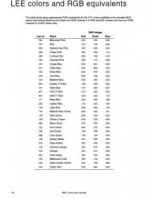
Do you mean dmx control for mixing the color channels? You would need at the least a USB to DMX convertor and compatible control software. As for color matching to RGB that would depend on how accurate the light itself matched the computer RGB values. Theatrical units often have tables that give the RGB equivalents for color filters.
Screen Shot 2016-11-04 at 9.06.29 AM.jpg
 
Back
Top