LED light panels

jrmiller_entertainment

Well-known member
Hey guys,

I posted this on Red User but I also wanted to let you know about some LED light panels I just bought from Spec-Comm. No, I don't work for them or affiliated with them in any way. I saw an email a week ago about a new light kit they're selling so I bought 2. They are awesome! They can either use AA batteries and ship with a sony or panasonic battery adapter (with battery included!). They come with a diffusion and 3200k filters for $165. A comparable Litepanels LED light is around $400 at B&H. The coolest part is if you get a few of them you can connect them together to create a giant LED panel, something the Litepanel micros can't do. I can't say enough about them. Perfect for an indy crew on a budget. I shoot weddings on the side and wearing a 10 pound battery belt all day was really annoying and the tungsten light looked horrible and got really hot but it was all I could afford at the time. Now I can shoot for hours with a very light weight LED.

The only thing that bummed me out was that it accepts AC power but doesn't come with a plug.

https://www.spec-comm.com/store/inde..._detail&p=4540
 
Last edited:
wow! Thanks for that link Spartacus. I don't mind paying what I did at Spec-Comm for the case, battery and charger but I'm planning on building a large panel similar to the lite panels 1x1 so I will buy from the ebay guy since I don't need batteries for those. $1800 for the 1x1 compared to around $280 for 4 of these babies plus the dc adapters is a no brainer.
 
There are also also single unit alternatives for the 1x1 out there, I guess sticking 4 or 6 of the 96z together, while doable won´t be a very stable solution, I like to move my light around a lot, so the setup should be able to take some "abuse"...
But if you build on of those, please post pictures, I might get convinced and do the same... ;)
 
Why do they always include the light robbing diffuser and that yellow filter? Both combined really cuts down on the brightness. Is there a camera top led that is very wide and not blue in tint as well as being as bright or brighter than a 100 watt halogen?
I shoot weddings and my 3200K halogen light really necessitates heavy brick batteries that go very yellow when they start to run down. My average shooting distance is around 20 feet in dark venues. I was thinking of getting 4 of the Z96 on top of the camera with the yellow and the diffuser in place, as long as together they can be at least as bright as my 100w halo. and all be powered from AA's in them.
 
Your 100 watt halogen is not the measure of brightness but the power consumed. Electrical power is measured in watts.Light brightness or luminance is measured in either lux, foot candles or lumens. A few factors have to be taken in consideration when a luminosity measurement is taken and claimed. the most important being distance and beam spread. A 100 watt common kitchen incandescent light bulb is approximately 1750 lumens, but that same light bulb when used with a reflector ( thus narrowing the beam angle) will produce a brighter spotty light than can be projected further. A common flashlight does the same thing, a single small bulb or led in it will get you a very bright spot at a considerable distance. It's all in the mirrored (silvered) reflector collimating the wide native dispersion of the source to project forward. Perhaps useless in video as a spotty source but as usual can be diffused for a wider beam but at a loss of brightness. The more the light is spread, the dimmer it appears. The native beam angle in the led units that use the teeney weenie leds in them are really small little led flashlights that have spotty beams, perhaps wider than regular flashlights but nevertheless spotty. That is why a diffuser is supplied, and also for the leds not to appear overly bright and harsh to the eyes.Instead of using reflectors, those multiple leds use encapsulated acrylic clear lenses ( cheaper to manufacture but same result) to project a bright and narrow beam. The lumen or lux figure of brightness would therefore be high and it would
look good on specs. Led light manufacturers rarely would rate the lux/lumen figure with the diffuser in place as the figure would drop to almost half. Add the yellow correction to that and really see what you will be working with. At wedding venues, no one I know used the bluish spotty units without diffuser and/or CC filter unless one wants a highlight effect. Sure, the yellow filter can be taken off and white balance for the blue, but now you would have an overly orange background. The brightness of one Z96 unit at 10 feet distance would be about the same as 4 of them at 20 feet ( your average working distance).This way you can see if that works out. Yes, it would be nice if there is a 3200K wide beam led on-camera unit with an equivalent to a 100-150w halogen, just for weddings.
 
Why do they always include the light robbing diffuser and that yellow filter? Both combined really cuts down on the brightness. Is there a camera top led that is very wide and not blue in tint as well as being as bright or brighter than a 100 watt halogen?
I shoot weddings and my 3200K halogen light really necessitates heavy brick batteries that go very yellow when they start to run down. My average shooting distance is around 20 feet in dark venues. I was thinking of getting 4 of the Z96 on top of the camera with the yellow and the diffuser in place, as long as together they can be at least as bright as my 100w halo. and all be powered from AA's in them.

Many LED lights (together with the HDV-Z96 also) are made in day light color balance 5600K, thus making indoor footage very blue. They are not diffused too so the video turns out a hot spot in the center and dark corners around. Thus the orange filter (lower color temp to 3200K) and the white diffuser (even out the light spread) come in place. They both lower the overall brightness.

I sell Comer CM-LBPS1800 LED lights and using them at weddings. They are 4500K which can be used indoor without too blue or too orange. The light is also diffused so it spreads evenly on the 16:9 screen.
 
how do the CN-160's compare to this light. After searching for a while the 160's seem to be the best bang for you buck
 
Z96 and CN160 output about the same amount of light. However, Z96 has a better built than CN160. CN160 orange filter also doesn't work so well. It has some sort of green spike in the video.
 
Hello, and a very warm welcome.
That site ergolcd.com sells mounting arms for monitors, office stuff and projector/lcd mounts.
???
 
Led technology has for several years not been up to par with the color rendering characteristics of the filament bulb. True, and that is because in my research about the issue is that there is a gap or discontinuous part of the color spectrum of the led light rendition that prevents faithful reproduction of all ( at least all visible colors) colors to be rendered as perceived by the human eye. Although there are many low priced led lights as well as high priced ones too that just fall in the same category of poor rendition of colors. Take for example the color purple or teale Most led units will have a difficult time coping to render those colors accurately on video capture regardless how many attempts are made to manually white balance them, including a white card placed in front of the light. In the quest to keep prices and costs low, most led manufacturers do prefer to incorporate the blue tint (binned) varieties of leds for their product line. Those leds , being blue or high Kelvin degrees (5000-8000K) do show as being the brightest as compared to the low K's which would favor more for video use. Brighter means more lux values and looks better on specs and therefore more sales. Too blue for most tastes ? no problem, as a warming/yellow filter is most always included to deal with that with a price to pay. That price is lowered brightness when filter is applied. Many times the use of that filter really messes up with the rest of the colors in the spectrum, especially when that filter is way too orange. Color rendering index specified by led light makers is also another indication of light quality, but unfortunately it is questionable as how true those figures really are. Easy to spec out a light as being 1800 lux at 3 ft. with CRI of 90 when in fact it is a 1200 lux and 80 or less CRI. Only when one takes it out of the box tries one out does the unit show its true colors. Leds are already there with a 90+ cri and really do come in beautiful 3000K tints, question is they are not cheap and need specific electrical requirements only obtained with quality drivers ( electronic circuitry that control led voltage/current) to make it happen. Will the led light manufacturers respond with the need for improvement in the near future or continue to offer the same beans in a different can all depends on their willingness to pay more for better beans. That "more" amount may actually be in the order of just a few dollars but most just look at the profit amount. Whay can't they ( the affordable ones) offer led units in warmer tinted varieties where most use will be done and if one wants it blue, then supply a blue filter for them. Warmer tinted varieties usually do have a higher CRI index to boot.
 
among panel lights, z96 is a great one. Although a small panel light and cheap , the wide beam is useful. Maybe it's not enough for many professional shooting. As fill light, z96 is good choice. I saw the items linked to ebay. the w96 is not the same as z96.

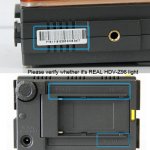
HDV-Z96 is from F&V company and has steel seal on the back of the light.


hdv-z96-verify.jpg


The image is a little samll. you could refer to here HDV-Z96

W96 is only clones and also don't the same qulity and color temperature as hdv-z96.
 
Back
Top