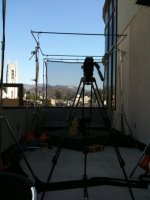
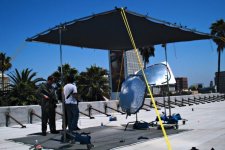
Knocking down the background in outdoor interviews?

I've been doing a lot of exterior shoots, and we generally rely on bounce to get our fill on talent.
Recently we added a small silk to the setup, and that helped out quite a bit (obviously).

I'm wondering if anyone has some good tips (and examples) on how to knock the background down a bit (instead of just relying on increasing the light on the talent). I've never tried shooting through a single or double (setting it up behind the talent, I mean), but I've seen that recommended before. If anyone has any samples of something like that, I'd love to see them. My concern would be keeping the net invisible in the shot.

Most of the shoots I'm doing are single person interviews - the widest we're getting is a midshot.

Any advice, tips, tricks would be appreciated.
Though, as always, I have to find a way to balance quality with speed - we're shooting out in the middle of nowhere most of the time, and the client always wants to cover more ground than we generally should.


Here's a piece we did over a year ago now - just to give you an idea of the kinds of conditions we're talking about.
The Broll doesn't concern me as much as the interviews themselves.
One this one all we had was a small collapsible reflector to work with (just fyi).

 
I have used singles and doubles in a 6x6 frame.

But ihave also invested in Joker 800 and 400 HMI lights for those situations as well.
 
Thanks, Matt.
Yeah, unfortunately any lighting (that isn't battery powered) is out of the question in these situations.
The sun is my HMI.

Do you happen to have a video you can link to where I can see how the background scrim came off?
Ever have any issues with seeing the scrim in the shot?
And any tips on how far back from the talent I should set it up?

I'm shooting with an FS100 now, and if not that it'll be some other large sensor cam, so I'm pretty confident I can keep the background pretty soft without issue.
Probably the kind of thing I need to test out a bit on my own first... just want to make sure I'm going down the right road before investing in more gear.
 
I don't. On location now.

In your case I'd make a cheap shiny board with reflectix and foam core, put the talent's back to the sun and fill with the shiny board. Or the white side of the foam core.
 
I'm with mcgeedigital on this. Looking at the shots you got, above, it would take a huge piece of fabric to do what you need to do, and any wind would quickly turn it into a sail. I once used a sheer, black fabric tacked to the exterior of a large porch to pull down a background because my subject was in the shade and I didn't have enough light to balance him out, but it was a huge pain in the patoot. Every breeze would cause it to ripple, even though I pulled it as tight as it could stand. Strong breezes blowing in the wrong direction would stress the tacking/tape holding it on. I'd just go the reflector route and save myself a lot of heartburn, if I were in your spot.

Still, if you really want to try it, look for sheer black fabric at your local fabric store and put it on a frame. You'll have to run some tests. Some sheer fabrics will alias and others won't. With that big sensor, you should be able to blur out most problems, though.
 
Take a look at this short I shot a while ago. We had a few situations where we were shooting in full shade and looking out into bright sunlight...it was pretty unavoidable so we had to make due. I used a 12x single net behind the characters, for one shot I pushed a 1200 fresnel through a 6x6 silk and for another I bounced the 1200 off a piece of 4x4 beadboard. I'm sure it would have worked a bit better if it was a bit more out of focus, but the film was shot pretty exclusively on the 18, 24, and 35, and our biggest net was a 12x...so we were a little limited in that regard.

The one thing I noticed is that it just makes the background feel very one dimensional. Like it's almost a backdrop or something.

Here's the link:
http://www.vimeo.com/18200230
PW: marbles

Another example is this TV show I worked on a while ago, Trauma. It's on netflix instant watch if you have it. Just go to the episode called 13 and when the kids in the trailer, we had a 8x or 12x double net outside the door to help match the light levels on the interior and the exterior. A good place to see it would be around 1:35 in the episode.

As long as you get the real thing and don't bother with any other silly solutions, I'm sure it'll work fine. People have been doing it forever.
 
I know you wanted some video Luis, this is the best i can provide (iPhone photo).
This shot is about two years old, I believe I had a double net knocking down b/g of Hollywood sign. I used two 1.2k HMI's to fill in talent @ high noon on L.A.
Sorry, I don't remember the f-stop. Long lens to obscure net w/ 2/3" sensor.

Hollywood sign.jpg
 
Similar setup, double-net (although it looks like a solid from this angle) to reduce over-head skylight, and reflectors to add fill and back light.
Again, sorry, no video.

Lashback.jpg
 
This is fantastic info - thanks so much for the pics and links and tips, guys.
Still weighing my options - next shoot for this client is at the end of August, so I'll come back and update on what we wound up doing.
 
Another option is to select backgrounds that aren't so bright and reflective? Obviously not always a choice, and shading a background is hardly ever possible :) but it's still something to remember when looking for a suitable background for a shot.

Otherwise, yeah, reflectors (and maybe some stands to hold them in position, if you have a small or nonexistent crew) seem the easiest way to get the best light onto your foreground subject. Reducing depth of field won't help with lighting as such, but can help you blur out distracting/ugly/inappropriate backgrounds.
 
I have shot through singles and doubles many times. Here is the trick. If the sun is hitting the net you can have some problems. To stop this I put up a solid topper of the same size as the net. It works great.
 
Hey Luis, I may be in Austin a lot more in the future. The wife and I are tired of 118 degree days in AZ. We miss Texas! It may be time to move home.
 
Hey Luis, I may be in Austin a lot more in the future. The wife and I are tired of 118 degree days in AZ. We miss Texas! It may be time to move home.

In overcast scenario such as your example, & without access to HMI's, I'd likely apply a vignette in post, or if time allowed, in-camera.

Alternatively you could run a 800w, or 400w, Joker from a Honda 2000i, or a 200w from batteries.
 
Last edited:
Been meaning to come back to this thread since I got back in town.
So I had another one of these shoots in the third week of August, and this time I took with me a 42" Scrim Jim and a 72" Scrim Jim.
We used the 42" with a 3/4 silk on the talent, and the 72" had a double net setup behind the talent.

I could have used a heavier silk, but didn't want the shots to look TOO manipulated.

Out of all the interviews we did I only had the chance one time to ask the talent to stay in place for a second while we removed the silk and the net
(so I could get a comparison shot).

It's not exact because he moved a bit so the comp is off - but you get the idea. It's not a drastic difference, but enough of a difference that I thought it was worth it. The difference was more noticeable when we shot in front of soybeans (which are only about a foot or two tall so there is more sky in the shot), but unfortunately I don't have any comparison shots of that.

You can also see, that by being in direct sun for just a few seconds the talent broke into a sweat immediately. While he was under the silk that wasn't a problem.
If I remember correctly, this was shot at possibly the worse time of day, roughly around 2 or 3pm.

Here are some grabs so you can see the difference.
We didn't use this setup on EVERY shoot, but it was great to have the option when we needed it (though we didn't always have the time).
Thanks for everyone for your advice and examples in this thread - it really helped out this last shoot.
We did a total of 8 interviews that week, all in these sorts of conditions - and the footage came out consistently better than what I'd been able to capture in the past.
I really appreciate it.


Raw.jpg Net&Silk.jpg


EDITED TO ADD:
It should go without saying, but those grabs are straight off the raw footage - not color corrected.
 
Back
Top