Key to making your film sound like it had a budget

Hardly! I do quite a bit of album mastering, and the "volume wars" in pop CDs have pretty much forced all of us to cram everything into the top 6 db or so of the dynamic range, typically with a lot of clipping. There have been countless discussions of this in audio professional groups, mastering engineers' websites, internet forums and the like. Simply put, it's a tragedy.
The thing that ticks me off most about the volume wars during the "digital age" is that digital audio supposedly allows us to have more dynamic range because we don't have to deal with tape hiss. I truly love some of the recent classical recordings; I'm not distracted by the "sssssssssssssss" in very quiet passages.
Thankfully, movie sound is completely unaffected by the trend.
Actually, the trend towards louder films is getting worse and worse, especially trailers.
 
...
Actually, the trend towards louder films is getting worse and worse, especially trailers.

Ironically trailers because they had gotten completely out of hand now have unofficial standards and are not as bad as they were. But that came down to $ not listening to mixers. Trailers were getting so loud that a lot of theatres had to turn down the playback levels and then of course the features were playing too soft. I don't think most films are too loud but I do think the ones that are too loud have gotten more so. 300 was the loudest film I have ever seen. It was way too loud for me even after I put in -15dB ear plugs and 1/2 the audience had their fingers in their ears. This was at an academy screening so it wasn't some out of whack playback system it was just TOO damn loud. It was also awful but I guess if you leave your audience deaf it must be art...
 
Noiz, excellent post.

One quick question I've always been curious about though... Home theaters are generally calibrated to -20dBFS @ 85 dBC signals at "0" on the receivers. Most people I know, myself included, generally listing to movies with the receiver set around "-20" (where the -20dBFS signal would only be playing at 65 dB). Even in small rooms the lowest mixing level I've seen suggested is going down to 79 dB ("-5" on a receiver) but that still is far too loud to be comfortable with just about any movie I've seen for most people's places I've been to.

Are films generally just mixed at that loud of a volume? Or is there something I'm missing?
 
Well unless your using an SPL meter I'm not sure how your getting your level. And I have never met anyone with a "home theatre" that had an SPL meter that didn't have a REAL home theatre, micropef screen and all. Yes films are mixed where the room has been calibrated with Dolby pink at 85dB spl c. But those are large mix stages, smaller rooms want less curve and lower levels. So it's room dependent. A mix stage may have 20-50 feet of space between the mixer and the screen. A home system is going to be a lot closer to a nearfield situation so 80 or less is probably much more correct. And I wouldn't depend on the dial of a receiver to give you any kind of accurate reading and it's not giving you an SPL reading so -20 does not nec connect at all with what your getting out of the speakers. You would need to pink them at the lower level and see what the SPL meter says. And lastly, as I mentioned up stream DVD's are mastered separately, it's not the theatrical mix. As a rule it will be more compressed and it might very well be louder.
Most films I have worked on get loud from time to time but are not mostly that way. But mixers at SZFC used to put the SPL score card up at the end of the day and some films definitely do mix LOUD.
 
Kill The Mix

Kill The Mix

I remember the old days at my first post house job... Crushing down dynamic feature film mixes for TV. We did a lot of reality shows and TV so when a feature would come in for an air date on some cable station with that 10-page QC report I shuddered ('overall program level very low' followed by 'multiple peaks above 0'). Then I would take that professionally-mixed film and limit the crap out of it for layback to DigiBeta. That's right. No more peaks, no more valleys, just keep those Dorrough's pegged and the boss will be happy...

Needless to say, things have changed now that I'm off on my own. Mixing for TV isn't as artful as for film, but it has its own challenges. And that's before you involve the LM100.
 
Somewhere I heard theater mixes are mainly 3 track L,R,C and they don't use surround because it takes eyes off the screen. When someone hears something coming at them from behind in a dark unfamiliar place they look around and this ruins the movie going experience. Any truth to this? What is the common US theatrical set up? There must be an ISO standard on this somewhere.
 
No standard, but yes most films are LCR. Partially it's because of the distraction thing, partly it's because edit rooms aren't generally set up for surround (so how are you going to cut in surround???) but mostly it's because the "surround" playback is so flaky in so many places. You can usually depend on "Dolby Stereo" (4.0 surround, LtRt) to play back at least in stereo but anything more is a gamble. I have done decently budgeted films that I went to the theatre to hear (billed as Dolby Digital) and had them played in MONO. A few films use surround to great effect. Saving Private Ryan is amazing in a good theatre. On the flip side all of Woody Allen's films are in mono, that's what he likes.
 
No standard, but yes most films are LCR.

So they generally only get a real surround mix for the DVD/Blu-ray? (Which they all do.) I've certainly noticed the lack of audible surround information in many theaters, but I assumed it was that the SLR speakers were turned down too conservatively. You mean that actual *mix* has no surround channels at all?

I could understand of course...it's hard enough to have more than a couple of decent listening positions for surround even in a living room/home theatre. Doing it effectively in a large auditorium would be basically impossible.

I'm trying to remember now if "Terminator Salvation" which I saw last weekend in a pretty nice theater had audible surround info...and I guess the fact that I don't means it probably didn't...
 
I should probably edit that. Many/ most films are mixed LCR first, then a little reverbed BG is splashed into the surrounds and some filtered stereo track is sent to the LFE. There will be something on all the channels if it's billed as DD but the surround channels will be an after thought. It's sort of like the early "stereo" recordings. The Beetles mixer has talked about how they would spend days/ weeks on the mono version and then just splash the sound around a bit and knock out the stereo version in an hour or so.

Some films are edited for surround and really use it but most don't really use the tracks, but they aren't empty. If you were missing surrounds in a theatre it was probably because they weren't working in the theatre, or they hadn't switched from stereo to surround playback. Apparently that is a problem with some of the "preshow" junk that's on the screen, it doesn't want to go through the decoder so the tech needs to switch the playback before the movie starts, and being way over worked these guys sometimes forget and the have to run off to the next theatre/ venue to do that film.
 
So the DVD versions are a separate mix then right? Because most titles I've seen in recent years on my home 5.1 system appear to have plenty of actual SLR content such as aircraft flyovers, crowd walla, weather/location ambience etc., along with some distinctly multichannel music elements (string sections in the back etc.).

It's one of the things that makes home theater so much fun in spite of my utter lack of interest in 5.1 music-only discs (DVD-A or SACD), which are usually way too gimmicky for my taste.
 
Side tracked comment for Noiz2,

Geoff Emerick, the Beatles Level engineer (mixer) said the mono mixes they have archived (that means not available to us) are still fantastic, even by today's standards. The Beatles 1st stereo mix (primary target) was Abbey Road. They went strictly for the mono mix on one Altec speaker they eventually wore out. A good mono mix according to Emerick is harder to pull off than a stereo: stereo is cheating. The point is, good mono can sound really GOOD!

Since sound is half the picture there is a great need to keep the standards high and not devolve. Maybe Dolby &/or THX will further facilitate standards for home as well as theater audio.
 
So the DVD versions are a separate mix then right? Because most titles I've seen in recent years on my home 5.1 system appear to have plenty of actual SLR content such as aircraft flyovers, crowd walla, weather/location ambience etc., along with some distinctly multichannel music elements (string sections in the back etc.).

It's one of the things that makes home theater so much fun in spite of my utter lack of interest in 5.1 music-only discs (DVD-A or SACD), which are usually way too gimmicky for my taste.

Yes DVD, airline, broadcast etc are all different mixes (on a film that can afford it) and any film that does DD is also going to do a "Dolby Stereo" because that is what the playback will fall back on when the DD drops out (scratches and all kinds of odd things can cause the DD to drop out, though it's pretty robust. You've probably heard it at some point on a film that has a lot of surround and the image just collapses back to the screen.

Now disclaimer time, I haven't worked on a BIG film in a number of years so the tendency may be changing. But from what I hear from friends still do ing big pictures on a regular basis that is still the case. The other catch is that most people only see the most expensive 5-10 percent of Hollywoods film and a lot of those are going to push the surround. Batman, Transformers, Bourne (new word here) will all have BIG sound and surround. At least in the DD mix. I forget what the numbers are now but most films are not mostly seen in DD. A LOT of theatres don't play the DD versions. Most people don't listen on (even close to properly set up) surround systems at home and a lot of people are still listening in mono. So you never want to put anything important in the surrounds or a majority of you audience will not hear it. On a film that is going to open wide, you can pretty much count on most of the opening week theatres having DD so as long as they turn it on... But most films don't open wide and don't have the pull to insist on DD playback. I live in the SF bay area and a lot of multiplexes are only playing one or two theatres in DD at any given time. It may cost them more? Either that or they don't have DD decoders in every theatre. Either way a bunch of folks are not going to hear that DD surround so it better not be really important to your film.
 
This thread officially has me scared of audio. Sorry to go off topic, but I have a question.

If I want this "high budget" sound, how much money is reasonable to spend on a short film when hiring every audio person needed on set and everybody on the post-production team? Let's say a dialogue-driven, 3-day shoot, with mainly interior locations.

I've seen some location sound mixers locally go for 500/day and boom ops for 300/day. Is anybody else needed on set? What about post? I know that if I'm editing the film, I won't be able to do the proper post production, so who do I hire and how much does this cost?
 
Right, Noiz...lots of people have horrendously ill-set up stereo systems, let alone 5.1, even if they've got the gear. I've seen 'em all stacked up on top of each other in a big pile on a shelf. Oy...

Being an audio pro, I've got a pretty well set up surround system in my living room, so I'm hearing more or less the whole enchilada as it was baked... and it tastes pretty darn great to me : ) What mixers are doing nowadays, at least with DVD/Blu-ray (and especially with uncompressed multichannel) is way big fun in my book. Cranking up "The Dark Knight" in my apartment is almost worth the eviction risk : )
 
This thread officially has me scared of audio. Sorry to go off topic, but I have a question.

If I want this "high budget" sound, how much money is reasonable to spend on a short film when hiring every audio person needed on set and everybody on the post-production team? Let's say a dialogue-driven, 3-day shoot, with mainly interior locations.

I've seen some location sound mixers locally go for 500/day and boom ops for 300/day. Is anybody else needed on set? What about post? I know that if I'm editing the film, I won't be able to do the proper post production, so who do I hire and how much does this cost?


Don't be scared :) You can do it.

You get what you pay for, but it really helps to know the tricks and techniques of audio and be able to direct less-experienced people in a technical way so you can achieve a pro result.

I think your boom OP is the most crucial, because there's only one chance to get it right. In post, you can go back and forth and change things. So if you can shell out the cash, pay a good boom OP with experience.

I'm sure you can find someone hungry to do a post mix that would work cheaply. Maybe a college student or someone with less experience and more drive. As long as you're not on too tight of a schedule, and you know what to listen for and how to correct mistakes, this might work out well. Might not....

You also might be able to find someone here too.

It's a lot of man-hours to do a great mix, so anyone that's done it a lot will charge accordingly. No way around that.
 
As Tim said, don't be scared.

How much time have you spent honing your script writing skills? How much time have you spent studying lighting, blocking, lenses and everything else involved in making a shot beautiful and effective? How much time have you spent learning editing, CGI and color correction? If "sound is half of the experience" have you spent an equal amount of time understanding the techniques and real possibilities of what sound can do for your film?

The key to solid sound is having someone who knows about sound running your sound. Do you pick just any random PA to run the camera? No, you don't, yet that is exactly what most indie filmmakers do when it comes to production sound, they hand the boom to whichever PA isn't busy at the moment, plug in the mic and hope for the best.

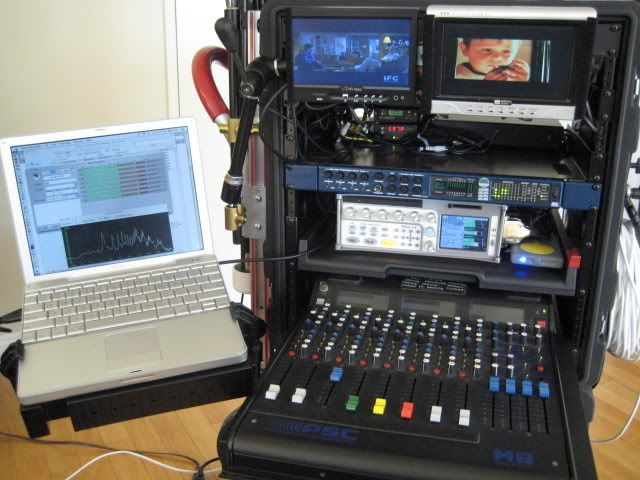
Yes, a production sound mixer can cost $500 a day. S/he is also mixing with a rig like this:

IMG_0881.jpg


There are lots of up-and-coming production sound mixers who will have the basics - a decent shotgun, cardioid, lavs, mixer, recorder and the assorted accessories - who will work for $100 to $200 a day. They will mix and boom at the same time. Just make sure that you give him/her the courtesy of doing their job properly. Nothing annoyed me more than when it took three hours to set up a shot and I was not given three minutes to get the sound organized, which is one of the reasons I got out of doing production sound.

Audio post engineers of the same stripe can be found as well; that's how I got my start, and a large percentage of my business is still low/micro budget projects.
 
Back
Top