Isolate light

If I had to choose between the light on the bar keep and the guests, the bar keep is the light I like the most. The two guests are too lit... Almost like you wante to light an interview. Also not the kind of light Id expect at a bar.

Personally I would do a more directional anf contrasty light that was less neutral in color.
Fx sell us the idea that there was a tube light under the cupboard of the bar, in the reverse angle light the subjects from a low angle, dimly with a matching source in color and flag it off so it mostly hits the guys..... Or... Sell the idea of lights overhead that creates pools of light which are flagged off to just hit the immediate area around the two.

Again.... Set design would help a lot because the lack of environment takes away from the rest.
 
I do love Deakins for his intuitive approach and use of motivated light or simply using practicals.

this.

light is hitting the actors, but where is it coming from? if you can use practicals to get the shot, do it. bring some lamps into the scene. 3 point lighting technique is a good starting point, but don't be so rigid with it that it takes away from believability.

also, your first shot makes it look like the room has a lot of lighting. if you establish that you are in a room with a lot of light, that needs to be consistent throughout the scene.

Is it possible to take away the light somehow?

use fewer bulbs or lower wattages. use barndoors to focus the light.
 
This reminds me of an article I read about a veteran cinematographer lighting a gunfight on an old-west street. Ideally, he would have liked to back light each gunfighter (I've noticed most of the old pros like to place their key light so far back, it's almost a back light). But since the gunfighters are facing each other, backlighting each each would look illogical. So he cheated a little, by having each side lighted, but with the side light back, close to being a back light. So the lighting seemed natural, as long as you didn't stop to closely examine exactly where each light was coming from.

So I suggest you do something similar. Avoid fully lighting the actors faces. Have both patrons and bartender side-lit, with the light seeming to come from a window or illuminated display case or overhead lamp. As long as all the actors are lit from sort-of the same direction, the audience will buy it, since they'll be concentrating on what's happening in the scene.
 
op - "I've just filmed the first scene of my new shortmovie and it's a desaster:"


Yes, You need a qualified DP, set designer, gaffer, camera operator, director. I see no knowledge, here, of any of these skills.

Suggestion: You obviously have the drive to produce. Go to school and gain insightc into these disciplines
before attempting such a project . . . and of being disappointed.

You will then enjoy producing it and be confidently proud of your work.
 
Last edited:
Your footage looks remarkably flat. Cinema (as many other visual media) is an attempt to squeeze 3D world on a flat surface (in this case - screen). That's why we try to find ways to make it look on the screen as we see it with our eyes.

There are many things that go into this: composition, perspective, lighting, choice of lens, format, etc. Unless there are specific reasons (like targeting some emotional response in the audience), the deep space is your best bet.

Here are some recommendations IMHO in your case:

1. Use larger space to shoot if possible - it's difficult to create deeper space on the screen, if your set is tiny.
2. Study light - I mean not only how to light sets, but how to paint with light. In fact, painting with light (as many call now the old chiaroscuro painting method) may be your best bet to understand how to do it. Study Rembrandt - look at this beauty:

1024px-The_Nightwatch_by_Rembrandt.jpg

Study Vermeer - isn't it amazing?
Johannes_Vermeer_-_Het_melkmeisje_-_Google_Art_Project.jpg

Once you understand this concept, it will be much easier to experiment with what you have to mimic painting with light techniques in filmmaking.

3. IMO, you use too much light - light only what you need. And you need to light what and where you want your audience to go with their eyes. It seems that often you use fill light to key (and really no key light). When you have too much light, in a small space with white walls (and you don't control it), you will have all sorts of bouncing and too much softness (too much of a good thing is usually very bad). As a result, it just doesn't look interesting.
 
Boy, this is the kind of thread I love on DVXuser. A wealth of info in here if you look around. The 2 minute tutorial was great!

Three useful words, especially for your master shots: Pools of light
Everything shouldn't be so evenly lit. I love the thought of playing off practicals, or at least using your lights to emulate the direction they would be throwing light.

Re: the bar scene. I tried to do a short one for DVXfest a few years ago. It's tough! You need a lot of elements to sell the illusion of a bar. Extras would really raise the....bar. haha. Not sure of your location, but as far as I can tell this looks like someone's basement. that flat, white wall @ :53 is a killer.

I would say if you can find help (gaffers, sound, PA etc) use them to your advantage. Like-minded film enthusiasts?

Practice! keep shooting & keep up the good work. Wish I could tell what the actors were saying....
 
Three useful words, especially for your master shots: Pools of light

This one doesn't quite show the 'pools of light', but I don't have time to make my own frame snaps of "Raging Bull"(1980).

Notice the 'pool of light' on the 3 characters at the table, with a much stronger light to the far right, but the camera is in the 'shadow/flagged' zone and the light is only rimming on the cast.

There's also 'near black' deep in the shot between the Joe Pesci character and the one on the right hand edge, but even that 'deep black' has a bit of 'texture' with the bottles or whatever.

RagingSalBroer.jpg
 
Last edited:
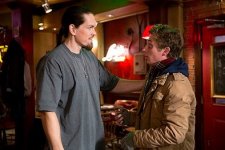
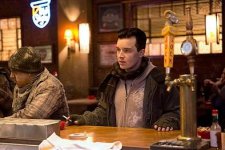
I'm watching and enjoying "shameless" season 4. I really love how they light & style the Alibi Room. Nice contrast of lights, shadows, neons and great extras to sell the illusion of a moderately busy bar. I would look for some stills but I'm on an iPhone.

EDIT: Funny enough, a quick Google search this morning found 2 images from the episode I saw last night. So to the OP, compare the look of these two shots to your 'bar' scene. IMO, it's those great neon signs that help to bring things to life. Light & shadows.

1625483_742041582474732_470391613_n.jpg

1513699_742041579141399_367775730_n.jpg
 
Last edited:
Your footage looks remarkably flat. Cinema (as many other visual media) is an attempt to squeeze 3D world on a flat surface (in this case - screen). That's why we try to find ways to make it look on the screen as we see it with our eyes.

There are many things that go into this: composition, perspective, lighting, choice of lens, format, etc. Unless there are specific reasons (like targeting some emotional response in the audience), the deep space is your best bet.

Here are some recommendations IMHO in your case:

1. Use larger space to shoot if possible - it's difficult to create deeper space on the screen, if your set is tiny.
2. Study light - I mean not only how to light sets, but how to paint with light. In fact, painting with light (as many call now the old chiaroscuro painting method) may be your best bet to understand how to do it. Study Rembrandt - look at this beauty:

1024px-The_Nightwatch_by_Rembrandt.jpg

Study Vermeer - isn't it amazing?
Johannes_Vermeer_-_Het_melkmeisje_-_Google_Art_Project.jpg

Once you understand this concept, it will be much easier to experiment with what you have to mimic painting with light techniques in filmmaking.

3. IMO, you use too much light - light only what you need. And you need to light what and where you want your audience to go with their eyes. It seems that often you use fill light to key (and really no key light). When you have too much light, in a small space with white walls (and you don't control it), you will have all sorts of bouncing and too much softness (too much of a good thing is usually very bad). As a result, it just doesn't look interesting.

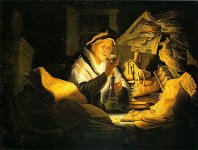
Thank you... old paintings are understated in the ways of cinematography. I remember a particular painting at the State Museum of Art here in Copenhagen. Im pretty sure it's a rembrandt... he has the people placed around a table and cleverly used one of the persons in the foreground to flag the light source which is a single candle on the table.

The light on the setting is amazing and really takes you into the painting.

I found this that somewhat lends the idea to the above:

rembrandt_the_moneychanger_lg.jpg
 
A couple thoughts on selling the location as a bar. It doesn't look like one in a wide shot, so don't shoot wide. The first shot that shows the bartender shows a background that isn't a typical bar, so don't show that background. A tighter shot on him with a shallower depth of field and some neon or bottles in the background would keep the scene believable. When you're shooting remember that just because in real life the bartender would be standing right there doesn't mean you have to shoot him there. If only one side looks like a bar then shoot that side only. Pick up the shot of the bartender somewhere else in the room that can look like a bar on camera. The shot of the bartender in front of your main characters worked.
The tight shot on the beer being opened needs more bottles around it. You don't have to build an entire bar, just make one square foot look like one. As it is, it's the saddest looking bar I've ever seen. Two bottles of water? That's all they've got in stock?
The solo shot of the guy in white shows a white wall behind him and that doesn't match up to what you'd expect from just seeing two guys sitting in a dark bar.
If you don't have a real bar, then think of what one looks like and make little parts of it look like that. I know that sounds easier than it is, but get creative! I've seen a totally convincing shot of someone traveling on a night train made with some cardboard, a back seat from a minivan, an aluminum window frame with a curtain, and someone swinging a piece of cardboard in front of a light to mimic the train in motion. Even on big budget productions you'd be surprised at how they get things to look "real" that really aren't.
 
I like to use references to try to recreate the look.

So you can simply googe the bar pictures:

images


images


z_787dcdea.jpg


7n8y.jpg


For me bar room is a dark place. A lot of yellow light falls on faces. And magenta-blue light on the background.
 
You need to flag your reflections, in the bar scene you can see the lights in every reflective surface. Kill your key light significantly, bars are never that bright as others have said. Throw some bottles in the cabinets, put a painting/black fabric/ANYTHING on that white wall.

The number one thing, get the hell away from big soft lights directly in front of your actors unless there is something in the scene that calls for it!


Also from a camera perspective:

Watch your shutter speed/angle, movement is not smooth. If your shooting at 24fps at 1/60 drop it to 1/50 or 1/40.
Don't go from sticks to handheld shaky cam, the shot from above is cool in theory but the movement in it means it should have been left on the cutting room floor. Same with the barman taking off the bottle cap, why is that so wide? Don't shoot the actors individually on shots when they are in the middle of a discussion or as the conversation goes further along get a little tighter/show more of both in the frame. Use close ups. Move the camera slightly, just because its on a tripod doesn't mean you can't move with your actors when they are moving out of frame!
 
Lighting - Planning the next shoot

Lighting - Planning the next shoot

I already asked a couple of questions about lighing in this forum but I think I had big problems with realizing the advice I got.

Here is a scene of a short movie on which I'm working on right now:
https://www.youtube.com/watch?v=hEEVzS6t2Hs

there is a similar scene which we will film the next weeks, also in a living room.
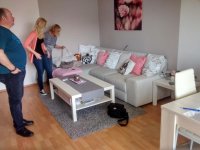
To prepare, I made a picture of the living room and I attached it to this thread.
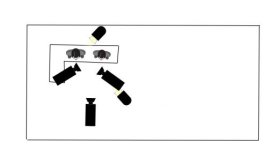
Also, I made a lighting plan.
As light sources I have
- 3 soft boxes, see: http://www.dvxuser.com/V6/attachment.php?attachmentid=98315&d=1425415972
and 3 big movie led lights. all sources have the same light temperature of 5.600 kelvin.


In the scene where they are sitting on the couch I want to film everything in a closeup and in a wide shot. I will pull the couch a bit away from the wall.

Right now its almost the same light plan like the last time, but this time I will try to flag the light a bit more. Does anyone has some more advice?
 

Attachments

  • 2015-04-12 12.48.56.jpg
    2015-04-12 12.48.56.jpg
    73.4 KB · Views: 0
  • Unbenannt.jpg
    Unbenannt.jpg
    9.1 KB · Views: 0
I watched the first piece and it's lear you're lacking in the light controls area. Lots of spill. Also, theres lamps etc ( pracs) in the shots, however you aren't using them. Use them. If they're too bright and no dimmer, wrap ND around the lamps. Motivate you're light a bit more clearly. Theres a light on the table beans him - add some more light motivated from that lamp to separate him / her. General rule, backlight to the opposite side of the key. The room in your photo is going to need some serious controls, with all those white walls.
 
Which contrast do you have in mind?
Is it a daylight shot or a night shot?

If it's a night shot, I suggest you to motivate your key light a bit more.
For example, if actors are watching TV at night, the key light could come from that direction. Best if you could "animate" the intensity of the key light as if it was coming from a real TV. A diffused key and a couple of cheap dimmable leds with CTB bounced on a reflector will do the trick.
Then you can add a backlight with CTO and motivate it putting a 2800-3200 prop lamp on the small table beside the sofa, that you can show in the wide shot.
To do so, move the sofa a bit further from the wall. This will also help to reduce the shadows of the actors on the wall.

This light scheme should work for the 3 camera angles.
Hope this helps :)
Cheers

ps make sure not to show any lightstand in your shot...
 
What was wrong with the other thread.....? People gave you loads of great advice. I don't see how a new thread will help you understand the advice better?
 
I watched the first piece and it's lear you're lacking in the light controls area. Lots of spill. Also, theres lamps etc ( pracs) in the shots, however you aren't using them. Use them. If they're too bright and no dimmer, wrap ND around the lamps. Motivate you're light a bit more clearly. Theres a light on the table beans him - add some more light motivated from that lamp to separate him / her. General rule, backlight to the opposite side of the key. The room in your photo is going to need some serious controls, with all those white walls.
Thanks about the suggestions for the room of the video, if we filme the scene again, I will use them!
But this time we film only in the room of the picture... What do you mean with serious controls? If you look at my lightplan, what would you change?

Which contrast do you have in mind?
Is it a daylight shot or a night shot?
its a daylight shot,and this time there is no TV involved.

What was wrong with the other thread.....? People gave you loads of great advice. I don't see how a new thread will help you understand the advice better?
I wasn't sure, I thought starting a new topic in the old thread would be a bit confusing. The old thread was just about controlling light (flagging...) and the new is more about the planning process, like making a lightplan, make a list f things I need (flags, reflectors...)
 
Stop trying to light it like an interview, there is NO REASON to use 3 soft boxes in this scene directly in front of your actors. Don't shy away from contrast and harsh lighting. Your actors faces do not have to be the brightest element in the scene.

Also, you really should not have started a new thread. You have added diagrams to the equation but still talking about improving your lighting technique.
 
Back
Top