Is resolution as threatening as others make it?

There are advantages to oversampling even if you know your work will never be seen at higher than HD. My 31 megapixel Hasselblad images definitely DO look crisper downsampled to 1600 x 1200 pixels than the 12 megapixel Canon 5D shots or even than 21 megapixel Canon 5Dii shots. Oversampling is only a part of the reason but it definitely helps. Oversampling at the front end of data acquisition is always a good idea if you are trying to get your final product right up there to the resolution limits of the final distrubution format.

I think you are sort of mixing up a couple of things... Naturally a 'larger sensor delivers a larger image'... if this were not so, there would be no difference between a 35mm film film neg, and the 2 1/4 square (aka 70mm) negative...

The ARRI Alexa has a sensor size which is approximately the same size as current 35mm film (I'm presuming 'movie film'...) and so the imaging area is actually smaller than the typical 35mm still film imaging area.

In sensors... size counts...

But back to Hasselblad... one of the reasons why the Wife and I did not make the 'digital jump' with Hasselblad... was the price... at the time when it made sense to do so, spending $30K for the digital Hasselblad just made no sense at all. There may be a reason for someone whose business is to make billboard sized enlargements... but for many applications the 35mm digital is the best compromise for price/performance/desired result. (And we always did have the film film Hasselblad in the closet if an absolute need arose...).
 
That's analog vs. digital for you, and one of the reasons analog recording formats still have ultimate fidelity. It's just not feasible in today's world.

If I had a choice between 35mm or digital, I would pick 35mm. Perhaps not all the time, but it's definitely not off the table when budgets allow.
 
I'm skeptical of "future proofing" as a justification for higher resolution. However, I have read that some filmmakers are using higher resolution in order to have more freedom in post production. If you shoot 4K, you can zoom in or crop in post, and still have the image look good.
Ken
 
However, I have read that some filmmakers are using higher resolution in order to have more freedom in post production. If you shoot 4K, you can zoom in or crop in post, and still have the image look good.

It won't look as good as the uncropped footage, unless it's a very mild zoom.
 
In light of all the madness going on between the C300 and Scarlet and whatever else, I'm very curious about the future proof mentality I read so much about. I'm a filmmaker and plan to be for as long as I can. My first feature Standing Firm was released in the US on DVD and in foreign markets in about a dozen countries. It's made its money back plus some, and has launched a more legitimate career for me. I mention all that because it has me looking at my past and looking toward the future, and the kind of quality I want to bring to new and future products.

...

When is enough enough? How in danger is someone's film who's shooting in 1080p to look like garbage 10 years from now on the typical consumer TV set? People talk as if 1080p is dead already when it's far from it. How long do you think it has left? I hear more talk about the growth of VOD in the next decade, you think 4k is an easy thing to stream? Hardly...even if 4k TV's became a standard, it'll take some more innovation in the simple way we do internet to pump volumes of 4k to TV sets around the country and beyond. For pete's sake, the Apple TV is still 720p.

Lots of questions here...but I wonder what others think.

NOTE: This is NOT a hit at RED or any other camera. Please, do what few in the last week have dared to do...breath...think...then post.

When it comes to anything technology-related, anything available today will be significantly inferior to anything released 3 years from now.

I don't think you should worry about 4k today for a few reasons.

First, who has a 4K TV to watch it on? no one...

Second, if they did have a 4K TV, how big would that TV have to be in order for people to see the difference? I mean, you don't really notice the difference between 1280x720 and 1920x1080 until you reach 60"+ TV's, and even then it's hard. You'd need a 150" TV in order to see the difference. The exception to this is, of course, making a feature that will be screened in theaters.

Third, tomorrow's 4K cameras will be better than today's 4K cameras.

I'd say "shoot for today". If you're making a feature that will be shown internationally and you have the budget, might as well shoot in the highest possible resolution. Otherwise, shoot on what you can afford and concentrate on delivering a quality story.
 
This sounds suspiciously like the argument of Blu-ray vs. DVD though, and I can tell a huge difference between them.
 
Hmmm.... do they make a shoulder-mount version?

Ken

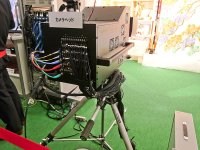
Actually this doesn't look larger than a 'blimped' 35mm camera of yore, or ones that Lean took to the desert, 70mm, for "Lawrence of Arabia"(1962). These days such 'large' cameras have sort of passed into museum pieces... but if the need arises... Ghost Camera will come...
 
Actually this doesn't look larger than a 'blimped' 35mm camera of yore, or ones that Lean took to the desert, 70mm, for "Lawrence of Arabia"(1962). These days such 'large' cameras have sort of passed into museum pieces... but if the need arises... Ghost Camera will come...

Well, yeah, the body is sorta kinda no bigger than a blimped Mitchell, although there's no telling about the weight -- but note that much of the "guts" of the camera is actually in that rack of electronics in the background, and you'd need to carry that around (and supply it with nice clean power and probably air conditioning as well) wherever you went. Even David Lean (definitely one of my filmmaking idols) might have balked at that!

- Greg
 
But have you ever watched something and thought it looked too soft? That can also be a lack of resolution as well.
 
Couldn't this thread have been closed after this post? I know that I don't need to read any more.

Well... no... because many things change from when a film is first seen and at some point in time, given some technology... the film is seen again...

I think Technicolor films of the 20-30's which used 2 and 3 stripe processes are now frequently shown with far lest 'quality' than they were preceived
in their original runs.

Even films that I saw in my youth, which now are on DVD/BD look 'crappy' in some cases relative to my ancient... and naturally 'perfect' memory... right...

Sure I can watch them, but in the back of my mind, and sort of limiting the willing suspension of disbelief, is the technical issues of the transfer.

Another example, "Excalibur"(1981), where at the time the 'visuals' were considered 'stunning'... I watched it a month or so ago... and all I could think of
was 'couldn't there have been less soft blur on the 'shinny stuff'... and further, why so much shinny stuff... I guess I've grown use to the current art
direction treatment of 'well worn armor'...
 
Back
Top