Is legal broadcast range required for everything?

JoeThePro

Well-known member
I've read that all tv broadcasts require the 16-235 video range, is that true? Do all hollywood films adhere to this as well? If so, how do they get such deep looking blacks?

The broadcast range definitely makes things look nicer at times and can smooth things out, but the full range contrast really helps sometimes.
 
The reasoning has less to do with actual color or contrast than it does with assuring signal conformity. It's more of a concern for broadcast than it is for things like DVD or Blu-ray. Not a concern for the Web.

Look up Rec. 601 and Rec. 709.
 
Im not experienced in broadcast but it would seem to me that 'legalisation' to the o/p device should be done by 'clamping' as the last stage in post.

Grading to 16-235 on devices which display 0-255 just means you gat an image with no black or white

Ive also heard of 'dop's trying to shoot legal, meaning even the brightest specular highlight is not allowed to clip - this would seem to me to impose a need for a bunch of extra fill lights or having the mid grey extremely noisy and low, both super inefficient for a production in the extreme

S
 
I've read that all tv broadcasts require the 16-235 video range, is that true? Do all hollywood films adhere to this as well? If so, how do they get such deep looking blacks?

For theatrical I'm not sure what specs they have to adhere to but when it comes time to show it on TV (DVD, VOD, broadcast, etc.,) yes, everything is 'broadcast legal' so that it plays back correctly on TVs. Long story short, video and audio signals are electrical signals that get transformed by TV screens and speakers into images and sounds and if the balance in the signal is off it can cause problems on playback. For example, if you make the whites too hot that can actually interfere with the audio portion of the signal. 16-235 and 0-100 IRE (on a digital video scale) correspond to 0-0.70 volts so when you adjust the lows, mids and highs in your image you are ultimately manipulating the voltage of an electrical signal.

And to answer you second question, very talented colorists work on hollywood-level films which is why they look so good.:thumbsup:


-Andrew

Thanks for the info. I wonder, do TVs essentially end up replicating the full range signal by expanding the range? Perhaps this is why you must not go outside 16-235? Its just very odd to me, its quite clear on many tv programs that the blacks are BLACK, not lifted to 16. Or, at least it seems that way...
 
I've read that all tv broadcasts require the 16-235 video range, is that true? Do all hollywood films adhere to this as well? If so, how do they get such deep looking blacks?

The broadcast range definitely makes things look nicer at times and can smooth things out, but the full range contrast really helps sometimes.

The broadcast standard has black as 16 and white as 235 but in general "ranges" are widely misunderstood and can be deceiving in nomenclature because it can mean different things when it comes to acquisition, working in post, and output or display to RGB devices.

Most of the time when the video image is going from one "space" to another it is being scaled automatically for you. For example your DVD using the "broadcast standard" 16-235 automatically gets scaled to RGB 444 0-1023 by your display.

In terms of "hollywood" some cameras can record broadcast legal, extended legal (sometimes called illegal) or RGB 444. A camera like RED for example is only RGB 444 and records the full RGB range off the sensor into REDcode - its proprietary format. Post production is also typically done in full RGB 444 color space. Later when the desired output is determined its easy to scale it to broadcast if that's whats needed.

One big issue that stumps a lot of folks is when working with illegal broadcast signals. They assume because the signal is outside of legal ranges that automatically it must be full data range video but this is not true and can result in problems later with grading software or worse NLE software where for the most part NLE software wants to work with broadcast legal signals. Therefore its very important to know what type of signal you are working with so you can determine the best way to work with it in post.


The biggest trick to deep blacks is rating your camera lower in ISO than it is so that shadows are lit well above a camera's noise floor and then later in post reduced back down.
 
The only real difference between 16-235 REC709 and 0-255 sRGB is a slight shift in standard gamma from 2.2 for sRGB to 2.4 for REC709. Both use the full 0-255 range (actually 1-254), REC 709 just includes buffer zones at the ends for chroma overshoot to prevent over modulation of the RF signal (which is still an analog FM carrier). This is a carry over from analog transmission days because digital and analog broadcasts until recently still shared the same channel space on over the air and CATV broadcast systems. REC709 calibrated monitors read anything below 16 as black with no detail and anything above 235 as white with no detail due to the gamma difference. Both sRGB and REC709 are tied to the same NTSC/PAL CRT analog voltage reference of 0-700mv from black clip to white clip, so the viewable dynamic range is identical, only the gamma correction and digital encoding values that represent that range are different.
 
Last edited:
DVDs are 0-255.
Japan broadcasts at 0-255 as well.

DVD's and BluRays are YCbCr 420 which means A.) it is not RGB 444 and 2.) means it does not use same range as full RGB 444 range values. You'd be hard pressed to find a YCbCr codec that can use 0-255 because the extreme low and top bits are reserved for other info and again the standard for YCbCr is 16 for black and 235 for white.

As for Japan, in North America 7.5IRE is reference black which uses a 16 code value. In Japan black is 0IRE but still uses a 16 code value.

The only real difference between 16-235 REC709 and 0-255 sRGB is a slight shift in standard gamma from 2.2 for sRGB to 2.4 for REC709. Both use the full 0-255 range (actually 1-254), REC 709 just includes buffer zones at the ends for chroma overshoot to prevent over modulation of the RF signal (which is still an analog FM carrier). This is a carry over from analog transmission days because digital and analog broadcasts until recently still shared the same channel space on over the air and CATV broadcast systems. REC709 calibrated monitors read anything below 16 as black with no detail and anything above 235 as white with no detail due to the gamma difference. Both sRGB and REC709 are tied to the same NTSC/PAL CRT analog voltage reference of 0-700mv from black clip to white clip, so the viewable dynamic range is identical, only the gamma correction and digital encoding values that represent that range are different.

No the big difference is that broadcast standard and RGB have nothing to do with eachother and people ought to think of them as entirely different. Just because both can use a similar range values to describe what goes on in the signal is no reason to dismiss how far from each other they actually are. I would never say the difference is "just a slight shift in gamma" etc.. they have nothing to do with each other period.
 
Last edited:
DVD's and BluRays are YCbCr 420 which means A.) it is not RGB 444 and 2.) means it does not use same range as full RGB 444 range values. You'd be hard pressed to find a YCbCr codec that can use 0-255 because the extreme low and top bits are reserved for other info and again the standard for YCbCr is 16 for black and 235 for white.

As for Japan, in North America 7.5IRE is reference black which uses a 16 code value. In Japan black is 0IRE but still uses a 16 code value.

No the big difference is that broadcast standard and RGB have nothing to do with eachother and people ought to think of them as entirely different. Just because both can use a similar range values to describe what goes on in the signal is no reason to dismiss how far from each other they actually are. I would never say the difference is "just a slight shift in gamma" etc.. they have nothing to do with each other period.

They are just different methods of producing the same result in analog light output from a display. The analog output color gamut and dynamic range of sRGB in any bit depth and REC709 in any bit depth is identical. Higher bit depths resolve small differences better with fewer artifacts. The only time you see a difference is when you view an image graded in one space in the other. If you calibrate the white balance and grayscale calibration of an sRGB monitor and an REC709 monitor with a log value step chart and grade the same image in sRGB for one VS REC709 for the other they will look identical. If you show the REC709 grade on the flatter gamma of the sRGB monitor it will look less contrasty. But the analog hue and value range of both is identical.

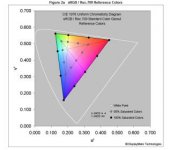
Chromaticity chart.jpg
 
There are lots of times where the difference can surface in every step of the way from acquisition, post production, monitoring and final delivery which is why I emphasize their difference, not their similarities as you have. See my post # 7.
 
As for Japan, in North America 7.5IRE is reference black which uses a 16 code value. In Japan black is 0IRE but still uses a 16 code value.

Just to add to this, the 7.5 IRE in the US is for an analog video signal only. If you are working with a digital video signal in the US 'black' is 0 IRE.


-Andrew
 
Just to add to this, the 7.5 IRE in the US is for an analog video signal only. If you are working with a digital video signal in the US 'black' is 0 IRE.


-Andrew

Yes REC709 is a universal standard for HD, not just the US. Code values are 8-bit 16, 10 bit 64 = 0 IRE= 0mv= black clip. 8-bit 235, 10 bit 960=100 IRE=700mv= white clip. The defined scene dynamic range between black clip and white clip as a gamma 2 corrected power density function (human visual response) is 20log(700/1) = 56.9dB, or a bit more than 9.5 photometric stops. If you look at the spec sheets for the latest gen Sony cameras, F5, F55, you will see the HDSDI signal to noise ratio listed at 57dB. The theoretical maximum for the format.
 
Yes REC709 is a universal standard for HD, not just the US.

Even for SD black is 0 on a digital signal. This became a big source of confusion around the turn of the century when digital acquisition and output started becoming wide spread.
 
Back
Top