Is everyone moving to cool flourscent lights?

Gillvane

Veteran
Is there a move towards cool florescent lights?
51n0tGn-FAL._SL500_AA280_.jpg


Or are people sticking with tungsten lights?

I live in the deep South. It gets hot. Really hot. The air conditioners are already working hard to keep things moderately cool during the summer. Being able to light up an interior without heating it up would be a big plus. Also, you don't have to worry about spill from windows during the day, which is nice.

But, what do you do for some hard light? Get a hot tungsten light and throw some ctb on it? Is that the only solution? (Besides HMI's which I can't afford. I'm not Paramount, geez).

I suppose there is no hard cool fluorescent light? Or do you forget the hard light, and just do everything with soft light?
 
Each have their place.

I have Flo's, Tungsten, & LEDs.

For situations where space and heat are an issue, Flo's and LED's are a great alternative.
 
Yes this is exactly why I started my business. The hot southern summers.

Fluorescent is soft light and can't be hard no matter what you do, so if you only use fluorescent you lose the ability to have a hard light when you need it. That's why we came out with our CDM line which is considered very affordable by a lot of people--because no kit is complete without both hard and soft light. Not all that much higher than some tungsten fresnels.

Many, including a lot of people on dvxuser, have transitioned to our CDM 70 and 150 fresnels for hard light as the economical and energy efficient alternative. The 150 giving the same output as a 650w and the 70 the same as a 300w. Thus, the same 4 to 1 ratio of light output to power usage like fluorescent. Daylight output without gelling. Compact size. Ability to switch out the bulb on the 150 to a tungsten colored one to match with other tungsten lighting, similar to the same ability with flos. Focusing between wide and narrow beam. We even have softbox options now for the 150 to allow it to be a soft light when you need that which is the nice thing about hard light--it can be diffused and turned soft when needed.

Of course, LEDs are the new kid on the block and they fall somewhere between a hard and soft light because of their composition.

Hope this helps.
 
I was using a lot of florescent lighting before it was cool. Both meanings of 'cool'. Like before the guy above me was a big deal.

Anyway, as was said, they can't do everything... but when they can do the job? I have a preference for these things. I always hate using more electricity than needed, and the heat factor is something to keep in mind for comfort, longevity of equipment and safety. Those advantages are pretty big when the lights can work just as well as anything else. But that doesn't mean everyone is.
 
Tungsten is just really inefficient. You can only get up to 2kw (which really isn't a lot) and you're already running the risk of blowing the household circuit, plus the heat factor.

Richard, when are you coming out with higher output CMD? I really want a 1k or a 2k equivalent hard light and I really don't want to go the tungsten route. One suggestion I have is for future model, is there's anyway you can put a display light or something on the ballast to indicate when the light is done cooling off? It just gets really annoying to keep having to flick the light on and off to see whether it's done cooling yet.
 
Hi Huy Vu,

We're working on a CDM 400 right now but I hate to promise when it will be out. Waiting on a better lens than the one we have right now so thats the holdup. It'll be the size of a 1000w compact fresnel and the ballast will be a bit larger. We'll skip a 250w unit as the difference in price between a 250 and 400 is not all that large, certainly not as large as the difference in price between the 150 and the 250/400 class of bulb/ballast. The bulb it will use is similar to an Osram HSD 400 cold start bulb with GX9.5 base and 6000K color temperature like most classic HMI bulbs. We'll have our own clone bulb that comes with the fresnel. No 3200K choice for that one at this time.

As for the 150 ballast (and 70w for that matter) restart, you don't have to do what you're doing. Just turn it on and let it go. It automatically retries every 2 minutes or so when its on. If it senses the current going to the bulb is too high (in other words, the bulb is still too hot), it just quits and waits another 2 minutes. This is one of the few ballasts out there that has a feature like that and it is really nice. So you don't have to worry about it. Just turn it on and it'll decide (usually about 4 to 6 minutes) when its ready.
 
"Gillvane" the fluoro lights you have pictured are practically useless as cinema lights, and marginally useful as photo lights. My friend bought some cuz they were cheap.
As for the use of fluoro vs tungsten vs HMI, personally I have tried moving away from fluoro's over the years, but for space, power and heating issues, LED's and kino's are sometimes the only way to do it.
As to whether fluoro tubes can be hard or not - it's a matter of opinion. Two footers on barebulb can be harder than you think - often times I have to grip it up to make it softer. I would not say that a fluorescent is a soft light no matter what. Not as hard as a tungsten open face, but not that soft either.
I believe I used Richard's cool lights before on a pick up day when we had no Kino flos, and as a matter of suggestion for improvement, I would rather have black matte flaps versus the mirrors any day. The mirrors make the units spill all over the place. Maybe it was just that particular model.
 
Actually the the studio models are fairly well appreciated for the mirrors. Those few that don't like it often just take them off. We don't have them on the portable models because of weight factors. We actually didn't invent that idea and you can find it as on option on other models from Lowel and some other manufacturers. They are known as "intensifiers" and the idea is to increase the surface area emanating light. It only works well on a softlight though, you'd never use such an idea on a hard light. Someone probably hit on the idea quite a while ago because they realized that barndoors are fairly useless on a softlight because you would have to fashion flags that are much larger than a barndoor could be to really have control. Eggcrates are superior for their size for controlling side spill and loss of light when using an eggcrate depends upon the size of the cells.

As far as whether fluorescent is hard or not, one thing to try is to render a cucaloris in front of a fluorescent and also try it in front of a fresnel or other hard light. See which one has better definition of the edges around the shadows and where light comes through. Hard light gives well-defined shadows, soft light gives vague ones. Sometimes well defined shadows are a good thing and you can't beat a single intense point light source for that. Fluorescent tubes of just about any size are too large to be point sources, hence why we say they can't be hard when compared to real point sources.
 
"Gillvane" the fluoro lights you have pictured are practically useless as cinema lights, and marginally useful as photo lights. My friend bought some cuz they were cheap.
As for the use of fluoro vs tungsten vs HMI, personally I have tried moving away from fluoro's over the years, but for space, power and heating issues, LED's and kino's are sometimes the only way to do it.
As to whether fluoro tubes can be hard or not - it's a matter of opinion. Two footers on barebulb can be harder than you think - often times I have to grip it up to make it softer. I would not say that a fluorescent is a soft light no matter what. Not as hard as a tungsten open face, but not that soft either.
I believe I used Richard's cool lights before on a pick up day when we had no Kino flos, and as a matter of suggestion for improvement, I would rather have black matte flaps versus the mirrors any day. The mirrors make the units spill all over the place. Maybe it was just that particular model.

Lots of good information over all.

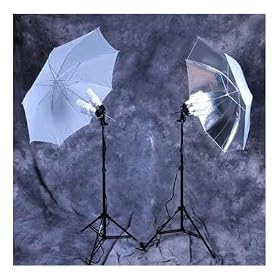
Why are the lights pictured above useless? If they are 1,000 to 1,400 watts (equivalent) and put out 5600 color temperature, what's the problem with them?
 
Those units you have in your photo are designed more for photo shoots.
They have a lot of spill because of the umbrellas. Also there's nothing covering the back of those bulbs, so not only do you have a softer light from the bounce, but you have a hard light from the bare bulb. Also, they're rated as being equivalent to such and such wattage, but it's a lot of b.s from my brief experience with them.

I don't mean to be a lighting snob - you can get by with those lights for some general ambience, but I have to warn you that a lot of these cheaper fluorescent solutions have strange spikes to their color wavelength - I believe the those particular tubes might have too much magenta but it varies by manufacturer.

They may say it's "5600K" but the magenta or green spikes can make it a very bad match with natural daylight. HMI's on the other hand can often be too blue and also can have strange spikes if they have are not in good condition or are just warming up.

It all comes down to trial and error and my brief use of my friend's units resulted in me having him put them away for good. But I had HMI's and Kinos to rely on. If you have nothing else due to budget, and need to make your movie, they are better than nothing.

Beautiful lighting benefits from having specific and precise tools to do the job. And it benefits from training your eye to see what looks wrong and right. Those lights looked wrong to me so I would discourage you from spending hard earned money from buying those photo lights. Sorry, but I don't know who manufactured them as they came from a friend on a shoot.
 
Various instruments have various purposes.

I know of more than one pro lighting guy who routinely use fluorescent instruments. Knowing what the lights can do and what they want is the key to applying the right light at the right time. That's why they have everything from 2k HMIs to little clip lights in their trucks.

And no light provides perfect 5500k with optimal spectral distribution. All have some odd spike or cast. That's another reason why lighting pros have a lot of correction gels. Lights change as they age and sometimes you have to compensate with the right gels.

Sometimes the budget isn't there and you have to improvise. And sometimes that leads to inventive people bringing new products to market. Like the LED Cool Lights.
 
Weird spectral shifts are exactly why some fluorescent lights are more trouble than they're worth. Having to spend time to find the correct gel or gel combination to filter out these shifts are time consuming and not worth it. All lights do vary in color temperature and spectral spikes, it's really up to your eye to determine what units are consistent and which are useful to you under your shooting circumstances. Unfortunately even the best human eyes sometimes don't interpret the colors correctly.

On a side note, a lot of cheap fluoro lighting units tend to be too magenta because the makers try to filter out the green spike with a magenta die in their glass.

Fluorescents and LEDs are very useful, yes sir.
 
Does anyone adjust their lights by using different kelvin temperature bulb mixes in their lights? I'm getting a set of 3 Biax 8's, and I'm wondering if I can mix bulbs to achieve the look that I want. This is what I do for my reef aquarium in which I have 6 48" retrofitted T5 bulbs with high quality individual reflectors - I use a mix of 14K bulbs for a crisp blueish-white, 20 or 22k blue bulbs to bring out the phosphorescence of the corals, and a bulb that is a 75% blend of 420 nm actinic for stronger green phosphorescence, and 25% full spectrum with a large spike in red to bring out the reds and pinks without washing out the blues.

Another thing to remember is that bulbs have both PAR and spectrum shifts with age. For instance, with reef tank lighting like I mentioned above, the lights run on average 10 hours a day with direct cooling on the endcaps (cooling bulbs directly actually reduces PAR output). After 18 months the spectrums have shifted significantly enough that they need to be replaced. If I were to use a ballast that overdrives the 54w bulbs to 80w, then I'd need to replace bulbs at 12 months. And the higher kelvin bulbs will tend to shift their spectrum down to a lower spectrum at a faster pace than the daylight bulbs.
 
Back
Top