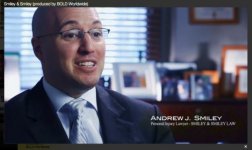
Interview 3 light kit color temp

Great information. Quick question. Say there isn't any window light /daylight at all, would you still opt to make the background cooler than the close/foreground subject ?.

Absolutely! Here's my cue
I spent a LOT of time studying made for TV interviews. All kinds, from documentaries to news and I discovered this pattern though it's not hard and fast:
Subject - Caucasian Male or Female
Scenario - News interview or Made for TV Doc
Lighting - Dramatic or Non Dramatic?
Dramatic - Softbox fill at 90º to lens axis on right of face. ( color bias - neutral 5,000K or slightly cold at 5,500K - simulating skylight)
Main is a small softbox or 'harder light' at 45º down and left of face (color bias 4,000 - 4,500 - simulating 'incandescent') I'll frequently include an out of focus lamp in the background for ambiance. If not....
Hairlight at 4,000K
Background light - Here's where the fun begins ( Blue to Deep Blue for Caucasians and Deep Red or Deep Green for Darn Skin Tones, Cosmetic Peach, Sea Foam Green ( Teal) or Magenta for Asians.

This set up, with properly positioned and balanced output lights will set your interviews head and shoulders about the rest.

For realistic look. dial down the colors or neutralize the total color balance and use selective focus to throw the background out completely.
 
Daylight.

Lots of times when I'm shooting interviews there are windows in the room. Also I really like shooting interviews with a window in the shot. Currently my setup is comprised of
only 3200k balanced lights and it's a pain in the a**! I have lot's of gels for the windows but one gel is never enough and you can't put 2 gels one untop of the other. So getting
enough daylight balanced light is always a problem in this kind of situations. A 800W redhead becomes effectively a 400W redhead when you put a full CTB gel on it to bring it to 3200k.

I'm going to buy some daylight LEDs or HMIs. I think I'll probably get a 2kW HMI...

You might want to wait to spend on the 2K HMI unless you have tons of Euros to spend. I'm having a blast converting handheld HID (4,300K) into lights for videos and the cost very little, run on 12V too ;)
 
Is all that brightness necessary like the 2KW, that's 2,000 watts right ? and also HMI ? 800W redhead becoming 400watts, gee what happened to all the talk about the sensors nowadays that many rave about 1200 ASA without grain and such. May I assume that my led designs of 200W may not be bright enough for interviews ? then again I hear that many use the famous Z96 for a "insanely bright" light. I always figured that if the light panels of 12"X12" ( which are way far less bright than a 2K or a 800W or a 4oo watter) are said to be great for interviews, then my DIY light ( 3400 lux @ 3 ft.) should be at least as good. Are small apertures for increased depth of field the reasoning behind using them "bright guns".
 
Absolutely! Here's my cue
I spent a LOT of time studying made for TV interviews. All kinds, from documentaries to news and I discovered this pattern though it's not hard and fast:
Subject - Caucasian Male or Female
Scenario - News interview or Made for TV Doc
Lighting - Dramatic or Non Dramatic?
Dramatic - Softbox fill at 90º to lens axis on right of face. ( color bias - neutral 5,000K or slightly cold at 5,500K - simulating skylight)
Main is a small softbox or 'harder light' at 45º down and left of face (color bias 4,000 - 4,500 - simulating 'incandescent') I'll frequently include an out of focus lamp in the background for ambiance. If not....
Hairlight at 4,000K
Background light - Here's where the fun begins ( Blue to Deep Blue for Caucasians and Deep Red or Deep Green for Darn Skin Tones, Cosmetic Peach, Sea Foam Green ( Teal) or Magenta for Asians.

This set up, with properly positioned and balanced output lights will set your interviews head and shoulders about the rest.

For realistic look. dial down the colors or neutralize the total color balance and use selective focus to throw the background out completely.
Wow thanks for the detailed write-up. I'll have to consider these tips for my next interview!
 
Is all that brightness necessary like the 2KW, that's 2,000 watts right ? and also HMI ? 800W redhead becoming 400watts, gee what happened to all the talk about the sensors nowadays that many rave about 1200 ASA without grain and such. May I assume that my led designs of 200W may not be bright enough for interviews ? then again I hear that many use the famous Z96 for a "insanely bright" light. I always figured that if the light panels of 12"X12" ( which are way far less bright than a 2K or a 800W or a 4oo watter) are said to be great for interviews, then my DIY light ( 3400 lux @ 3 ft.) should be at least as good. Are small apertures for increased depth of field the reasoning behind using them "bright guns".

I keep it short.

1) You are correct in assuming that insanely more receptive sensors have conversely and proportionately resulted in higher value exposure per lumen of light. So this means that YES, the lower powered LEDs are not only fine for video, in many case they are PERFECT, as long as they are proportionately balanced to the prevailing ambient. That means lights such as the legacy 12X12 and larger LED arrays make perfect key, fill and accent lights where the designer wishes to preserve the prevailing mood of the ambient light, while highlighting key subjects.
In principle, due to how light actually emerges from the component emitters LED diodes, the effects is VERY different from traditional quartz halogen or HID ( AKA - HMI). I will not go into details here. Suffice to state that LED panels are excellent at CLOSE ranges to the subject. Beyond that range they not only loose effect ( due to the Square Rule) but also because of the character of the LEDs (collimation) . CFL's suffer from the same characteristics.
2) The minute we start talking of longer distances, particularly at night, most LED's, even the optically focused ones, can't compete with hotlights on a dollar/per lumen basis. Enter HID and Tungsten
3) If you're scene requires lighting control, versus simply supplementary ambient, you need more powerful lighting. The trouble with LED's is heat management and circuitry are so expensive, that once you get into 1K range, you're at a $1,000 fixture . Whereas in the realm of HID, I can do it DIY for less than $200. In hotlights, the cost goes down to $60 (Lowel DP for example).
New, and more powerful LED emitters are here and they are not too expensive in bulk, but the rest of the story, heat management, voltage regulation, dimming, and beam modulation... are still expensive
Finally.....
4) White it is true that current (2012) Digital Photo sensors are 10-15 times more sensitive and deliver exponentially better, noise free images than their circa 2000 predecessors, we still recognize that MOST DIGITAL CAMERAS deliver the best resolution / color gamut and Dynamic Range mix at the bottom of their ISO range, so if you want the best core image you still need to shoot at ISO 200 or wherever the sensor's sweet ISO might be, NOT at 1,200 +

So. best quality image ? > more light | Lower ISO
 
Very helpful, thanks. I can see why leds have their limitations as far as brightness and "throw" are concerned. The square law applies to all light sources BUT does the same rule apply to different beam angles ? On a 45 degree beam angle, I have observed on a flat white surface using a reflected light meter. the brightness does indeed diminish 4X as to the distance doubling. Well within the square law. BUT and this gets interesting, when I did the same measurement with my led 20 degree flashlight and doubled that same distance, the brightness diminished by 2.5X. Much netter throw. When I used another led flashlight with a very narrow beam of 8 degrees, doubling the distance diminished only by a factor of 1.6, not by 4 as the square rule would have it. So the thinking that leds do not exhibit good throw is questionable, in my opinion. The light's projected angle seems to be the determining factor as far as throwability is concerned in my simple experiment. I was just thinking about a laser beam, perhaps that is the reason it "throws" so far, the extremely narrow angle.
 
Very helpful, thanks. I can see why leds have their limitations as far as brightness and "throw" are concerned. The square law applies to all light sources BUT does the same rule apply to different beam angles ? On a 45 degree beam angle, I have observed on a flat white surface using a reflected light meter. the brightness does indeed diminish 4X as to the distance doubling. Well within the square law. BUT and this gets interesting, when I did the same measurement with my led 20 degree flashlight and doubled that same distance, the brightness diminished by 2.5X. Much netter throw. When I used another led flashlight with a very narrow beam of 8 degrees, doubling the distance diminished only by a factor of 1.6, not by 4 as the square rule would have it. So the thinking that leds do not exhibit good throw is questionable, in my opinion. The light's projected angle seems to be the determining factor as far as throwability is concerned in my simple experiment. I was just thinking about a laser beam, perhaps that is the reason it "throws" so far, the extremely narrow angle.

You are right about the potential. Way back in 2006, An Italian company, called SpaceCannon created the amazing 'virtual twin towers' to mark the anniversary of the WTC disaster. Even with legacy Luxeon emiitters they really showed the world what LED's could do in environmental settings.

Not to scare or confuse you but LED emitters (keep in mind that they are NOT filaments or gas tubes. like HID) emanate light so differently that even though the law of Inverse Square apply to all lights equally, something different happens when LED light is released from the fixture. it scatters wildly. Fluorescent lights collimate light. making them the king of uniform lighting ( ideal for close-up and large space lighting) On an atomic scale, the phosphor that is the 'glowing' chemical in an LED, gives of light in Billions of tiny cones which requires heavy management through optics and reflectors to 'tame'.
So yes, once the beams are focused with a reflector they deliver amazingly powerful Lumens/watt.

Have a read about what I'm playing with these days.....

Cree X-lamp Easy White

A few years ago I published a white paper for a different industry than video. This Cree lamp is the result of that research.

It's so beautiful because it will be fully computer controllable for brightness , Color Temp and CRI

I wan to see these powered by 12-24V circuits ALL OVER our buildings and homes.

Then.... you will not need supplementary power for video lighting at all. just plug your location LED or HID lights straight into the wall and using an APP coordinate them with the ambient LED lighting!
 
Is all that brightness necessary like the 2KW, that's 2,000 watts right ? and also HMI ? 800W redhead becoming 400watts, gee what happened to all the talk about the sensors nowadays that many rave about 1200 ASA without grain and such.

I was talking about combating daylight. For not having the windows clipped.
 
I get it, so the idea is to use them very bright 1000+ watters just to fight the bright daylight that comes through the windows. I guess now you also need to find AC sockets and perhaps extension cables and make sure you don't overload the circuits if using 2 or 3 of them bright lights. I dunno, isn't it much easier to just roll down the shades a bit ?
 
You really don't seem to get my point!:) I WANT the window in the shot. Read my first post again. And a 2000w HMI isn't the same as a 2000w tungsten light regarding power requirements.

Edit: I would also be happy with a 1k HMI. My brightest lights are 1k tungsten. So when I'm fighting daylight they become 500w. a 1k
HMI will still be a 1k HMI:)
 
Last edited:
Here's what I did tonight to demo my method using LED Flashlights. These are basically low powered lights in this rough demo, though that Cineroid does put out enough at close range. The same principle is practiced with any lights of any power. To counter strong window or other outdoor daylight, you obviously need stronger Mains and fills. Note how the Blue background give the window mini blinds a 'daylight' feeling even though it's interior at night.
Pitty my poor model, she was off to bed ;)

This is run-n-gun Interview lighting at very close range. took 5 minutes to set up , battery powered and I used only the camera tripod and one table tripod for Illumination support

https://vimeo.com/54994181
 
Here's my typical "quick'n'dirty" set-up:

- 250 watt Lowel Pro light ( tungsten )
- Photoflex 45 inch convertible white umbrella ( with black backing left on )
- Lastolite 42 inch Silver/White Circular Reflector Disc ( white side used )
- Sennheiser G2 100 Series UHF Mic System
- Tram 50 Lav Mic

All of this tucks into my main tripod bag, so I only have my camera and tripod bags to carry.

Set-up time is usually under 2 minutes.

Here's a sample interview shot with my GH2 running LPowell's FlowMotion ver 2.02 patch and a Nikon 35mm f/2.0 lens set to f/2.8, light through the blinds is daylight.

Winston Husbands Interview

Notes About the Shoot
- Because the office I shot in was so tiny ( about 6' by 8' ) I had to shoot through the office door, which let lots of noise from the office kitchen 10 feet away creep in.
- I also forgot to move the gentleman's dreadlock from the lav mic, so there is some occasional noise when his hair scraped the mic.

Entire shoot was set-up, shot, and packed up in about 20 minutes total time.
 
Guys, let me be Mr Obvious, but posting mediocre (at best) examples of your lighting will not convince anyone of your point.
 
Guys, let me be Mr Obvious, but posting mediocre (at best) examples of your lighting will not convince anyone of your point.

Hi Patryk,

I posted my example of what I consider to be a quick no-budget interview, where you literally have walk in the door with the gear you can carry, and be done and out the door in 20 minutes.

It's obviously not portfolio material, but it's a typical "joe job" that happens a lot. And sometimes "joe jobs" lead to real jobs, that you got because you did somebody a favor.

I've also shot projects where I have all day to film two interviews, with a budget to pay for a studio, a 5 person crew, lots of rental gear, and anything else needed to make things go smoothly.
 
Nice job. But I only used one light stand for mine. 2 Minutes is fast for sure!
Can't wait to see what the OP comes up with ;)


Here's my typical "quick'n'dirty" set-up:

- 250 watt Lowel Pro light ( tungsten )
- Photoflex 45 inch convertible white umbrella ( with black backing left on )
- Lastolite 42 inch Silver/White Circular Reflector Disc ( white side used )
- Sennheiser G2 100 Series UHF Mic System
- Tram 50 Lav Mic

All of this tucks into my main tripod bag, so I only have my camera and tripod bags to carry.

Set-up time is usually under 2 minutes.

Here's a sample interview shot with my GH2 running LPowell's FlowMotion ver 2.02 patch and a Nikon 35mm f/2.0 lens set to f/2.8, light through the blinds is daylight.

Winston Husbands Interview

Notes About the Shoot
- Because the office I shot in was so tiny ( about 6' by 8' ) I had to shoot through the office door, which let lots of noise from the office kitchen 10 feet away creep in.
- I also forgot to move the gentleman's dreadlock from the lav mic, so there is some occasional noise when his hair scraped the mic.

Entire shoot was set-up, shot, and packed up in about 20 minutes total time.
 
Guys, let me be Mr Obvious, but posting mediocre (at best) examples of your lighting will not convince anyone of your point.
Attached.
This is a good set up. Just needs less DOF ( more bokeh) and the exposure on the window is blown out.
For the bokeh , larger sensor and wider aperture, for the blown out window, bring the ISO down to the minimum and or add ND filter, forcing wider aperture.
In the old days, when sunlight blasting through the window was unmanageable, we simply hung large sheets of ND gels right over them.
One of the downsides of the latest gen of sensors is the lack of a low ISO I mean ISO 50 specifically.
Picture 1.jpg
This is a helpful little tutorial I just found. The only shot I like is the tutorial sample. Perfect bokeh, only I really do like creating more color separation, but that's just me :)
http://www.magicgoggles.com/?p=64
 
Last edited:
Hi Patryk,

I posted my example of what I consider to be a quick no-budget interview, where you literally have walk in the door with the gear you can carry, and be done and out the door in 20 minutes.

It's obviously not portfolio material, but it's a typical "joe job" that happens a lot. And sometimes "joe jobs" lead to real jobs, that you got because you did somebody a favor.

I've also shot projects where I have all day to film two interviews, with a budget to pay for a studio, a 5 person crew, lots of rental gear, and anything else needed to make things go smoothly.

Many people here were forced to shoot on the fly (including a number out of over 100 interviews i have shot) still unless you accomplish something superb given the time constrains, posting average results only proves that yes it's possible to point a camera, get right exposure, white balance etc and still have time to set up a light on the stand - in other words, it is possible to get AN image. Which is kind of "duh...!" moment - yes, we know that. Is it possible to get superb image in the 5 minutes given - that still remain to be proven.
 
Back
Top