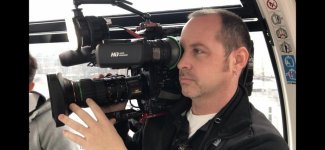
Interesting article about evolution of digital cinema cameras

CP
Of course yours inspired mine. If I had a 3D printer some of my mods would be neater.

Mine does have some secrets though..

The single hdmi is split to give hdmi out for a local operator and input to the transmitter. The splitter is 5v so my box also needs a 12-5v transformer

GOTCHA. Have you experienced any heat issues? can't tell from the one pic what the venting situation is like in there.
 
CP you can see my red HDMI, - if this rig is placed in my van or on the floor of a press centre the first thing to be knocked is the red HDMI, I use HDMI because the SDi already got bust :)

You may see my hombuild power is Transvideo style with the connector hugging the monitor (red arrow)

View attachment 139037

Jeez... That looks like a medieval torture device, Morgan.

That's why I still prefer this for actual operating comfort. And you can't see it, because my head is blocking it, but the wireless receiver is slotted INTO the body of the camera. No extra audio or power cables or anything extra hanging off the body. The VF is where it's supposed to be, as is everything else. Why can't the manufactures give me THIS with a s35 (or larger?) sensor?

IMG_4374.jpg
 
Why can't the manufactures give me THIS with a s35 (or larger?) sensor?
What is the Arri Amira lacking in this regard? To me it's the best S35 camera design for shoulder mount balance and ergonomics. My avatar photo shows a simple and straightforward setup with no dangling cables. Using the 17-120, I can also then use the handle on the lens rather than the Shape handles.

Teredek has a pass through power slot mount which attaches to the camera via the battery mount so you don't need to use power cables, just connect the SDI. Makes it basically the same setup as the ENG camera slot then.

https://www.bhphotovideo.com/c/prod...ek_11_0761_dual_gold_mount_battery_plate.html


I just thought of this; if you have one of those SmallHD's with a built-in Teredek reciever, and a Teredek transmitter on the back of the camera, you could then be feeding a wireless signal to your on-camera monitor as well as the AC and/or client monitors to eliminate an extra cable attached to the camera.
 
Last edited:
Jeez... That looks like a medieval torture device, Morgan.

Actually its well balanced and has a good set of abilities you might notice..
monitor for director
dangling XLR for fast addition of interview mic on wire
go pro
single vlock power

its just heavy and fragile and takes four or five power buttons to start :)

I could not agree more on the 2/3 build being preferable.

--

Eric , good point, - I love the Amera as a shoulder camera - I think one of the most under rated elelemnts is that it is thin so you can bring it close to the ear putting the mass closer to the spine.

I also love the fore aft dovetail build in for balance - Ive emulated that on my FS7 with a 20cm arca plate and zacuto wedge.

I think your build might be a little commercially unrealistic with not much audio or image transmission to director, add that stuff and it might end up as more spaghetti ?

ps - the Small/teradek might work but Im never going near Small again as per the earlier posts - they blew it with me. I would also be unlikely to have enough outputs on the body?
 
Last edited:
I think your build might be a little commercially unrealistic with not much audio or image transmission to director, add that stuff and it might end up as more spaghetti ?
Maybe, but that build worked stellar for the photo shoot of myself that it was built for. ;)

More seriously, my built up setups don't tend to get too crazy. SmallHD 702 with a power cable to the back of the camera and SDI, if we have an audio guy, a timecode sync box or Lectro receiver on the side of the body, and the Teredek on the top back when we have a Teredek (I not too long ago finally bought a Teredek, thus won't have the problem of not having one available as in some previous shoots). Another great aspect of the Amira's ergonomics is the real estate to put things; the Lectro can be velcroed to the side real estate and the Teredek on top as I said which with a C300 or Alexa Mini often means getting various rigging gear out to mount those items, mounting gear which adds weight, complexity, and cables that are dangling more. I mount my wireless follow focus via the top rails, that way I can completely remove the camera from the baseplate/shoulder mount when going to Steadicam or tripod to reduce weight and size.

Another benefit (aside from the better padding and other benefits) of me using the Zacuto VCT Pro baseplate with the Amira over Arri's crappy baseplates which I own that collect dust because they're crappy (that's right, a crappy Arri product), is that the fore aft distance can be adjusted to a much larger degree. I recall Matthew Allard saying he had trouble getting the Amira to fully balance with the 17-120 as the 17-120 is front heavy; I've gotten perfect balance thanks to using the Zacuto VCT Pro baseplate with the Vocas Amira flatbase adapter.

And yeah, the way it rests against your head in a manner that many other cameras do not provides an extra point of contact and thus stability.

I'm considering selling one of my two Amiras to replace with the original Mini in large part because the Alexa Mini has the name recognition that can get one hired for a job, but sometimes I worry that I'd end up disliking the ergonomics of the Mini. I don't shoot RAW or anamorphic so those would not likely be a big benefit that the Mini offers. Lighter weight is nice, but not necessarily at the cost of worse ergonomics, and the weight differences when fully rigged and balanced often begin to diminish.
 
Last edited:
The real kick in the nuts: great, established, proven camera design has been around for decades, but the manufacturers took the transition to "large sensor digital cinema cameras" as the opportunity to F it all up and throw all that away.

Have they though? The Alexa LF, Mini LF, Venice, C700 and DXL2 (in particular) are all set up pretty darn well (excluding the Mini LF's stupid external battery plate setup), and the ergonomics have genuinely been well thought out (for the most part) there's very little to complain about.

Less "productiony" cameras like the new C500ii/C300iii take a different approach ergonomically (they're designed around a solo operator rather than expecting a camera assistant to be there), but even so, they're really nicely laid out - with all the controls you'd want to access a simple physical button push away.

The upcoming Mavo Edge from Kinefinity looks similarly well laid out (and might just be the most fully featured camera any company has released to-date - and that's at the lower mid-range of the market).

Everything else, all the mass-market tiny cameras, are basically made for wedding shooters/youtubers who simply aren't working in conventional production styles, and want cameras they can mount on single-arm gimbals. So it's kinda silly to lump them in the same category - the fact that they can make images that keep up with the more focussed tools, doesn't actually make them comparable or viable for the same kinds of work.
 
What is the Arri Amira lacking in this regard? To me it's the best S35 camera design for shoulder mount balance and ergonomics. My avatar photo shows a simple and straightforward setup with no dangling cables. Using the 17-120, I can also then use the handle on the lens rather than the Shape handles.

Teredek has a pass through power slot mount which attaches to the camera via the battery mount so you don't need to use power cables, just connect the SDI. Makes it basically the same setup as the ENG camera slot then.

https://www.bhphotovideo.com/c/prod...ek_11_0761_dual_gold_mount_battery_plate.html


I just thought of this; if you have one of those SmallHD's with a built-in Teredek reciever, and a Teredek transmitter on the back of the camera, you could then be feeding a wireless signal to your on-camera monitor as well as the AC and/or client monitors to eliminate an extra cable attached to the camera.

I have a client with several Amira's and they are about the closest thing a s35 cam has gotten to a 2/3" ENG camera, but it's still not quite there. I prefer the button and switch placement on ENG cameras along with the turret dial for ND, as opposed to motorized systems, but the larger internal filters needed makes it harder(as evidenced by the F55/5 only having clear + 2 densities instead of your typical clear + 3). The Amira also doesn't sit on my shoulder as nicely, because it's a narrower body and sits up a little higher. And while I do like the flip-out LCD portion of the Amira VF, I prefer the larger VF on my Vari. I've also looked at the wireless power boxes, but they make the overall camera longer, which can help with the balance with a heavy lens by moving the battery and it's weight back without having to slide the camera on the shoulder mount as much, but you're still gonna have to tie up both of the XLR inputs with the wireless. Something I really like about my Vari's, I have options for audio. Typical two-man crew, I have the camera breakaway for the umbilical attached to the XLR inputs at all times and the wireless is feeding directly internally. Just have to flip a switch to go from wireless to hardwired and vice-versa if/when we need to. Doesn't sound like a big deal, but from doing this since the 90's and having a camera that has this ability for the last nine years, it's one of those things you don't want to give up and you feel like you're going backwards when you don't have it. I actually do have a quick switch system I made for use with my cameras that don't have internal wireless, but I still like the receiver inside better.
 
Actually its well balanced and has a good set of abilities you might notice..
monitor for director
dangling XLR for fast addition of interview mic on wire
go pro
single vlock power

its just heavy and fragile and takes four or five power buttons to start :)

I could not agree more on the 2/3 build being preferable.

--

Eric , good point, - I love the Amera as a shoulder camera - I think one of the most under rated elelemnts is that it is thin so you can bring it close to the ear putting the mass closer to the spine.

I also love the fore aft dovetail build in for balance - Ive emulated that on my FS7 with a 20cm arca plate and zacuto wedge.

I think your build might be a little commercially unrealistic with not much audio or image transmission to director, add that stuff and it might end up as more spaghetti ?

ps - the Small/teradek might work but Im never going near Small again as per the earlier posts - they blew it with me. I would also be unlikely to have enough outputs on the body?


On thing I definitely hate about my C300. Depending on the exact set-up, I could have to worry about turning on the camera, turning on the VF, turning on the wireless and making sure the lens is plugged in to the battery for the servos. And reverse it all when you're done. My Vari: one power switch period(camera, VF, wireless, lens). Unless you have a Teradeck or external monitor and if I'm running around with it, there's not an external monitor in-play.
 
I'm considering selling one of my two Amiras to replace with the original Mini in large part because the Alexa Mini has the name recognition

IMO you would want the mini because you do a lot with a crane or gimbal.

It seems there are two distinct styles, shoulder/sticks and gimbal/crane. It would not bother me if a camera did one of these things well.
 
Everything else, all the mass-market tiny cameras, are basically made for wedding shooters/youtubers who simply aren't working in conventional production styles, and want cameras they can mount on single-arm gimbals. So it's kinda silly to lump them in the same category - the fact that they can make images that keep up with the more focussed tools, doesn't actually make them comparable or viable for the same kinds of work.

I think about this alot - people operating with a GH5 on a gimbal. Should I bin the bigger camera and just lighten up both mentally and physically. But that is a struggle, I really cant imagine going out without some form of long lens and a way of seeing in the sun and a way of getting audio. *

Or going out without sound. I mean even if one is filming a music festival and the plan is to use music from archive or the desk I still want a mic on the camera for that moment where the client walks over and says (unplanned) Ive got Mr Jagger for 1 min for a soundbite. You cant be saying 'sound was not specced for this job' can you?

How are these kids so light (lite??) are they cool or riding for a fall?

I was taught 'picture without sound is a dead picture' which is why Im always recording something to paste under my slo-mo.


---
* I would have to be literally 'the pit guy' at a concert with two big lens operators there too.
 
The slimness of the Amira is nice, compared to cinema cameras , but i agree with RnG on the button layout. Cameras like the HDC27 already had it pretty right. And even the old ENG cameras weren't all that wide, and they narrowed and sculpted well towards the neck and shoulder typically.

48829187302_47d2e3934c_w.jpg

(^Arri Amira top slim profile)

Button layouts colour coded:
49679191173_32dbc98dc1_z.jpg

Green - core functions
Blue - white/black balance
Red - power
Yellow - menus and other
 
Last edited:
IMO you would want the mini because you do a lot with a crane or gimbal.

It seems there are two distinct styles, shoulder/sticks and gimbal/crane. It would not bother me if a camera did one of these things well.
I don't even own a gimbal or jib (aside from a 10 lb capacity Kessler Pocket Jib traveler that I never use anymore (can barely handle a C300; I used to use with a C100)). I have a full size Steadicam which can handle my Amira. I think one of the big selling points of the Mini is that it can be used on a gimbal for shoots that can't afford a dedicated Steadicam operator, but since I can always afford to have myself bring my Steadicam it heavily negates that benefit. Sure, there are still some types of shots that a gimbal is better suited for than Steadicam, but Steadicam works better in enough instances that the Mini's benefits of being able to be used on a gimbal (which I don't currently own anyway) are not as much of a benefit. I've been meaning to get a Seven Jib for awhile, which is rated for up to 50 lbs, so with a setup like that which could easily handle a Mini or Amira I still wouldn't see much benefit to a Mini.

I just think the Mini gets extra clout because of it's higher end features like open gate RAW and anamorphic, with lower budget productions not using open gate RAW, but those same productions look at what the big productions use and want to use the same even if they're not using the main features that differentiate the models, as well as the Amira having been marketed as a doc camera, so in the film and commercial world it can get looked down at for those reasons. That, and the difficulty of using the Amira on a gimbal, which for shoots without a DP who is a Steadicam operator is a bigger negative which a producer looking at me with a Steadicam may not immediately think of.

So yeah, I think the Amira is often better suited for narrative films than the Mini, if as I do you do a good amount of handheld, have a Steadicam and jib that can support the Amira, and don't need anamorphic or RAW. But a lot of times it's better to own the gear a producer who's hiring wants than the gear you consider best for the job, as this is a business. In any case, the Mini is no slouch of a camera, so it's not like a downgrade, and it has some features that would be nice to be in the position of having the versatility of owning both.

The Mini is $10k more than the Amira new, and $10-$20k more on the used market. Just recently with the pandemic I've finally seen some lower priced Minis as it used to be you could get an Amira for $20k used and a Mini for $40k+ used, which is quite a big difference, whereas I've recently seen a Mini for $27k on Ebay, which makes it more appealing, and also appealing compared to saving up $80k in the shorter term for a Mini LF. In any case, I'd have a difficult time justifying buying a Mini LF before they release the Super35 firmware as without that the camera is more limited in versatility.
 
Last edited:
The slimness of the Amira is nice, compared to cinema cameras , but i agree with RnG on the button layout. Cameras like the HDC27 already had it pretty right. And even the old ENG cameras weren't all that wide, and they narrowed and sculpted well towards the neck and shoulder typically.

48829187302_47d2e3934c_w.jpg

(^Arri Amira top slim profile)

Button layouts colour coded:
49679191173_32dbc98dc1_z.jpg

Green - core functions
Blue - white/black balance
Red - power
Yellow - menus and other

I actually put colored pieces of gaffe tape on certain buttons on my F55 and C300 to help quickly ID and locate them. A friend used to do the same on his C300, but with neon nail polish. I also put P-touch labels next to some of the buttons on my C300, because they’re assignable/customizable and/or only have numbers.

And yeah, we’re not talking about the difference in width between a one-lane road and two or three lanes. It’s kinda like coach vs. first class.
 
Back
Top