
Navigation
Install the app
How to install the app on iOS
Follow along with the video below to see how to install our site as a web app on your home screen.
Note: This feature may not be available in some browsers.
More options
You are using an out of date browser. It may not display this or other websites correctly.
You should upgrade or use an alternative browser.
You should upgrade or use an alternative browser.
Insects?
- Thread starter Gord.T
- Start date

Michael Lloyd
New member
(first post... since I'm a newb to moving pictures I guess it makes sense that my first post is in the still section)
A little-
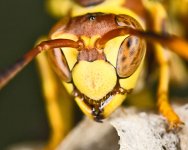
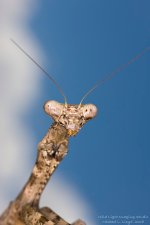
A little-


maranfilms
Veteran
I got some shost about a week ago of two ant colonies fighting, I had no idea what it was till I looked it up online, apparently it's pretty normal for ant colonies to fight over territory. it was cool indeed. Were talking thousands of ants to.
one mapped Dragonfly
one mapped Dragonfly
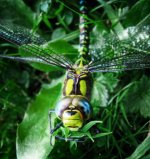
one mapped Dragonfly
This photo was taken with a Canon Rebel T2i. The colour and detail was enhanced using Photoshop native filters and HDR Efex Pro Tone Mapping plugin. Tone mapping is something I'm really getting excited about. Anyway, as it's an insect I thought this would be a good place to post....
Ian
http://pixelrev.blogspot.com/
Ian
http://pixelrev.blogspot.com/


HKB
Well-known member
That is some incredible work!

James Carpenter
Well-known member
I rented a macro lens a month ago and had a lot of fun trying to get some bugs and other things.
http://www.flickr.com/photos/96061250@N04/
The spider grossed me the hell out.
Nice work steB, there's some great shots in there.
http://www.flickr.com/photos/96061250@N04/
The spider grossed me the hell out.
Nice work steB, there's some great shots in there.

Doc Bernard
Indie Arms Member
Come on guys......LOL. Share what you used to get the pic. Lenses, filters, etc. Distance to subject.....camera.
That's a very common practice, so you can help your fellow photogs.
Maybe tomorrow, I'll break out the 500mm with macro and slap it on the D7000, and try my hand at it. There has to be some bugs around South Central LA somewhere.
That's a very common practice, so you can help your fellow photogs.
Maybe tomorrow, I'll break out the 500mm with macro and slap it on the D7000, and try my hand at it. There has to be some bugs around South Central LA somewhere.

Zephyrnoid
Veteran
By coincidence. I am posted a funny fb thread on the misadventure. Finally nailed my shots today. ANTS

Mark Williams
Veteran
Used a +4 screw on diopter from B+W on my HPX170 for the insect shots. You can see some of the macro shots here.
https://vimeo.com/69471313
https://vimeo.com/69471313
First, thanks to everyone for their compliments.
It would be difficult to know where to start as I have a pretty encylopediac knowledge about macro photography. One of the things I've done is try to develop methods and techniques, which I share with others to advance macro photography. I've developed light modification principles and methods for macro lighting, which have completely transformed how you can prevent blown highlights on shiny curved surfaces such as insects. I can also get flash light to look like diffuse daylight. Whilst the bits of stuff I use for diffusion may look crude there is a lot of thought behind it. I'm aware how many people are now using it around the world now because it leaves a distinctive lighting signature which I'm starting to see a lot of in published photos. Also I've worked hard on developing methods for approaching insects.
These 2 old discussion threads contain lots of advice and descriptions of these methods.
http://www.flickr.com/groups/bbcspringwatch/discuss/72157624094094213/
http://www.dpreview.com/forums/post/28619260
Essentially what I try to do is to share my ideas and methods with other enthusiasts and experts, who develop their own take on it. My real interest is conservation and ecology. I use macro photography as a way to get people interested in and connected with the natural world. The great thing about macro photography is you can do it anywhere. In your back yard, in urban greenspaces and even on your desk. There's more than enough exotic creatures and action in the micro world to satisify anyone. So it's not so much finding the location, but in learning the techniques and understanding your subject.
I can answer specific questions on techniques, but it is difficult to give a potted account because I use a lot of different methods. However I will do a quick decronstruction of a recent image.
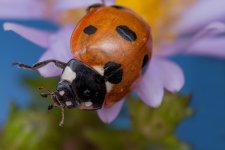
I would highly recommed seeing the full resolution file below to see the detail and lighting.
http://farm8.staticflickr.com/7325/9762312744_9c23f72751_o.jpg
This is completely lit by flash, although it was taken outside in wild natural vegetation. I was using a Canon 40D, Canon MP-E 65mm lens and an MT24EX macro twinflash. I used my end of lens light modification, similar to illustrated here. It was at ISO 100, 1/250s shutter speed, a nominal aperture of f11 (the effective aperture is much smaller), and it was probably just over 2x life size. Working distance on this lens is 4-10cm depending on magnification, which goes from 1:1 (1x) to 5:1 (5x) continuously.
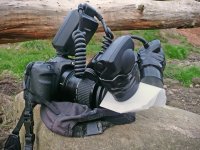
The problem is that at this ISO and exposure setting you will get a black background with flash, and any supplementary light, as the light level needs to be much greater than daylight can provide. So I use a small piece of blue plastic cut from an ice cream container for the background. I use a method called the left hand brace technique. You hold onto the flower with your left hand and rest the end of the lens on your left hand. The blue card was attached to the fingers of my fingers with elastic bands. I often use a piece of leaf in a similar way. It takes quite a lot of practise to do this as you have both hands full, and have to manipulate the subject and background with different fingers of your left hand.
http://dalantech.deviantart.com/art/Left-Hand-Brace-93226846
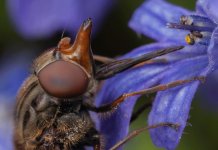
This animated GIF might be of interest as it's composed of 5 different shots in rapid succession. So it will give an idea how I shoot. This is not a large fly, and the maginification is probably greater than 3x i.e. about 7mm frame width or less.
http://farm4.staticflickr.com/3722/9626048784_1b4e62de87_o.gif
I would have explained more, but wasn't sure what the question was. Most of the information on my basic equipment is on the EXIF data on my Flickr photostream. I use Canon equipment. A Canon MP-E 65mm f2.8 1-5x lens for greater than life-size. For less magnification I mainly use a 70mm f2.8 macro lens, which is really super sharp wide open. It is one of the sharpest lenses out there. Plus a Sigma 150mm f2.8 macro which I commonly pair with a 1.4x converter. I use a Canon 600D (T3i) and an older 40D. Sadly the 40D doesn't have video, but I still like it for higher magnification shots as diffraction limits resolution.Come on guys......LOL. Share what you used to get the pic. Lenses, filters, etc. Distance to subject.....camera.
That's a very common practice, so you can help your fellow photogs.
Maybe tomorrow, I'll break out the 500mm with macro and slap it on the D7000, and try my hand at it. There has to be some bugs around South Central LA somewhere.
It would be difficult to know where to start as I have a pretty encylopediac knowledge about macro photography. One of the things I've done is try to develop methods and techniques, which I share with others to advance macro photography. I've developed light modification principles and methods for macro lighting, which have completely transformed how you can prevent blown highlights on shiny curved surfaces such as insects. I can also get flash light to look like diffuse daylight. Whilst the bits of stuff I use for diffusion may look crude there is a lot of thought behind it. I'm aware how many people are now using it around the world now because it leaves a distinctive lighting signature which I'm starting to see a lot of in published photos. Also I've worked hard on developing methods for approaching insects.
These 2 old discussion threads contain lots of advice and descriptions of these methods.
http://www.flickr.com/groups/bbcspringwatch/discuss/72157624094094213/
http://www.dpreview.com/forums/post/28619260
Essentially what I try to do is to share my ideas and methods with other enthusiasts and experts, who develop their own take on it. My real interest is conservation and ecology. I use macro photography as a way to get people interested in and connected with the natural world. The great thing about macro photography is you can do it anywhere. In your back yard, in urban greenspaces and even on your desk. There's more than enough exotic creatures and action in the micro world to satisify anyone. So it's not so much finding the location, but in learning the techniques and understanding your subject.
I can answer specific questions on techniques, but it is difficult to give a potted account because I use a lot of different methods. However I will do a quick decronstruction of a recent image.
I would highly recommed seeing the full resolution file below to see the detail and lighting.
http://farm8.staticflickr.com/7325/9762312744_9c23f72751_o.jpg
This is completely lit by flash, although it was taken outside in wild natural vegetation. I was using a Canon 40D, Canon MP-E 65mm lens and an MT24EX macro twinflash. I used my end of lens light modification, similar to illustrated here. It was at ISO 100, 1/250s shutter speed, a nominal aperture of f11 (the effective aperture is much smaller), and it was probably just over 2x life size. Working distance on this lens is 4-10cm depending on magnification, which goes from 1:1 (1x) to 5:1 (5x) continuously.
The problem is that at this ISO and exposure setting you will get a black background with flash, and any supplementary light, as the light level needs to be much greater than daylight can provide. So I use a small piece of blue plastic cut from an ice cream container for the background. I use a method called the left hand brace technique. You hold onto the flower with your left hand and rest the end of the lens on your left hand. The blue card was attached to the fingers of my fingers with elastic bands. I often use a piece of leaf in a similar way. It takes quite a lot of practise to do this as you have both hands full, and have to manipulate the subject and background with different fingers of your left hand.
http://dalantech.deviantart.com/art/Left-Hand-Brace-93226846
This animated GIF might be of interest as it's composed of 5 different shots in rapid succession. So it will give an idea how I shoot. This is not a large fly, and the maginification is probably greater than 3x i.e. about 7mm frame width or less.
http://farm4.staticflickr.com/3722/9626048784_1b4e62de87_o.gif
Attachments
Doc Bernard
Indie Arms Member
Those are really good! Usually for EXIF data....a pic caption will include camera name/model, focal length, stop, and shutter speed, i.e.: Nikon D7000, 50mm, f2.8, 1/250.

Gord.T
Still "Senior Member"
This is one of the stranger insects I've seen in your collection SteB. (Flickr's auto-play is great to watch these. Amazing pictures.)
Female Scorpion Fly.
http://www.flickr.com/photos/9578475@N02/5833711630/lightbox/
//Edit: Another one of my many faves. Isn't that the slickest thing you've ever seen? http://www.flickr.com/photos/9578475@N02/4589873877/lightbox/
Female Scorpion Fly.
http://www.flickr.com/photos/9578475@N02/5833711630/lightbox/
//Edit: Another one of my many faves. Isn't that the slickest thing you've ever seen? http://www.flickr.com/photos/9578475@N02/4589873877/lightbox/
Last edited:
Firstly, thanks @Doc Bernard.
Yes, and the males are even odder + you can see why they are called Scorpion flies. There's no sting though as they are harmless and feed mainly on dead insects they find on leaves i.e. they are sort of an insect vulture. I do have quite a lot of shots of them on file, but not which really satisfy me yet. They have a weak flight, but you need a keen eye to see them as they sit and flit about in the shade low in vegetation. Stinging nettles are the most common place I find them. The problem is they don't fly far, but they're very easily disturbed. They're my favourite for angles and geometry. I could get some great portraits, if they'd sit still. The problem is getting the best angle for the portrait. I change my angle for a better angle, and the fly moves with me. So I've got lot of not quite ideally framed shots of them. Their bad habit is to always look away from you. The one in the photo was at first light hence the dew drops. So all the insects are either still asleep or loathe to move. It gives me a better chance of getting my tripod in place.
http://en.wikipedia.org/wiki/Panorpa_communis
I take nearly all my shots of live insects in the field, so if they don't want to cooperate, they can, and frequently do fly off. So there are lots of failures on the way. I tend to think of it all as a problem solving exercise, and these are just experiments one the way to where I want to get. In other words my Flickr photostream is just a random example of much more.
My personal enjoyment is in the challenge. Getting the first type of shots of an insect etc. This is to inspire others to do better. It's also a great learning experience. Over the years lots of people have told me lots of things couldn't be done. So I had the greatest pleasure proving that it could be done. Doing it with wild insects in the field greatly increases the challenge because they can just fly off if they want. It means learning a lot about how insects see things, because I have to get so close to them with the end of the lens. I'm good at getting snatched shots. However for the best framed and composed shot you need a cooperative subject, which lets you work for the right angle. I find once I can follow hoverflies for a while. Then after time, they will just let me get close and accept me as something to be cautious of, but no more than they would be to say a Bumblebee. There's many frustrating days when I can see a lot of stuff an arm's length in front of me, but nothing will let me get any closer. So I can spend loads of time getting in position, and then nothing because the insect flies off at the last moment. With some stalks I have to patiently snip through the vegetetation with a tiny pair of folding scissors, for a clear shotl. Yet that's good, because it forced me to learn insect etiquette, and once you do, you can get very close to a relaxed insect. If it wasn't relaxed it wouldn't still be there carrying on normally.
This is one of the stranger insects I've seen in your collection SteB. (Flickr's auto-play is great to watch these. Amazing pictures.)
Female Scorpion Fly.
http://www.flickr.com/photos/9578475@N02/5833711630/lightbox/
Yes, and the males are even odder + you can see why they are called Scorpion flies. There's no sting though as they are harmless and feed mainly on dead insects they find on leaves i.e. they are sort of an insect vulture. I do have quite a lot of shots of them on file, but not which really satisfy me yet. They have a weak flight, but you need a keen eye to see them as they sit and flit about in the shade low in vegetation. Stinging nettles are the most common place I find them. The problem is they don't fly far, but they're very easily disturbed. They're my favourite for angles and geometry. I could get some great portraits, if they'd sit still. The problem is getting the best angle for the portrait. I change my angle for a better angle, and the fly moves with me. So I've got lot of not quite ideally framed shots of them. Their bad habit is to always look away from you. The one in the photo was at first light hence the dew drops. So all the insects are either still asleep or loathe to move. It gives me a better chance of getting my tripod in place.
http://en.wikipedia.org/wiki/Panorpa_communis
I take nearly all my shots of live insects in the field, so if they don't want to cooperate, they can, and frequently do fly off. So there are lots of failures on the way. I tend to think of it all as a problem solving exercise, and these are just experiments one the way to where I want to get. In other words my Flickr photostream is just a random example of much more.
My personal enjoyment is in the challenge. Getting the first type of shots of an insect etc. This is to inspire others to do better. It's also a great learning experience. Over the years lots of people have told me lots of things couldn't be done. So I had the greatest pleasure proving that it could be done. Doing it with wild insects in the field greatly increases the challenge because they can just fly off if they want. It means learning a lot about how insects see things, because I have to get so close to them with the end of the lens. I'm good at getting snatched shots. However for the best framed and composed shot you need a cooperative subject, which lets you work for the right angle. I find once I can follow hoverflies for a while. Then after time, they will just let me get close and accept me as something to be cautious of, but no more than they would be to say a Bumblebee. There's many frustrating days when I can see a lot of stuff an arm's length in front of me, but nothing will let me get any closer. So I can spend loads of time getting in position, and then nothing because the insect flies off at the last moment. With some stalks I have to patiently snip through the vegetetation with a tiny pair of folding scissors, for a clear shotl. Yet that's good, because it forced me to learn insect etiquette, and once you do, you can get very close to a relaxed insect. If it wasn't relaxed it wouldn't still be there carrying on normally.