Innovation (or the lack of)

keylight

Veteran
I was having a discussion over lunch about the state of innovation in the industry, when someone mentioned how much they wished Apple would jump into the DSLR market because... they are the biggest innovators EVAH!

I've not put a copy of this image on my phone (Android) so I can at least partially (and quietly) refute that argument.
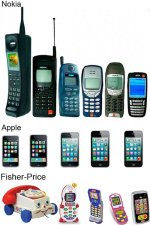
apple innovation.jpg

Who do you think are the big innovators in technology? In the film/video industry?
 
Im not quite sure your drift but

Sony Nex5r - talks to your iphone, does the F55 do that ?

I think camera interfaces etc are in the 1990s still

Again the GoPro - talks to your phone

Its a big thing - video village - or everyone checks in on their Ipad

Other little things - like the FS100/700 have that crappy IR remote that never works, but the NEX5r - well that has a remote that works

Obviously the apps - share to Facebonk - are not really much to our industry but the 5n has apps, the F5 does not?

And I think that is indeed lack of innovation.

S
 
Slates, funky timecode, fixed file naming, lack of meta data, lack of GPS data

All this stuff shows that really camera industry is not onboard with the basic electronics industry

Times really have changed, say in other areas of my business, huge PC systems for example not a scratch on google diary for one

S
 
Im not quite sure your drift but


I guess I'm asking what companies out there are innovating in big ways.

Apple clearly had a big innovation with the iPod and then the iPhone. But that last one was 5 1/2 years ago. They've just done iterations since.

If Apple did for cameras what they did for phones 5 1/2 years ago then that would be great. Unless of course they locked people into their ecosystem. Maybe a Google DSLR?

Or Microsoft? They stopped innovating years ago (some would argue they never innovated) but they're showing signs of actual innovation the past couple of years. I wish they had come out with Courier:

 
Keep in mind 5 years isn't really that long. I think just with the way things keep moving forward, that we expect the gap between revolutionary products to decrease. To expect something amazing every year is a bit much.

However I think there's a lack of inovation, simply because of the need for innovation. Simply put, things have moved forward so much that the room for innovation is getting smaller and smaller. Yes there can be better batteries, there can be faster processors, there can be wi-fi in everything... but then what? Once they take that step they can only improve speed and displays, and etc...

Perhaps we could start going a bit more sci-fi, holograms, smart glass, etc... but these concepts have been thought of already (google glasses?) and I'm sure are well on their way in the secret labs of microsoft, google, apple, etc... (perhaps waiting on other tech to catch up)

My dad runs a small programming company for accountants. I remember when they first came out with the product they wanted to have all of these features added to it. However they realized if they released like that now, they wouldn't have any upgrades. So they left features out just so they have something to offer the next time.

I think that's why companies are slowing down with their innovations. It feels like they're not catching up with the times, but if they did then they'd have less for the next time around.

People expect improvement even when improvement isn't needed. A great example I like to use is all the fancy flexing and super bristles that toothbrush companies are throwing out there. They seem to have a new technology every few months, but a simple toothbrush works just fine. A toothbrush is a toothbrush, but we'll always go for the the one that's 'innovating'.

Another more relevant exmaple is apple. Iphone is 5 years old and was the most evolutionary thing to happen in a long time. Iphone 5 was expected to change the industry... but it was a dud... but the question is, where do they go from there?
 
Last edited:
I'm sorry but I reject the notion that professional gear should interface with consumer telephone handsets in order to be innovative. We have cameras that can practically see in the dark and use cheap media and shoot with any lens ever made and etc etc, and at price points that can be covered with just one contract. That's innovative. Or at the very least it's a logical progression to somewhere new.

I think that the tech/science journalists are just doing copy-and-paste reporting of company press releases. We're told that the latest high technology is yet another version of what is essentially a sophisticated 2-way radio. Or a new social media website. Not high tech.

Though I've never seen it in person, this represents a direction I hope will continue in the future:
http://www.prg.com/product/foton-2-2-2/

Can somebody please come up with something that looks as good as tungsten, but without all the downsides? That would represent a true innovation. And one with a wide effect on society.
 
People expect improvement even when improvement isn't needed. A great example I like to use is all the fancy flexing and super bristles that toothbrush companies are throwing out there. They seem to have a new technology every few months, but a simple toothbrush works just fine. A toothbrush is a toothbrush, but we'll always go for the the one that's 'innovating'.

Another more relevant exmaple is apple. Iphone is 5 years old and was the most evolutionary thing to happen in a long time. Iphone 5 was expected to change the industry... but it was a dud... but the question is, where do they go from there?

I don't know, once I got my philips sonicare toothbrush, my visits to the dentist got a lot shorter! :grin:

I think Google Glasses could bring - if it becomes a real mass market product - a major change into how we live our lives. Already today, the sense of privacy and personal space has shifted from what it was just a couple of decades ago. People routinely post information and facts to twitter, facebook... that just 10 years ago they would never have told friends in the real world.
 
If Apple did for cameras what they did for phones 5 1/2 years ago then that would be great. Unless of course they locked people into their ecosystem. Maybe a Google DSLR?

Both iOS and Android have killed the point & shoot camera market. Not necessarily through the software, but through the ever growing capabilities of built-in camera sensors (lets drop the misnomer that a "DSLR" refers to some kind of pro camera...all it stands for is that it's a digital camera with a mirror in it for the viewfinder). I think the only "pro" feature outside of mere sensor specs will be FPS on the camera phones. I wouldn't be surprised if we're barreling down towards the phone being something of a viable option for professional photography, depending on what apps are used, and what controls are opened up for manual operation. Indeed, there's nothing wrong at all with using an iPhone 4S or 5 (or the Android equivalent) for a professional shoot in a controlled environment, and adding options like Raw stills and so on will only increase the phone's capabilities. You can already purchase mounts for additional lenses as well!
 
I'm sorry but I reject the notion that professional gear should interface with consumer telephone handsets in order to be innovative. We have cameras that can practically see in the dark and use cheap media and shoot with any lens ever made and etc etc, and at price points that can be covered with just one contract. That's innovative. Or at the very least it's a logical progression to somewhere new.

I think that the tech/science journalists are just doing copy-and-paste reporting of company press releases. We're told that the latest high technology is yet another version of what is essentially a sophisticated 2-way radio. Or a new social media website. Not high tech.

Though I've never seen it in person, this represents a direction I hope will continue in the future:
http://www.prg.com/product/foton-2-2-2/

Can somebody please come up with something that looks as good as tungsten, but without all the downsides? That would represent a true innovation. And one with a wide effect on society.

What about plasma lights? Like sulfur plasma lighting.
 
I guess I'm asking what companies out there are innovating in big ways.

Apple clearly had a big innovation with the iPod and then the iPhone. But that last one was 5 1/2 years ago. They've just done iterations since.

If Apple did for cameras what they did for phones 5 1/2 years ago then that would be great. Unless of course they locked people into their ecosystem. Maybe a Google DSLR?

Or Microsoft? They stopped innovating years ago (some would argue they never innovated) but they're showing signs of actual innovation the past couple of years. I wish they had come out with Courier:


Bill Gates and Co. really never 'innovated' much. The PC was an IBM design, and in the IBM world was seen as a 'smart data terminal'... and oh by the way enough disk and a BASIC programming language to tailor the box to 'custom' needs. Microsoft got the direct benefit of the IBM imprimatur, and the 'business' world took the box and ran with it... along with "Harvard Graphics" to do bar and pie charts for business... ooohhhh...

Legend has it that Steve Jobs formed his 'innovative' vision of the Mac after visiting XEROX Parc and seeing a Smalltalk system in action...

Sculley was the one who promoted the Apple Newton, the forerunner to the 'iPod/Phone/Pad' (you can see one in "Under Siege 2"(1995)). An early version of the ARM processor used in the current i{everything} was used in the Newton.

A few years after the Newton was ended, the ARM processor was up to running a 'real' operating system and 'innovation' happened.
 
Msoft with windows had monopoly for businesses and apple has monopoly for students.no magic or secret here.Windows should really stop on WinXP and upgrade new version with drivers for new hardware, theyre forcing new system on people and at the same time arent backwards compatible- big fail.
Apple clearly had a big innovation with the iPod
Whats innovative about mp3 player ? It was only about marketing and iTunes monopoly again.
Biggest innovation is to have monopoly on something and block other companies with court cases.
apple-braun.jpg
 
Last edited:
I was having a discussion over lunch about the state of innovation in the industry, when someone mentioned how much they wished Apple would jump into the DSLR market because... they are the biggest innovators EVAH!

I've not put a copy of this image on my phone (Android) so I can at least partially (and quietly) refute that argument.

View attachment 63873

Who do you think are the big innovators in technology? In the film/video industry?
The image you show is very telling. Apple innovated by introducing a product completely different from what was offered in the past, and then refining it over time. Nokia came out with a basic device and then refined it over time, responding to market trends. Two very different approaches, but the point is that Apple was the one to recognize that something different could be done.

The problem is what to do from there? You should read The Innovator's Dilemma to learn more. Fact is, most innovators really only have one "big idea" and after that they are often driven down as the competition borrows from their concept and refines beyond it. That's why patents and Intellectual Property laws exist. It's really, really hard to continue to think different and to innovate.

That said, I see interesting and fascinating new products every day. Most of the comments here are not of innovation but instead of evolution. Most products do not need to be innovated. They are good tools and they only need to be made better. On rare occassion someone comes up with something radically different that is actually worthwhile in that it solves a problem or opens up a new opportunity. Nobody knew they needed a Steadicam until Garrett Brown invented it. For the past 37 years he's been refining it. Such things are rare birds.
 
Oh goodie.... another Apple vs. Microsoft thread. :thumbsup:

Exactly... I read the first post and sighed... as a user of both platforms... I've never understood the passion and contempt on both sides for the other... it's like a pee-on-chevy sticker on a ford or vice-versa. Who gives a crap what somebody else prefers? Why on EARTH do people CARE what somebody else prefers to use?

Meanwhile... SETI hopes to discover intelligent life that God only knows why scientists expect we'll get along in some sort of kumbaya partnership... when human beings can't get along with their own kind over a myriad of trivial bullsh*t.

I realize this thread hasn't really "gone there" (yet)... but I had to vent anyway.

People should watch Pirates of Silicon Valley or maybe not... don't know how well it's holding up... but the gist is there.


Innovation? I thought the Foveon sensor was going to be it... but who knows. At this point I think GoPro is the ultimate innovator... they change their stuff every 1.5 years... and in each generation it's making leaps forward. Once GoPro gets some large sensors going... or decides to do something like RED did when they hit the scene... then we'll all be caught up in a wave of suddenly cheap and awesome camera capabilities. That's my innovation list right there... RED, GoPro, and Black Magic... for camera gear that's my top 3.
 
Oh goodie.... another Apple vs. Microsoft thread. :thumbsup:

Exactly... I read the first post and sighed...

[SNIP]

I realize this thread hasn't really "gone there" (yet)... but I had to vent anyway.

Why "exactly"? That isn't at all what this thread is about (and hopefully doesn't turn into).

Apple innovated with the iPod, although bwwd asks what's innovative about it. So maybe Apple brought the innovation (Creative's mp3 player) to mass market in a very usable and appealing way. Maybe they didn't innovate the tech, but I think they at least innovated how the tech is accessed and used. So, maybe Apple is mostly about innovating behavior.

Microsoft innovated with Courier, but never brought it to market.

What might tech (and non-tech) companies that are NOT in the camera (or other media tools) business be able to bring to our field?

What about robotics? iRobot has some pretty incredible hardware (mostly military) that could change the way we work. UAVs could change the way we work if the FAA approves that kind of use (they're in the rulemaking phase right now).

Autonomous cars could change, well a whole lot of stuff.

Now imagine an autonomous flying camera that can follow your subject around. Or that you can remotely control to compose shots from any angle. Or a flying microphone? Or lights? Or.....

So... what companies are innovating today in big ways?

I agree about Foveon and it's such a shame that it never really took off.

I think GoPro is less innovation and more evolution - refinement of the Flip (which was the big innovation) - although here too maybe it's more about innovating behavior (like Apple) than technology.
 
I have always felt to be considered "innovative" is "game-changer" stuff. Like the first digital camera. Or the first electric car. Or the first......well you get the idea. Adding bells and whistles does not equate to innovation in my book, neither does making something smaller. That is just natural progression, for the most part.

Take quantum computing. Now when that hits the market.....that's innovative. A motherboard with an extra slot for RAM is not.
 
I'm getting paranoid, all my electrical appliances and gadgets are talking about me behind my back
 
I have always felt to be considered "innovative" is "game-changer" stuff. Like the first digital camera. Or the first electric car. Or the first......well you get the idea. Adding bells and whistles does not equate to innovation in my book, neither does making something smaller. That is just natural progression, for the most part.

Take quantum computing. Now when that hits the market.....that's innovative. A motherboard with an extra slot for RAM is not.

I don't know that 'being first' is all that beneficial, at least financially... there's a combination of 'usable', 'need(or perceived need...)', and 'producible'.

You mention 'electric car'... well the Wiki gives a Hungarian 'one of the first status', for a 1828 'model' electric 'car'. A short time later an American has a 'one of the first' mention...

Nearly 200 years later we are beginning to see 'electric cars' more than just on the golf course... and even then the rich brother-in-law tells me that the 'range' for pure electric powered from batteries is about 35 miles for his Chevy Volt...
(and of course there were a flurry of e-cars around the turn in to the 20th century... that had disappeared in the first few decades of that century...).

The 'steam engine' at least something that whirled around when heated was known for nearly 2000 years or so before it was 'exploited' into the early phases of the Industrial Revolution...
 
I'm getting paranoid, all my electrical appliances and gadgets are talking about me behind my back

Open up your microwave and override the safety interlocks. The resulting mass of 2.4 GHz energy will kill off all Bluetooth, WIFI and many cordless phone conversations, and the voices behind your back that you can probably hear via fillings in your teeth, will drop down dramatically. (Oh, yeah, don't stand in front of the open door yourself...)... (and oh, oh, yeah... do you have any blasting caps in the area... you know... just in case the voices get too much and you have to fight back... well remove them... and place them in a 'safe' place... which you should have done anyway...).

Unfortunately this won't work on Government Surveillance Systems, for that you need major medication, often found at your parking lot pharmacy vendor.
 
Back
Top