inexpensive LitePanels on ebay

Anyone know why there is so many $1600 (or around) 1x1 LitePanels on ebay available? If the new light cost about $2500, those seem awfully cheap. Anyone know the reason? Are those some kind of knock-offs?
 
Hi Patryk, sometimes knock-offs are really better than the originals. Or perhaps the originals are knock-offs themselves from another similar product. It is amazing that in this industry there are no knock-offs in cameras and lenses as they would be impossible to manufacture considering electronics and tooling costs and the high risks facing trademark and copyright issues. As I don't have a model or link to see the unit (s ) on eBay, I can only imagine that there may be great similarities as far as performance/build/functionality and overall look of the unit (s). Sure marketing, distributorship, wholesale and retail channels all have to make a buck, but it's how much of a buck they make or like to chew on that drives the price up for the consumer. The consumer is at the lowest end of the totem pole that has to support the weight of all the profits above him. A classic case was the Comer 1800 led on-camera light that really was a dead ringer to the Sony version, Guess what ? the Comer was a better unit in every way along with hundreds of dollars less than the Sony. Was the Comer a a lower priced and better knock-off ? Absolutely. Can the Comer be called a knock-off ? Not really. Perhaps the Sony unit was the inferior knock-off to the Comer at a much higher price. Chances are that the Sony was manufactured by another company but had their name on it. In this dog eat dog world of competition, companies should really take a closer look at what's out there and price their products accordingly and not have the consumer pay a premium just for the name on the label. Best bet here is to wait and see for a consumer report or direct comparison with similar. Read the specs carefully, although many overrate their products by a wide margin. Also to consider is the after sale service and support. Where will the unit have to be sent out and how long the wait to get it serviced is an important consideration that will far outweigh the money saved. To answer your question, the reason they are "awfully cheap" is a combination of quality control, distribution channels, packaging, marketing, service and support, and the possible simple fact that they are not using the quality components as the higher priced models. Choose wisely.
 
They are either knock off's, or Litepanel estimated their sell through to be way too high for the market, and they overmanufactured the panels themselves, leading to a ton of stock sitting around that is now selling for cheaper. I'd guess knock off though

In my opinion, the price Litepanel asks for them in the first place is insane. Its an array of LED lights. Now I know its not THIS simple, but if you are handy with a soldering iron, and can find the right type of enclosure, you could build an LED array at home.

I've never found a decent use for the LED panels except when space / heat is a concern. If I am lighting a scene, I want actual tungsten lighting gear. Some Arri's or Mole Richardson 1K's. I'd never go to these panels as a replacement, only if they gave a benefit against traditional lighting. For me, they just don't. (except I did use them in a car interior. For that, they were killer)
 
Nice site...thanks for posting that

As far as my experience with LED lighting is concerned, I'll stick with lamp based lighting for now. Nothing LED based has held up to a nice 3 light Arri kit for my needs
 
I worked a music video this weekend and all the stage lighting was RGB LEDs. I was impressed enough with the PAR-like lights that I'm going to take a good look at what the concert and DJ market are offering now.
 
As far as my experience with LED lighting is concerned, I'll stick with lamp based lighting for now. Nothing LED based has held up to a nice 3 light Arri kit for my needs

Up until now I would have agreed with you. I was of the opinion that except for special applications requiring battery operation or for travel kits, LEDs did not offer sufficient additional benefit in general production applications to justify the cost – especially when the technology was evolving so rapidly that anything you purchase would be obsolete in a year or two. However, I think that Arri changed the cost/benefit calculation of LEDs with their new L7 LED Fresnels.

Knowing that their LED Fresnel line was going to be more costly per lumen than other light sources, Arri realized that there had to be an additional benefit or savings to justify the additional expense for them to be successful in market segments other than Broadcast Studio installations. For that reason Arri set out to engineer the first true LED Fresnel Light. The ability of Fresnels to render crisp shadows make them ideal for creating gobo effects like window or branch-a-loris patterns. The ability of Fresnels to render clearly defined cuts enables their light to be precisely cut to set pieces and talent. And, simply by adding one of a variety of diffusion material you can vary the softness of a Fresnel’s output. These are the characteristics of traditional Fresnels that make them extremely versatile, that the Litepanel Sola “Fresnels” have not been able to emulate. Arri, on the other hand, may have finally engineered in their new 200W L7 LED Fresnel a fixture that combines the cool-burning, energy-efficient advantages of LED illumination with the controllable versatility of traditional Fresnel fixtures.

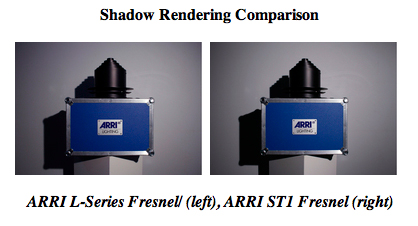
Arri_LED_Shadow_Comp.jpg

As you can see in the pictures above, that compare the output of the L7 Fresnel to an Arri ST-1 Quartz Fresnel, the L7 Fresnel has clear and defined shadow rendering capability like that of the ST-1 Quartz Fresnel. And, as the pictures below demonstrate, the L7 Fresnel has a spot to flood range similar to that of the ST-1 Quartz Fresnel and excellent field homogeneity in both flood and spot.


Arri_LED_L-Series.jpg

​

And, just like the ST-1 Quartz Fresnel (pictured below), the beam of the L7 Fresnel (pictured above) is easily controlled with barndoors - enabling the light to be precisely cut to set pieces and talent (see far right photos above & below.) And, given the discernable amount of light the L-Series Fresnel prototypes threw in a show demonstration video from IBEC last fall, on what appears to be a 6x6 Ultrabounce rigged 20’ overhead, and under the high ambient light levels of the show hall, it seems the production model L7 Fresnel has more than enough output to waste some to diffusion and color gel if one so desires (a shortcoming to most LED panels is that they have barely enough.)


Arri_LED_ST-1.jpg

​

It’s capacity to provide both hard crisp light that will throw a distance and is easily controlled, as well as offer soft light with diffusion, makes the L7-C much more versatile than any Fluorescent or LED light presently available. One L7-C will be able to do what it takes four Litepanel 1x1s to accomplish (spot and flood in 5600K and 3200K color temps) and appreciably more.

Another feature that offers tremendous benefit in location production is the fully tuneable color blending multi-emitter LED engine that they offer in the L7-C model. Capable of full spectrum tuneable white light with a CRI and CQS greater than 90, this LED engine makes the L7-C fully compatible with existing Tungsten as well as Daylight Light sources and makes it able to match to mixed-light environments without sacrificing output to color correction gels. Tuneable white light is a feature that benefits DSLR users in particular. One downside to lighting for DSLR’s native color balance of 5000K in the past has been that it requires an all 5000k balanced lighting package and HMIs are considerably more expensive to buy or rent. Kino Flo fixtures, particularly the Parabeams, were a cost effective alternative to HMIs because they could use either 3200K or 5500K tubes. But, the drawback to fluorescent fixtures has always been that they generally have a very broad soft light output that drops off rapidly which means the units need to be positioned close to the subject they are lighting. This characteristic has always made them better suited to lighting documentary interviews than dramatic scenes. With a 5600K output comparable to that of a 575 HMI Fresnel, the Arri L7-C offers the same benefit of being a less expensive alternative to HMIs, but also the added benefit of being more versatile than a Kino Flo.

Another feature that Arri has included in the L7s to benefit location production is Power Factor Correction (PFC.) Without a doubt, the even greater reduction in power consumption, and particularly line noise, that Arri achieves (that other LED manufacturers don’t) by incorporating PFC into their L7 Fresnels offers location productions an even greater cost benefit: not having to rent a movie blimped tow generator, with all of its’ hidden costs, in order to obtain decent production values.

Until recently, to power a lighting package sufficient enough to get good production values required a large diesel tow generator. Movie generators are not only expensive to rent, but they come with hidden costs that usually break the budget of modest HD projects. Movie generators require special tow equipment not found on Ryder or Penske rental trucks. For that reason, movie generators require that you rent a more expensive grip truck from a lighting and grip rental company in order to tow them. Lighting rental companies will not send out a grip truck without a company driver - further adding to the expense of renting a movie generator (in this market driver rates run about $500/10hrs with overtime after 10hr).

One of only a few LEDs available with PFC circuitry (and the only Fresnel near unity power), the L7 Fresnels will create virtually no power waveform distortion when operating on portable gas generators. For this reason, the generator will be capable of operating larger, or more smaller, lights than it could otherwise. With PFC in all your heads, you can load an inverter generator to capacity (use this link for details.) Which, in the case of our modified Honda EU6500is means the ability to operate up to 30 Arri L7s – effectively eliminating the need for a diesel generator in some situations. Even when you require a bigger gun like a 4k Par, the low line noise and power consumption of the Arri L7s make it feasible to operate an entire location package from a single Honda EU6500is. For instance, you can operate up to 10 L7s in addition to a 4k Par on the enhanced 7500W power output of our Honda EU6500is. And, since, Arri plans to introduce the ARRIMAX reflector technology to the 4k HMI power class (resulting in a head with the output and light quality of a 12kw Fresnel that can operate on a portable Honda generator), what can be accomplished with a portable gas generator will be tremendous when used with the latest generation of light sensitive HD camera systems like the DSLRs, the Red Epic, and the Arri Alexa (that is capable of a fourteen stop exposure range and ASA sensitivities of 1600 without grain.)

With Power Factor Corrected L7 LED Fresnels, ARRIMAX reflector HMIs, and Kino Flo Parabeams, you won’t need anything more than can be operated on the enhanced 7500W output of a Honda EU6500is to get decent production values in most production situations – effectively eliminating the need for a large diesel tow generator, with all its hidden costs. This is what has Harry Box so pumped about our HD Plug & Play Gen-set and why he has included it in the 4th Edition of his “Set Lighting Technician’s Handbook” ( use this link for details.) When you start to use the new math of not only lower power consumption, but also of lower line noise, to calculate what can be operated on a portable gas generator, you quickly realize that the savings of not having to rent a large diesel tow generator to get good productions values starts to outweigh the additional cost of the Arri L7s. And, when you factor in the hidden costs of renting a large diesel tow generator – the rental house grip truck, truck driver to tow it, and the extra electrical crew to distribute the power – the cost savings more than offsets the additional cost of the L7 LED Fresnel.

The final thing Arri did that makes me feel comfortable investing in them, was to build the L7 on an expansible platform. Not only, do the heads allow for the incorporation of more efficient LED chips when they become available, but the light engine is also fully upgradeable, ensuring that the fixtures can take advantage of technology advances as they happen. To accommodate future control protocols (such as ACN), their firmware is also upgradeable through the USB port on the rear of each unit. They are also compatible with planned future optic accessories that will expand the L-Series versatility. Able to incorporate future developments in LED technology, the expansible platform of the L7s ensures that they will have a long useable life and so will assure a return on investment in them. Given the rapid pace of LED chip development, I can’t think of another LED fixture that won’t be obsolete in a year or two, making the Arri L7 Fresnels the safest investment out there. I have posted more detailed information on the Power Quality generated by LED power supplies and a demonstration video of the new Arri L-Series LED Fresnels, at my website at www.screenlightandgrip.com/html/emailnewsletter_generators.html#anchorHigh Output AC LEDs.

Guy Holt, Gaffer, ScreenLight & Grip, Lighting and Grip Rental and Sales in Boston.
 
mystery solved - those are chinese knockoff that are made to look like litepanels. Buy would i hate to spend over $1500 on something one can have from Richard at Cool Lights for 1/3 of price and i'm sure way better customer service.
 
Back
Top