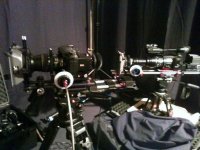
I think adaptors are still the best bet.

I'd like to personaly thank canon, panny and all the rest of these major companys for making it possible for a poor indie such as myself to tell my stories. These are all just tools, and the film look lies on the end user of these tools not the cameras as we have witnessed time and time again.
 
My point is that the "look" is not the same (aside from the afore mentioned technical problems). The Adapator and the ground glass will give you an "emulsion" look while the non adaptor systems will not. How do I describe the "emulsion" look? As some sort of imperfection which allows the medium to be part of the image. A vibrating adaptor will add ground glass grain. A rotating adaptor will add the GG movement in a very subtle wobbling effect. With adaptors the white is not as white as with the non adaptor systems since the GG is never perfectly white. As a result adaptors will be less contrasted, more grainy and-or more imperfect and will more look like analog or film. The non adaptor systems look digital and more harsh.
 
I find shooting weddings much faster with DSLRs. When you have a bunch of DSLRs, you can very quickly bounce from accessory to accessory (slider, crane, steadicam, tripod, monopod) and get all the shots you need. This is just in my experience. For certain narrative situations, a traditional video camera is certainly faster.

The 5D now has histogram since the 24p firmware update. It goes away while recording but that's not much of an issue in my opinion/experience. There's no need to take a still shot to check exposure.
 
We may not be talking bout the same things. If you're talking about weddings or coorporate videos, it makes no real difference. Any camera will do since film emulation is not the objective here.

I'm talking about movies for the big screen. Adaptor systems look much more like the product was made on film.
 
I too concur, After using an EX1 w Cinemek G35 and also a 7D with manual lenses ,side by side, the look of the adapter is far more filmic in many ways! But as we all know Films need crews, lighting and time! The 7d is great and was helpful with motion control and small spaces.
Basiclly, You get out what you put in! Many interviews with DPs reveal "hdslrs are for b rolls," (Rick Mc'callum, Lucas fIlm) and background plates for 24 quoting Mr Charters! Places where a a small camera can fit!
Reality television, Music Videos with MB looks, Nature and time lapse, great! I wouldn't at least right now, shoot a feature only with a HDSLR. Too much time in Post! But there are specific tools right for each job, golf clubs right for each shot, that is really what it is. Budget issues doesn't always allow us to choose the right or best camera, you do the best with what you've got to work with, the talent behind it will always be the most important. Cheers for your thread, kodjo!
 

Attachments

  • 7d twins.jpg
    7d twins.jpg
    304.8 KB · Views: 0
Last edited:
How would you pit the 7D against the blade setup?

With a fast lens the 7d destroys the blade setup in lowlight.

But for lit and daylight shots, I like the Image quality and video functionality of the sgblade/camcorder setup much better.
 
I feel the same way. I think the only real advantage of DSLR is portability and low light shots. For everything else, adaptors are better. Read my post on the Zacuto shootout on this forum. I just posted it.
 
I have to intervene here, but it really sounds like you've never actually seen raw footage from a higher end camera, or DSLR camera blowup up vs. a 35mm adapter footage blown up to film... You're getting mad at a moderator for giving you real world info ....

Fact is you are speaking from the stand point of one person, and this is a form for helping others, if you have nothing useful to contribute there's really no reason for you to be posting on here.

Your fact's are not backed up by anything other than your non-caring about anyone else but yourselves- opinion. That helps no one on here.

The things you are talking about are completely backwards... If you blow up to film, you are going to see a lot more problems with an adapter footage than say a DSLR.

Now if you do your research on me, I pretty much HATE the use of DSLR's but on this, using facts I will have to side against you and with DSLR's. Having DSLR footage blown up to film projected, or projected digitally produces way nicer results than through a ground glass type device. The image is too soft when viewing ground glass adapters (and you keep spelling adapter wrong, its not "adaptor"...

I stand up for teaching people proper techniques and information. This is not Wikipedia, facts here matter, some people view this everyday as their important source for information and education to questions that cant be answered in other places.

I suggest you either respect this Form and the people who run it, and write for it every day. or start your own form considering, you really don't care about others opinions (as for your statement earlier about not caring about clients. and considering most of the people on here eventually have clients and or want to have clients in the future, your statements don't matter to us at all.) What you may want to do if you would like to have others view your opinions and not comment on them, is start your own blog.

This site is for helping others. Either contribute accurate or artistic information, and chime in when others respond with an opposition , in a proper manor, or don't post at all.

MY OPINION -

P.S. The moderators are here to make sure you follow the rules, and you are not following the rules of the form, hence why he chimed in.
 
Last edited:
Do people really blow media up for film nowadays, i really don't know how that is an option when talking low budget" Digital DI and Digital Projection and Reel 3d is the future. They used to say don't use any filters to diffuse your CineAlta if u g o to film, but it looked way to raw. We are supposed shoot things technically, super clean and then we spend months in post making it look washed out and gritty on screen. Shoot the mood in the first place and capture it! Technical issues are important but the Mood is everything! Cheers
 
Do people really blow media up for film nowadays, i really don't know how that is an option when talking low budget" Digital DI and Digital Projection and Reel 3d is the future. They used to say don't use any filters to diffuse your CineAlta if u g o to film, but it looked way to raw. We are supposed shoot things technically, super clean and then we spend months in post making it look washed out and gritty on screen. Shoot the mood in the first place and capture it! Technical issues are important but the Mood is everything! Cheers

The reason why we shoot everything clean, is because in the field if you make a change you cannot change in post, and someone changes their mind later, you cant go back.

In Hollywood everything is a gamble, and everything is subject to change at any moment, due to all kinds of things. You shoot clean so you have the most options later on. If you spend 5 million dollars on a film, you want to maximize that 5 million dollars. It insures your investment has multiple paths to go down, later in post. If you created in the field, something that couldn't be worked with in post, you are pretty much screwed, and it will cost even more money to fix the problem.

Things are shot clean not because anyone is lazy, or un-artistic... It's done because its the smartest and safest way to ensure your production is safe from mistakes and keeping your production open to change which happens all the time.

And media is blown up all the time, in fact one of the worlds biggest "indi" hit was blown up: "paranormal activity". That was a HUGE hit. This happens all the time, and will happen for many years to come. Even if you're not doing a "blow up to film" you will still have people blowing up to whatever resolution is standard at the time for a digital theater projector. If thats 2k, and you shot 1080p, although its close, you are still doing a "blow up". Basiclly low budget films ARE the ones getting blown up, not large budgets that can afford to shoot 35mm.

Even an Oscar winning movie such as "The Hurt Locker" were shot on 16mm and blown up. The movie that changed everything "Avatar", was only shot in 1080p, that was also a blowup. So so sum it up, yes blowups happen all the time, and is going to happen for many many many years. But mostly its the smaller budgets that will be blown up.

When you are working in post to get the mood you want, you are also ensuring that the mood is consistent throughout the entire film. Post color correction, sfx, and other things also have to be factored in.

Even if your film is a straight drama with no visual fx what-so-ever, you should shoot it clean so that in post, color can be graded and matched so consistency is achieved throughout your film.

This is even more important in lower budget films, that don't have the budget or time to check and make sure your footage is exactly matching the mood of something you shot 20 days ago.

Those are just a very small amount or reasons why you need to shoot it clean. VFX is another HUGE reason, but that goes without saying.
 
Last edited:
Does everybody here agree with Giuseppe's PERSONAL OPINION that DSLR definiately looks better than adaptor systems when blown up?
 
My point is that the "look" is not the same (aside from the afore mentioned technical problems). The Adapator and the ground glass will give you an "emulsion" look while the non adaptor systems will not. How do I describe the "emulsion" look? As some sort of imperfection which allows the medium to be part of the image. A vibrating adaptor will add ground glass grain. A rotating adaptor will add the GG movement in a very subtle wobbling effect. With adaptors the white is not as white as with the non adaptor systems since the GG is never perfectly white. As a result adaptors will be less contrasted, more grainy and-or more imperfect and will more look like analog or film. The non adaptor systems look digital and more harsh.

Well all of this is your opinion, and unfortunately opinion and fact are far apart in your writing.

Ground Glass is there to have the image projected onto it. When you white balance your colors shift so that white is white. Period. You aren't getting a "not perfect white" as you are putting it, because the CCD or CMOS chip once white balanced cancels all of that out. Unless of course you don't white balance... then lets just say, good luck with that... You would have more problems getting proper color and contrast from the lenses you are using, than from the ground glass. There is more shift in the coatings on the internal, front, and back elements on a lens, than color shifts from a ground glass.

You seem to speak a lot about film as if you've worked with film a lot, yet you seem to not be up to par with film stocks of our age are at. They are super clean, yes the have film grain, but when you are watching that fresh Arrilaser print in the test theater, you don't see all of this "film grain" that you are talking about. Its clean, its beautiful, crisp.

I have a feeling what you are talking about is the film grain you see in the movie theaters, which is completely different. Those film reels are played over and over and over again, and mass produced, thus greatly affecting the quality. there are also very few movie theaters that keep up to standards of quality of projector, projector lens cleanliness, and screen reflectivity/fade. Also sometimes air clenlyness within the projection booth can affect the look. In the projector even thought the motion and air is blown over the print to remove dust, dust still will fly and land on the front of the lens. All of this accounts for some of these artifacts. You also must realize that once you "blowup" to film, you are adding film grain right there, it doesn't just all of a sudden go away just because you shot digital in the first place. By the time you are watching a film print in a movie theater there are MANY prints that were made before it got to that final. Adding all kinds of grain. There are a bunch of "answer prints" made after chemical tests, after coloring, after all kinds of things before you get into a theater.

If your film was actually making it to a theater other than a one time showing in a film festival setting, you will have tons of steps before that final theater print is made. Thus adding all that lovely film grain and look you are talking about.

I very much hope you get a blueray player, a 1080p monitor and watch some movies that were direct from the Avid cut to the Blueray that were shot on film. The images are CLEAN as day. None of which you are talking about is seen unless they put it there or used a stock that had more grain.

Second of all... The DSLR's have been personally tested at LUCASFILM. aka Gorge Lucas's compound.

The DSLR footage was projected in 2k in his personal viewing theater with 40' screen. The same theater that reviews all the other films that LucusFilm works on for post production. They were stunned and blown away by how great the footage looked. They commented on how filmic it was, not only that, but how amazed they were at the low light abilities with hardly any noise.

The look is WAY closer to film in terms of quality of image and everything else you speak of. Yes there is horrible wobble, and deeper depth that I just don't like, but as for image quality, besides the lack of bit depth in color, it is worlds better than a GG, as well as being way closer to the look of an actual film stock, considering their gamma curves within the camera are as close to film as you can get at that price.

These aren't opinions, they are facts. I think you have the "film look" confused with the "im going to add grain/vignetting/and other factors to look like beaten in film".

If you want to start a fight here, do it with someone else, I like to help others with knowledge of film, weather it be digital or good ole' celluloid. I look for the same on this forum as well, I don't know everything, I ask questions I can't find elsewhere, I have conversations with very skilled individuals who have top end clients in the industry. If I ever need technical help, this is one of the first places I ask.

And one more thing, clients do know their stuff, just because your clients didn't know, doesn't mean ours don't know. My credits go as high as MTV, VH1, Bravo, MTV3tres, NBC Universal, and others. My clients know a lot. Don't talk down down to others just because you are having a bad night. I am trying to educate, you are trying to pick a fight.


:costumed-smiley-047
 
Does everybody here agree with Giuseppe's PERSONAL OPINION that DSLR definiately looks better than adaptor systems when blown up?
Heck yeah.

Sorry Huy Vu, :)

You seem to speak a lot about film as if you've worked with film a lot, yet you seem to not be up to par with film stocks of our age are at. They are super clean, yes the have film grain, but when you are watching that fresh Arrilaser print in the test theater, you don't see all of this "film grain" that you are talking about. Its clean, its beautiful, crisp.
This is so true. Compared to movies I've watched just 5 or more years ago film today is so dogone crisp. Like these DSLRs.
 
Back
Top