I Still Love Tungsten

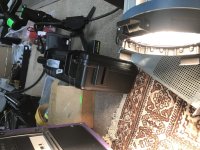
grug - I wonder if your real pleasure from that wasn't the fuller spectrum, but just the quality of light - that sort of specialness? I can't describe it, but mainly because of heat in the summer and of course expense in running costs, I put all the old lighting away. With LED I can have softlight and I can have shadows, and without any treatment, the image look pleasing and 5500K seeps to give me the colours I expect - but something is missing, and I don't think its lack of continuous spectrum? As I do a lot of theatre, I have loads of RGBWAUV colour mixing lights and I can have any of these and the blends that work, but it's all a bit .... sterile? It's also so cold today, I've actually pulled out a 1K to use as a heater!
 

Attachments

  • heat.jpg
    heat.jpg
    127.1 KB · Views: 0
Obviously some DPs prefer using only Tungsten lights, but I'd say the majority use LED as well, along with HMI which is lower CRI than LED. One way is not better than another; it's just a matter of preference and style of the DP. But again, if we're speaking of majority, I believe the majority use a mix of lights instead of going Tungsten only.

Deakins used 100 Skypanels for a scene in Blade Runner 2049. I believe he also uses Tungsten sources quite a bit.

https://www.arri.com/en/company/arri-news/news-stories/2017/lighting-blade-runner-2049-


Going back to my original point; I think it's a bit short sighted to be worried about Tungsten vs LED as far as skin tones if one is not currently getting the best skin tones from other factors that are more likely to affect skin tone quality, namely camera and lenses. Then again, tungsten lights are more affordable than the best cameras and lenses for skin tones, so I suppose it's a more attainable color quality improvement for many.

I dont think the point is that you're a loser if you're not lighting with tungsten. Or even that the big boys use tungsten, because usually they don't.

I think the OP was pining for the quality of a light source we have all largely eschewed in favor of LEDs. LED lighting has many advantages over tungsten, but color reproduction is not one of them. To paraphrase Crocodile Dundee, "it looks like ****, but you can live off it."
 
Hmmmm.... I think someone's opinion on this depends greatly on the kind / type of shooting - and perhaps more specifically - the amount of space, crew and electricity you have at your disposal.
All my tungsten fixtures have been gathering dust for about the past 2, maybe even 3 or 4 years or more... I literally don't think I've used a one of them. But then most of my work is supplementing / matching existing lighting - often in large industrial areas (which tend to either have 45k or 56k lights more often than 32k). And for me, personally, I don't miss having to gel hot lights to try & get 4300k or 56k color temps - or having to have a generator or long run of AC to keep from blowing breakers. I still use 800w Joker Zoom when I really need the punch - but even it doesn't get pulled out as often. Certainly tungsten has it's place and can look great... but again, for my work, the convenience, speed and lower wattage / heat of LED is worth the possible trade-off of less spectrum - which arguably may not be the case - if not shooting at 32k.
 
It's really simple.

If the light source doesn't emit some part of the colour spectrum, then what you're lighting that has that colour won't reflect that colour and therefore won't be reproduced accurately. You can't use a gel to add colour in. it only reduces the other colours to attempt to balance it. But if it's missing then it's missing. Cameras of course also have their own colour response as well, but we're talking about lighting right now.

No LED light can match what Tungsten does in terms of full spectrum and frankly neither can a lot of HMI's or Fluros. HMI's are hugely variable fixture to fixture depending on the age of the build etc.

Yes LED is getting close. But it's not the same. And this is SUPER easy to test. Dare you to.

I do lot's of very fussy sensor type testing and once I though I could cheat using a skypanel. If I'm testing for daylight colour, I'll use tungsten gelled and metered using something like a Sekonic C800 to be exactly the white point I am trying to hit. Using a Skypanel I got to the same numbers but you could tell instantly something wan't right in the evaluation against previous versions of the same test I'd done with colour reproduction using Tungsten lights. I had to do them again using Tungsten gelled to daylight and then we could really see what was going on.

There's lots of good videos for this. I like this one because it has skin tones, but it's skewed more towards "good" lens and "bad" LED lights (though they do show tungsten as a control), but the concepts are what I'm talking about here.

https://youtu.be/5U-F7EhLp7g

And of course it depends on how fussy you want to get.

But if colour reproduction matters, if you're going for beauty lighting, you want rich lush skin tones, then nothing beats tungsten. Are you prepared to put up with the downsides ? A light that only outputs about 10% of the energy you put into it as light and the rest as heat ? Typically is much heavier and more cumbersome ?

On the plus side they are really cheap fixtures to buy for what you get. And they often can do jobs that LED's can't do yet and for total light output there's no comparison.

I was talking to the studio that have my lighting rig left over from The Great. They were upgrading the climate control because of Covid and had done some power calculations and asked me to explore changing over the tungsten lamps for LED ones because they emit far less heat.

The problem is that there's nothing that can do what an Arri T12 does in LED. Not only does it not look as "nice", there just ins't anything that has the same photometries, where you can mount the lamp 30" away and blast it through a window with drapes from that distance and still get a T5.6 base reading in the flood position for an ISO800 camera. Closest I could find 4 months ago was an unmet shipping Mole 20K LED. Even on paper it wouldn't match a T12. And the cost increase was ridiculous. And, I know for sure it still wouldn't have looked as good in terms of skin tones.

The show I'm on right now has very well known A list old fashioned Hollywood actors. We have hundreds of sky panels because they suit the look and the modern feel of the show and it's the second seasons sit somewhat established. Yet I'm doing my key lights on the close ups as a couple of blondies into a book light while I have 2 x 360 Sky panels for the back ground.

I did a scene a couple of days ago where number 1 is in a cinema watching a promo of for the show she's on and I "only" used a couple of 360's in pixel mode to simulate a cinema screen, so of course in that scenario it's appropriate to use an LED source as the key. The animation benefit outweighs the need for beauty and it's "fine" in that one scene to do something like that.

Use the right tool for the job.

Tungsten still can't be beat if colour and beauty is what's most important, but there's lot's of times LED do things better and can also come close to being as nice as tungsten.

JB

(EDIT, had the wrong clip like din you, fixed it now)
 
With tungsten, I wonder if it is the deep red, or the reduced blue that is doing more of the "beautifying"?

Fewer colour spikes and a warm bias would be enough to allow skin tone to look pleasing. But it might be interesting to see skin tone under incandescent that has the deep red spectrum diminished.
 
I'm still not completely sold on the 'beauty' element coming from LED/Tungsten. Even Black and White looks better from our old kit, hence my feeling (completely subjective, of course) that what we are missing is optics - reflectors, real lenses, shutters, peaky/flat field adjustment, barn doors, gobos, doughnuts and going back years and years colouvred Fresnels, although not sure if they ever made it to the US.
 
I'm still not completely sold on the 'beauty' element coming from LED/Tungsten. Even Black and White looks better from our old kit, hence my feeling (completely subjective, of course) that what we are missing is optics - reflectors, real lenses, shutters, peaky/flat field adjustment, barn doors, gobos, doughnuts and going back years and years colouvred Fresnels, although not sure if they ever made it to the US.

Could it be both? Separate to the optics, it's pretty easy to see a difference with a tungsten light being bounced/diffused with large frames.

A b/w comparison would be interesting. I remember a stills photographer talking about controlling the grass on a black and white image by adjusting the green levels, sort of like an extra contrast dial. I know not all editing programs work this way though.
 
All this talk about deep red smoothing... I don't know if I'm really convinced that tungsten light is a better beauty light than daylight. Because daylight is also a full-spectrum source (although perhaps it has modest spikes in places?), then won't you get a similar effect on human skin by balancing for the proportions of wavelengths (ie setting color temp)? All the same colors should be represented, no? I've seen skin tones look absolutely stunning in direct sunlight all the time....or at least, they look as nice as the person's skin does
 
It’s not about about the red/orange white point of tungsten.

It’s about the flatness and evenness of its spectral output. Don’t confuse the white point with the overall spectral emission. It’s not a better beauty light because it has more orange red. It’s better because it has flat and even colour across the board.

I gell tungsten to 5600 all the time. It’s just as great at 5600k

JB
 
It’s not about about the red/orange white point of tungsten.

You are right about the even and nice graduation of the spectrum, but there is also that aspect of warm tones that adds to the allure of tungsten.
 
It’s not about about the red/orange white point of tungsten.

It’s about the flatness and evenness of its spectral output. Don’t confuse the white point with the overall spectral emission. It’s not a better beauty light because it has more orange red. It’s better because it has flat and even colour across the board.

I gell tungsten to 5600 all the time. It’s just as great at 5600k

JB

I agree with you. I was responding to this point, although it's possible I misunderstood him:

Shooting with red light lowers skin contrast .. ie smoothens the skin.

Googiny 'black and whte photograhy blue filter portrait' demos the rough skin look of not enough red light and googling I guess 'hollywood classic portrait' shows the opposite - the smoothening effect of tungsten.
 
Well, RnG, looks like we've covered the whole spectrum on this topic. Even if some of us are a little bias.
 
If one searches black and white portrait blue filter (no red frequencies) one sees very exaggerated skin texture - it’s because reddish bits of skin read dark.
It’s entirely not a myth - nor it’s opposite - red light creating smooth skin.
I guess one could add an orange filter and wb at 10000 - interesting test :)
 
Back
Top