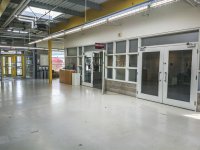
How would you light this scene?

marvinhello

Well-known member
Have a shoot coming in a few days, it's a night interior shoot inside an art gallery (also adjacent hallway).

Theme is fantasy/romance, three characters, one normal guy, one female dancer in red dress, one security guard.

The fluorescent light tubes are 3600K temp, with strong green tint and discontinuous spectrum. It can't be turned off unfortunately.

pics taken in daylight
(inside the gallery)
2014-10-24-0191.jpg

(gallery entrance)
2014-10-24-0192.jpg

(adjacent hallway)
2014-10-24-0193.jpg

we have access to tungsten fresnels, kinoflos, red heads, blondes, HMIs and a couple of 1x1 LED.

Any suggestions on how to approach lighting this scene? thanks in advance!
 
Any light can be turned off - you just haven't found the right person to talk to yet.

Failing finding a switch, my suggestion would be to get on a ladder and try to replace the bad tubes with better, or at least twist them until they go out. Then you can get started with lighting your scene - many ways to do that with the "blank canvas" lumen-wise, but first things first.

The other option is to load up on the plus-green gels and try to match the light that's already there, compensating with camera white balance while lighting just the talent and selected bg accents with your movie fixtures. Can be done, but it's harder to get good results with such limited control of your environment - negative fill will be your friend.
 
Last edited:
Any light can be turned off - you just haven't found the right person to talk to yet.

Failing finding a switch, my suggestion would be to get on a ladder and try to replace the bad tubes with better, or at least twist them until they go out. Then you can get started with lighting your scene - many ways to do that with the "blank canvas" lumen-wise, but first things first.

The other option is to load up on the plus-green gels and try to match the light that's already there, compensating with camera white balance while lighting just the talent and selected bg accents with your movie fixtures. Can be done, but it's harder to get good results with such limited control of your environment - negative fill will be your friend.

Thanks, we now have full control of the tubes, they can be turned off.
 
Have a shoot coming in a few days, it's a night interior shoot inside an art gallery (also adjacent hallway).

Can you find a better gallery? This location works against you every step of the way. Sure, it's a real-life art gallery, but looks like a factory. In your movie, it will look like you found a factory and hastily hung up some pictures to make it look like an art gallery.

Theme is fantasy/romance

It would be easier to change your theme to industrial/sci-fi than to light this set as fantasy/romance.

It would look better if you took some pictures and hung them in your living room, and tried to make that look like a gallery.

I'm not usually this pessimistic. Maybe some lighting genius can give you advice that will totally transform it. But in general I try to go with the grain of what I have.
 
The first pic does look like a gallery, just leave the ceiling out of the frame. The other two, you're right, they don't look like a gallery to me either.

Now, about lighting... I would also like to know what more-skilled-than-me fellows would do in that first place.
 
How can anybody give useful hints here?

We need to know:
-what kind of film this will be
-how does the rest of the film look like
-what is the key function of this particular scene (dramatically)
-who's the main character here
-what's your budget
-how many lightning technicians will have how much time to light the scene
...

I'm not a lightning professional at all.
But I'm sure that you need to know first, what exactly you wanna tell with
this part of the story and how the rest of the story is already told.
 
As I understood it, he especially asked about the fluorescent lights in the hallway, because at first he could not turn them off. The gallery itself is not terrible, but the hallway looks like a factory or school (because of modern architectural trends I sadly can't tell which).

It looks to me like someone decided to insert a gallery into some other building. This building is otherwise so unlike an art gallery, and furthermore unlike the theme of fantasy-romance, that I thought that he in fact would get better results if he did what this building's owner did: pick a building, find a room, hang some pictures, and light it.

Or he could use just the art gallery and shoot the hallway scenes in some other place.

Or he could just shoot everything at this place. I'm sure it would come out as adequate. It's just that trying to fix a set with lighting reminds me of trying to fix lighting with post. Yes, you can do something, but it looks so much better if you do it right the first time. Instead of working so hard to light this industrial complex as a fantasy-romance, that same amount of work spent on location scouting would probably yield better results.
 
The gallery space is actually great! You've got a ton of height there plus essentially a grid above your head, so you can easily rig small units to the structure if you want. But you may not even need to. Save the ceiling fluorescents and start by tuning the existing can lights onto the art in a way that you like. Don't feel the need to use all of them, turn off the ones that you don't need. Hopefully they are on a wall dimmer but if not, you can set your exposure based on the desired intensity on the walls, or potentially change out the bulbs to something lower wattage if necessary (those look like LED globes so you may want to anyway, if the color reads funky on camera).

You can turn some of the bulbs downwards to make pools of light. Others can be turned further so that they become backlights. This is helpful if your actors are doing a lot of walking around within the scene. If they are predominantly in one spot, you can light them off stands in the traditional manner, perhaps a high, soft sidelight via Kino with the 1x1 dimmed very low as an eyesight/subtle fill. If the subjects are examining a piece of art such as on those freestanding wood pillars, you could suggest bounceback from the ceiling spots off the art and thus give them a low soft key coming from the direction of the artwork, which is a great look. If you want backlight (the fantasy/romance aspect suggests you might), you can rig one off the i-beams. I prefer more gentle backlight myself so I'd use another Kino or a Chimera rather than a direct tungsten unit.

The overall look then is that you have several layers to work with: the back wall falls off except for the hot spots on the art, which should look great if you are shooting shallow focus, you have pools of light in the mid-ground, and a beautifully lit and fully controlled foreground. If what I'm proposing is too contrasty, you can always rig a few China balls up in the ceiling structure: super-easy. Make sure to put then on dimmers down below so you can tailor the ambient fill to your preference.

As for the hallway--not knowing the action this becomes harder to define. Is it a walk and talk, or is the scene confined to just the area outside the doors? I'll assume the latter. Given the sort of low-key, spotty background sexy vibe I detailed above, I'd make the hallway feel fairly dark by removing alternating sections of tubes (possible two sections at once, so it becomes a one on, two off pattern) so that the background once again becomes pools of light rather than a continuous blast, and also turn off the tubes above your actors. Match the color on your units as suggested above, via plus green and/or CTB gel as required (if the house tubes are modern cool whites, it won't be more than 1/4 strength of each). An even easier route is to see if the facility has spare tubes and mount them into your Kinos. Light your actors to desired effect. I can't be any more specific than that because I don't know where they will be in the hall, what their action is.

I don't know if that will be helpful at all. I am regularly given locations like this to make look good even on budgeted jobs, it's just what we do...
 
Last edited:
Jeez guys, did I kill this thread or something? marvinhello, have you done your shoot already, what tack did you take?
 
It's a night interior. The recce shots don't show what it would look like at night. Art galleries often have small narrow sources illuminating the art. That works well with the type of scene you've described. Some fresnels illuminating the art (and subjects) from above might be a start.
 
You most certainly had a different outlook on the location situation. I like that. Less complaining and more working with what you have.
 
That's really what I was more interested in addressing, to be honest. Discussing lighting on a message board is kind of a slippery slope. Crowd-sourcing a medium this subjective will result in so many different ideas, I don't know how anyone can decide who to listen to.

What is perhaps more valuable than offering a blow-by-blow lighting design in this scenario is to instead tackle the process of how to approach location lighting. At this stage of the game I can walk into a room and devise a lighting plan in minutes (or even just from those photos shown above), but that's a skill learned over many years. I can well remember my first few attempts to light where I just couldn't figure out where to put anything, or had to try multiple things to figure out what would work and what wouldn't. It is a bit of a helpless feeling! And unless one has a phenomenal aptitude for it (I didn't), it takes plenty of practice, study and trial and error to begin to crack the nut.

I wouldn't want to hijack this thread by going any further, but perhaps that's another long-winded treatise I could post separately, once I have time...
 
The problem I always have with these "How would you light this?" threads are... I have no idea. I haven't looked at the script. I don't know the budget, or the shooting schedule. I don't know what our tone is, what the genre is, who the characters are in the scene or what the direction is. I haven't talked to the producers or director.

So at the end of the day, without that information, I don't really see how I can give any valuable information. There are infinite ways to light this scene.

I find it far more... I guess, easy to give useful information, when the poster comes up with specific challenges they're facing in a location. Way more defined and I can actually be helpful there, my gut reaction to just a general "How do you light this?" is to grunt "I dunno, however you want." But if they say something like "I want to get more light into my actors' eyes and less on their heads, but this hallway space is tiny and I don't want to lose the overheads completely," I can maybe help there.
 
That is indeed all true.

To add to that, using visual references (stills, or links to clips) is a great way to communicate the desired look.

Having learned how to light before the advent of the internet, the idea of crowdsourcing help in that arena is honestly a little hard for me to wrap my head around. Not sure how you pick whose advice to listen to out of a sea of differing opinions, since there is no single right answer (although there are general better ones than others).
 
That is indeed all true.

To add to that, using visual references (stills, or links to clips) is a great way to communicate the desired look.

Having learned how to light before the advent of the internet, the idea of crowdsourcing help in that arena is honestly a little hard for me to wrap my head around. Not sure how you pick whose advice to listen to out of a sea of differing opinions, since there is no single right answer (although there are general better ones than others).

The Wife use to give seminars for various photographic organizations, and sometimes she would have models and equipment provided. The problem was that often those 'hands on' presentations, while they did allow for specifics... often only showed one or two setups, and more often than not just one... one time she did a real wedding photo sequence as part of a week long seminar... the whole enchilada from bridal portrait to reception coverage... the bride go the proofs for free, and a set of prints, but had to pay for any album work... That sort of worked, because the various situations were varied, where not staged, and while some of those conditions probably would not be repeated, I think the students learned more about the mechanics of 'event/wedding' coverage than some hot house studio setup... well unless the photographer mainly worked in their studio...

But otherwise there was no way we could present to the attendees all the variety of situations, and even if we narrowed it down to 5 or 6... that would still be a several day seminar... in a 1-3 hour seminar... diagrams perhaps a few video clips of the photographer working, and some amount of 'verbage' about generalities...

Same too for threads here... identify the style/genre/setting, then give some 'advice' based on one's on style/genre/setting preferences...

Not much can be done more than that... other than BTS fly on the wall + some illuminating voice over remarks...
 
Back
Top