
Navigation
Install the app
How to install the app on iOS
Follow along with the video below to see how to install our site as a web app on your home screen.
Note: This feature may not be available in some browsers.
More options
You are using an out of date browser. It may not display this or other websites correctly.
You should upgrade or use an alternative browser.
You should upgrade or use an alternative browser.
How would you light a cooking video?
- Thread starter Victor Nhat Nguyen
- Start date
Victor Nhat Nguyen
Well-known member
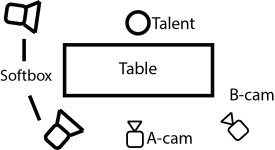
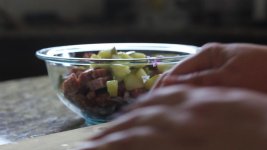
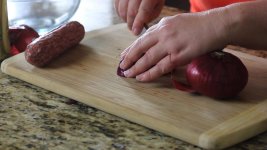
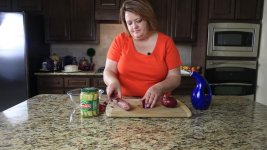
Here are some frame grabs of the lighting diagrams above. Shot on Canon 6d and t2i on landscape picture style. No color grading (don't have time). Be as harsh as possible but also know that this is my first time lighting :cheesy:
Attachments

CharlesPapert
Director of Photography
That's a pretty good approach to take, especially for your first time out.
My main note would be that since this is a cooking show, it's very important that the food be seen clearly and attractively. I am all for this style of lighting in dramatic situations, but I do think that for this application, some fill is needed on the food. I also find the side/backlight (the softbox on the top left corner of your diagram) a bit cold for my tastes--backlight often reads a little cooler than if the same unit was used frontally--I might suggest 1/4 CTO or CTS gel to give it a little warmth, and it would be good to flag off whichever softbox is reflecting in the stainless steel fridge. Also, the composition of the last picture is a little strange, chopping the head and showing so much foreground counter.
After that I could indicate some subtleties I might add, given more units--but that becomes a matter of personal taste and nuance.
In general though, it's a very good start. Do you have any other lights outside of the two softboxes...?
Victor Nhat Nguyen
Well-known member
The lights is all her gear not mine. I only have the 2 softbox, but I would like to start owning my lights. If you have all the time and money, what would you do Charles?
LightBender
New member
Nice one for your first go man, as charles said fridge is hot also when you cut the fridg it will also cut that big reflection on the table. 
Perhaps also maybe a bit more ambiance, it looks really moody your BG. I think for a TV style you want to get it in all honest a bit more "Flat". But not "Flat boring"
For instance in the BG right next to the fridge you go to hard blacks, seems pretty intense. Just my personal preference though, if you feel right with it and the clients happy, then take the shot.
Oh and also all your ... hmm vessels? I think it's a blue oil pourer. You can see the softboxes, I'd probably just pull it back so the lady will cut the Back light on the blue vase. The shine looks nice but I think one of them would seem more 'real".
Anyways just my opinion.
In the past I've used some small LED fixtures (if you want to do it on the cheap, go down and buy some of those LED bike/ mechanic work lights)), flick them on and place them around as either down-lights, or sometimes I've even just put them behind some glasswear and although if you saw it in real life you'd be like WTH? ON camera it looked nice. Might need to cut some small color correction for them aswell, I think I used 1/4CTO and they looked a treat.
All the best with it
Perhaps also maybe a bit more ambiance, it looks really moody your BG. I think for a TV style you want to get it in all honest a bit more "Flat". But not "Flat boring"
For instance in the BG right next to the fridge you go to hard blacks, seems pretty intense. Just my personal preference though, if you feel right with it and the clients happy, then take the shot.
Oh and also all your ... hmm vessels? I think it's a blue oil pourer. You can see the softboxes, I'd probably just pull it back so the lady will cut the Back light on the blue vase. The shine looks nice but I think one of them would seem more 'real".
Anyways just my opinion.
In the past I've used some small LED fixtures (if you want to do it on the cheap, go down and buy some of those LED bike/ mechanic work lights)), flick them on and place them around as either down-lights, or sometimes I've even just put them behind some glasswear and although if you saw it in real life you'd be like WTH? ON camera it looked nice.
Might need to cut some small color correction for them aswell, I think I used 1/4CTO and they looked a treat. All the best with it
Victor Nhat Nguyen
Well-known member
Thanks for replying lightBender. She's not paying me much but she gave me full creative control on how to shoot it. I'm just using this as a way to learn how to light.
How would you light this LightBender? Considering you can use whatever light you want.
How would you light this LightBender? Considering you can use whatever light you want.

Postmaster
Dark Side of the Camera
This is, how it's done on TV. Probably a bit over the top for your budget, but it gives you an idea, especially in what direction to build your future lighting kit.http://provideocoalition.com/aadams...g_the_cooking_show_for_driscolls_berriesFrank

Samuel H
Major Contributor
I'm far from being able to give advice on this kind of things, but that doesn't look like a cook show to me: it looks too dramatic and there are lots of shadows in the food.
Look for a point of reference that you like.
https://www.google.com/search?q=coo...4AQ&biw=1920&bih=967&sei=D_kBUt76K_SP7AaxrYAI
Looking there, I would put one softbox on each side of the camera, slightly in front of the talent but not much, say at her 2 and 10 (so, in your diagram, where it says "B cam" and just opposite that on the other side, below "Softbox"). If that's too flat (quite probably), I would try to make one of them stronger (take the diffussion out) or weaker (take it farther away). And then look for a cheap rim to fix somewhere in the ceiling behind her.
But as I said, I'm just starting to learn how to light, so I mostly posted to see if somebody would comment on my comment
Victor Nhat Nguyen
Well-known member
This is, how it's done on TV. Probably a bit over the top for your budget, but it gives you an idea, especially in what direction to build your future lighting kit.http://provideocoalition.com/aadams...g_the_cooking_show_for_driscolls_berriesFrank
This link is not working. But what if I don't want to light it for tv. What if I want to light it for a film?
Samuel H
Major Contributor

Matt Gottshalk
Resident Preditor
Talent looks at least a stop underexposed in that Art Adams article.

David G. Smith
Steak Knife Member
I do think that you are off to a pretty good start. The large reflection on the fridge really bugs me and you should work on knocking that down. Some cheap black foam core made into flags (Tape a 2 foot piece of 1/2" PVC pipe to the bottom of the foam core and stick the pipe into a grip head on a stand) would help. I also think that the background on the right goes a tad dark. I assume that your soft boxes are the CFL type using daylight bulbs. You might want to get some high CRI daylight CFLs and put them in kitchen fixtures for some top light. You can shape the the light with black wrap and control the intensity with ND gel or screen material. I carry a large roll of black insect screen from Home Depot and it is a great, inexpensive material for knocking down light intensity (Keep away from hot lights).

legrevedotcom
Veteran
I've worked for two of the best still food photographers in Denmark. And their approach was basicly the same, so I've grown into doing the same thing.
Now, this is based on the nordic light thing, so bare with me, I'm fully aware that other parts of the world sees good taste somewhat different.
"Up here", we micmic natural light and since most homes consist of single rooms with one light source that is also our basic approach.
Food loves single large sources and light coming from 90 degrees to the camera or more in front of it.
In short, I think your approach was pretty good. Maybe flag off the fridge like others have mentioned, but apart from that, I'm not a natural proponent of always filling up the light. I like contrast even in food. In fact the worst food shots I've seen are ones where texture and depth disappears because the photographer wasn't bold enough to let the light go contrasty. But ok... maybe add a tiny bit of fill.
Also, I tend to let my light go a wee bit cold. Again, this is probably nordic taste, but I think food shots with warm lights looks distasteful and I imagine the food not only being warmish but also stale and uneatable.
Check out my bosses shots here: http://peterkam.kam.dk

Matt Gottshalk
Resident Preditor
Food "photography" and "Cooking Show" lighting are two different things entirely.
David G. Smith
Steak Knife Member
Food "photography" and "Cooking Show" lighting are two different things entirely.
+1
I remember watching the Food Network show "Everyday Italian" with Giada De Laurentiis and they shot 24P with a more "Cinematic" style of lighting. I found the look kind of disconcerting actually.
Victor, you might consider getting one or two 500 watt construction lights and bounce them to get more light in the room. Also, if you can, place a light behind and above the talent for a rim light to add highlights. I'd also try to get the softboxes up higher if you can. You may be using CFL, and then my suggestions may not be applicable.
j1clark@ucsd.edu
Veteran
Victor, you might consider getting one or two 500 watt construction lights and bounce them to get more light in the room. Also, if you can, place a light behind and above the talent for a rim light to add highlights. I'd also try to get the softboxes up higher if you can. You may be using CFL, and then my suggestions may not be applicable.
The last time the Wife shot a 'cooking' promo, stills, we used a large soft box pretty much high and over the camera, and since we were shooting in the cook's kitchen, similar to the OP's setup, we had window light to kick in the background.
I think the 'watchword' for this is sort of situation is over all 'light/bright', not necessarily TV Comedy lighting, but unless one is doing a "Cuisine Noir" shoot... bright is good.
Well... not to the point of having major stainless steel doors reflecting in the shot...
Once a plate is prepared... perhaps then a more 'dramatic' lighting setup to highlight the plate on the table... candles... et cetera...
CharlesPapert
Director of Photography
Well, as always when it comes to lighting, there are no 100% right or wrong answers, just opinions and taste.
Victor, to answer the question you posed me about what would I do in addition:
Two downlights onto the cabinets in the back, rigged from the top of the cabinets. I'd probably use Dedos for control, possibly with the doors off to create a softer scallop shape. This would lift up the tones on the cabinet (on either side of the talent in the frontal shot) and pop the objects on the counter a little. Speaking of which: there's too much clutter going with that stuff on the camera left side. Minimize it down to a few objects (as seen on the other side) that have nice shape and color. In many many instances, the difference between low-budg looking stuff and high end is attention to production design, set dressing etc. Breaking up white walls with art or fabric, removing clutter, arranging things with balance is all very important.
Some may feel that a cooking show should look "TV" in execution. I think Nigella broke that wall with her shows, and I enjoy the way they look, but it's not for all. Your approach resembles that more than the standard lit-looking kitchen set. I don't see any need for a hairlight on the talent, she is separating nicely from the cabinets already and it's simply not necessary for this type of look (and many others that people assume it is, because of the old 3-point lighting thing). Your side softbox is acting as a backlight on the food, so that works.
As I noted, I'd add a little fill for the food from right of center, a soft source with egg crates to keep it from flattening out the rest of the image. Should be quite subtle, certainly a stop to a stop and a half down from key, just enough to add highlight and detail in for the close-up camera. Easy does it with this one.
In the angle of the glass bowl, the background is quite dark and this feels false in that you have the hot source coming from that direction. I'd rake a unit (probably a 650) from the side across that counter, creating scattered highlights which will give you more depth in the frame as well as continue the logic of the hot source on the foreground, but still give plenty of contrast via shadows between the highlights.
Agreed with the note given earlier about raising the sources, particularly the one closer to camera, which will be more flattering on your subject.
Jorn van Oostende
Active member
Don't forget art-direction and props: flowers in the background, fruits and vegetables on the counter, bottles of wine, pots and pans, etc. Make it an inviting kitchen, cinematography is more than lighting a set. When you have a beautiful set the inspiration and ideas for lighting will come by it self.