How to light like this

Er…. well lots of people who understand the concept. It's not a 'best' practice requirement, just a way of producing nice looking pictures, and practically everything we do has some link to it. Sure it's last century, but why would anyone throw away a technique that is fundamental to almost everything TV and movie we've seen for years. Nobody has produced a better and different technique that beats it, have they?

All the people who are now producing well illuminated, but boring lighting with soft light would really benefit from a little experimentation. Only recently I was production manager for a bit of live TV, that had gone a bit wrong in the planning, and the cameraman (with one LED panel light in the truck) looked around the room and smiled. One 12V 50w MR16 on the ceiling, lighting a dart board - flu tubes both ends. By moving the interviewees chair around, the MR16 became the key, the LED the fill, and by removing one of the flu tubes, the other became backlight - 3 point lighting! The MR16 did a pretty good job on the face, and moving the LED back a bit filled them in. The flu just tweaked the fluffy bits of hair. Boring it is not! The image we're considering in this topic meets that criteria!
 
I think three point is to some extent res. dependent - ESP with black and white you had to really sculpt the subject.. to even see it

Now we have resolution and colour we can move in other directions (if we want) so yes I think 3pt is to some extent last century..
 
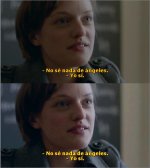
I think the main issue with this style of lighting is: Does the shot look lit?

Looking at the frame-grab posted, this shot looks like it could be "found" or "natural" lighting. ( which is very unlikely )
 
I think the main issue with this style of lighting is: Does the shot look lit?

Looking at the frame-grab posted, this shot looks like it could be "found" or "natural" lighting. ( which is very unlikely )


Judging by the size of her pupils I'd say any lighting was low powered. Either that or she's on crack:-)


Who doesn't do some variation of key, fill, and rim?

Lots of people more talented than I am.
 
So if they don't key, and they don't fill, and they don't do something to separate a subject from the background (when appropriate, of course), what do they do?

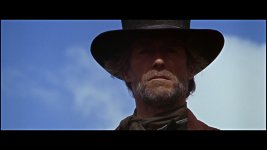
...This made me think of Clint Eastwood's in "Pale Rider", where you either love or hate the film's "natural" approach to lighting.

Pale Rider 1.jpg
 
Last edited:
...This made me think of Clint Eastwood's in "Pale Rider", where you either love or hate the film's "natural" approach to lighting.

Not sure what you mean, vis-a-vis what I said.

There's lots of key and fill in the interior and night shots of Pale Rider.
 
Not sure what you mean, vis-a-vis what I said.

There's lots of key and fill in the interior and night shots of Pale Rider.

...But it's pretty subtle compared to other films. There were lots of complaints about "bad lighting" when this film first came out, especially some of the interior scenes where things get pretty dark when a character is not standing near a window.
 
...But it's pretty subtle compared to other films. There were lots of complaints about "bad lighting" when this film first came out, especially some of the interior scenes where things get pretty dark when a character is not standing near a window.

Still not entirely sure what you're trying to say.

Someone made a comment that three-point lighting is "boring."

If you're going to set up a lighting scheme that isn't boring (and most of the exteriors in Pale Rider are indeed flat and boring in terms of lighting), and has some shape and style to it, how do you do it without some variation of key, fill, and rim?
 
The Pale Rider image is to me, so much better than the flat shot some people love. That would be tricky to do with video, as getting those details we can see in the dark areas is hard for video cameras. Some people have mentioned pulling the subject away from the background - the thing the back/rim light helps to do. Looking yet again at the original, I think I know what it reminds me of - those videos we see on sites like Philip Bloom, where he's shot raw footage and lets you see it before grading - the sort of video where the colours are muted, the contrast a bit feeble. That's what that image needs (in my opinion, as they say!)
 
So if they don't key, and they don't fill, and they don't do something to separate a subject from the background (when appropriate, of course), what do they do?
Dogma cinema:-)

OK sensible answer:

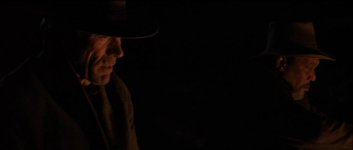
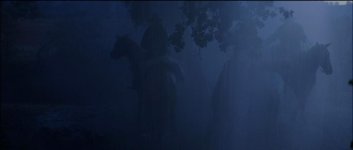
Staying on the theme of Clint Eastwood, I'll take your Pale Rider and raise you an Unforgiven:

Chiaroscuro:

46.jpg

Low key:

47.jpg

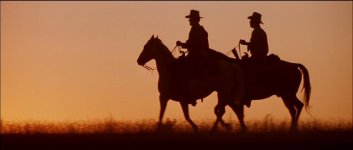
Silhouette:

20.jpg

Single Point:

22.jpg

Not sure what to call this one, but I think it's beautiful:-)

I'll go with low key:

31.jpg
 
Last edited:
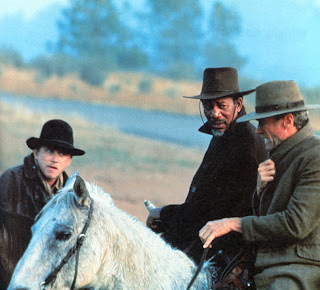
OK, here's a shot from Unforgiven:

Unforgiven5.jpg


This can't be purely natural light, because the brims of their hats would put their faces in shadows. Morgan Freeman is being keyed from his left. Reflectors? Artificial light? Dunno. But he's being keyed. Clint and the other guy are sharing the same key. And given the contrast on Freeman's face, Munny on the left there is probably being filled to his right.

Another shot:

EastwoodUnforgivenRain-470x260.jpg


Clint is being keyed from his right, and it looks like from slightly behind, while being well-filled on his left, maybe at about 45 degrees in front of him. There's a hat light, too.

Are there a lot of shapeless, flat exterior shots? Sure. Is the lighting in those shots actually interesting? I don't think so. And are exteriors on the wide-open plains of Westerns really the only things we're talking about here? As well, I don't think so.
 
vlcsnapboth.jpg
It's personal preference, but if you are going to use this lighting, then some adjustment in contrast, levels, colour and saturation help no end.

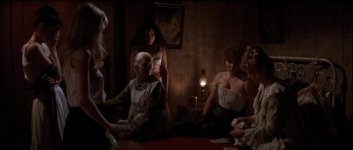
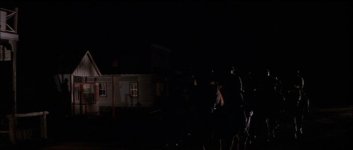
For what it's worth - all those pics Liam just posted do it for me - I think that I'd really struggle to create images still or moving like those - the one with the girls really does have the kind of light quality that suits the lamps. The silhouette horses, the firelight, the blue cast - these to me are proper quality images, that do, sadly, make the one we first looked at look weak and uncontrolled, and maybe even unplanned - which the Pale Rider shots are absolutely not!

If it's old fashioned to light like that, then thank goodness I'm old. I wonder if people see images and the associated techniques, perhaps in college/university, get told this is cutting edge, and all that old school stuff is obsolete. Like that (thankfully) brief period where everyone flavour of the month threw away their heads, tripods and even steady cams, and gave us real movement. For a few months people raved over it, until reality set in and people realised the few experts being vocal about how rubbish it was, were actually right, and wobblycam went away as quickly as it came in!
 
Dogma cinema:-)

OK sensible answer:

Staying on the theme of Clint Eastwood, I'll take your Pale Rider and raise you an Unforgiven:

Chiaroscuro:

View attachment 81099

Low key:

View attachment 81100

Silhouette:

View attachment 81101

Single Point:

View attachment 81102

Not sure what to call this one, but I think it's beautiful:-)

I'll go with low key:

View attachment 81103

I didn't actually ask who doesn't do strict three-point lighting. I asked who doesn't do some variation of key, fill, and rim. Each of those shots has some variation of them, even if they don't include every single point. But the points are still the points, and they do what the points do, even in those shots.

Even the silhouette shot is keyed and slightly filled.

But even then, it doesn't mean that every single possible shot must adhere to the points. What it means is that the points do things for you, and if you want shaping and style, you use them in some way.
 
To be fair, we were discussing three point lighting so you can see where I might have thought by "variation of key, fill and rim" you meant using all three since there is more than one way to do it.

Anyway, gave me the chance to go through the Unforgiven stills, which is always a pleasure:-)
 
To be fair, we were discussing three point lighting so you can see where I might have thought by "variation of key, fill and rim" you meant using all three since there is more than one way to do it.

Anyway, gave me the chance to go through the Unforgiven stills, which is always a pleasure:-)

That's why I said "variation." You use a key to set your exposure and define your overall image and mood; you use a fill to handle shadows and manage contrast & contrast ratios; you use a rim to add seasoning or provide separation. The possible variations are near-infinite, and you can add and remove points to a great degree, but understanding what those points do in a three-point scheme is the bedrock of learning how to paint with light.
 
And then there is 'flat lighting', essentially from 'above'...

Liz-in-The-Taming-of-the-Shrew-elizabeth-taylor-4750493-1280-800.jpg

"Taming of the Shrew"(1967)
And similarly 'broad' lighting...

Romeo-and-Juliet-Dancing-1968-Movie-Version-1968-romeo-and-juliet-by-franco-zeffirelli-26652066-780-468.jpg

"Romeo and Juliet"(1968)
This one does have a bit of 'rim' that can be seen on the fingers/hands held above the head, and hair of the central figure. But the dominant light comes form above and nearly on axis with the camera.
 
Last edited:
Who does three point lighting anyways these days, it's something from the last century. It's boring.


in a way, everybody in the world, since its just a way of analyzing lighting setups and "organizing" the lighting process into steps. 1. light up the subject(s) with some kind of light. call it a "key" light if you feel like it. 2. bring up the shadows with another light if you need to hey lets call this a fill, since it fills in shadows, ...etc...etc...
 
Back
Top